Confirm

Centerhung vs Scoreboard LED Displays: What Works Best in Stadiums?

16.03.2026

In stadium projects, buyers often compare display types as if they are competing solutions. That framing is usually too simplistic. A centerhung display, a perimeter board or a scoreboard, and a ribbon display do very different jobs, serve different viewing moments, and support different revenue models. The real question is not which display type is universally best. It is how each one contributes to the overall venue experience, commercial strategy, and operational workflow. Modern sports venues are increasingly being designed as year-round, media-rich platforms, and display planning has become part of that broader evolution. Deloitte noted in its 2026 sports industry outlook that venues are evolving into year-round platforms, while stadium experience research continues to emphasize the importance of in-venue engagement and differentiated fan experience.

That is why the best stadium LED strategy is rarely based on one display category alone. Centerhung systems typically dominate shared sightlines and game presentation. Perimeter and ribbon systems support sponsorship, branding, wayfinding, and repeated in-bowl messaging. When those systems are planned together, they can reinforce each other rather than compete for attention. When they are planned in isolation, the result is often uneven fan visibility, underused inventory, or impressive hardware that does not translate into measurable venue value. AVIXA’s coverage of modern stadium AV ecosystems highlights this exact shift toward integrated video distribution, ribbon boards, and synchronized venue infrastructure rather than single-screen thinking.
Infiled

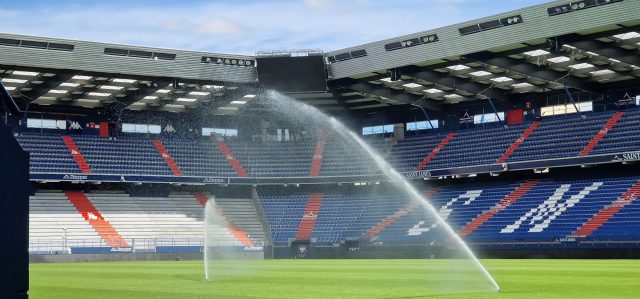
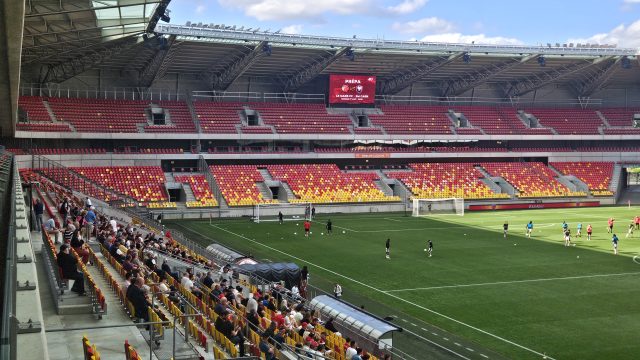
Marie-Marvingt Stadium at Le Mans, France. INFiLED MV Series, 9m x 5m

Types of LED Displays Used in Stadiums

Stadium LED systems generally fall into several functional categories. The most visible is the centerhung display, typically suspended over the field or court and designed to deliver primary game presentation, live video, replays, and major sponsor moments. Then there are perimeter displays, often positioned pitchside or courtside, where they are especially valuable for repeated brand exposure and fast-cycle commercial messaging. Ribbon displays usually run along seating decks, fascia edges, or bowl perimeters, extending the digital surface across the architecture of the venue. Each format reaches fans differently because the scale, distance, angle, and duration of attention are not the same. AVIXA’s stadium coverage and broader digital signage guidance both underscore that display format and content purpose need to align with audience context and operational goals.

There are also auxiliary displays that sit outside this article’s main comparison but still matter in a full ecosystem, including concourse signage, entrance displays, suite-level screens, and exterior media façades. These surfaces often support wayfinding, sponsor rotation, event promotion, and crowd flow before and after the match rather than core in-game presentation. That matters because stadium buyers sometimes expect the centerhung screen to carry too much of the communication burden, when in reality a venue’s digital value often comes from how many moments and zones can be activated coherently across the fan journey. Deloitte’s work on fan experience points to the same broader venue logic: the strongest in-stadium experiences are designed across multiple touchpoints, not just the moment of play.

Centerhung Displays: Advantages and Limitations

A centerhung display is usually the emotional and operational focal point of the venue. It delivers the big shared moments: live action support, replays, starting lineups, crowd prompts, celebratory content, and high-impact sponsor integrations. In bowl designs where sightlines are strong, centerhung systems create a common visual anchor that helps unify the audience experience. They are especially valuable in sports where fans look back and forth between the live field of play and a centralized information source, such as basketball, hockey, or many indoor arena formats. AVIXA’s stadium fan-experience coverage describes how large-format central displays help create shared engagement moments that extend beyond simple score reporting.

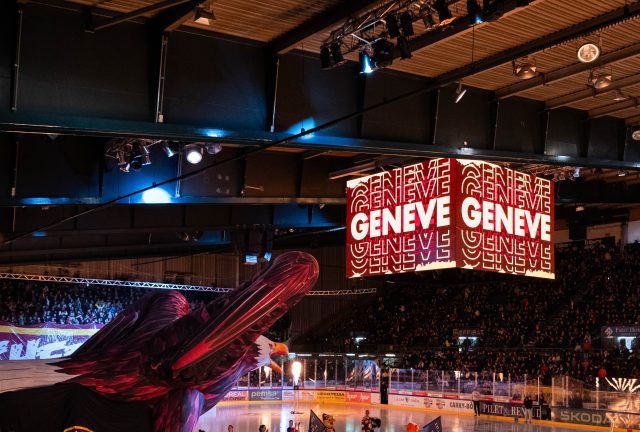
A relevant example is INFiLED’s work with Lemanvisio, GSHC’s official AV partner, to deliver a 96 sqm high-resolution, four-panel LED screen cube for Genève-Servette Hockey Club (GSHC) in Switzerland. Customized with INFiLED MV Series, the center-hung LED cube provides immersive, uninterrupted visuals from every angle while enhancing the game-day experience for fans and sponsors.

Infiled

Their biggest strength is concentration of attention. When a venue wants to deliver a dramatic replay, a coordinated animation, or a premium sponsor feature, the centerhung unit provides unmatched visibility and impact. It can also centralize key game data, timing, and storytelling in a way that perimeter systems cannot. For that reason, stadiums often over-prioritize the centerhung board early in the project. That instinct is understandable, but it can distort the planning process if it leads the venue to underinvest in the rest of the display network. A spectacular central screen does not automatically solve sponsorship inventory distribution, repeated brand exposure, or communication in the upper bowl and circulation zones.

Centerhung systems also come with limits. They are structurally demanding, highly visible when content is poor, and not always ideal for every seating geometry. In some stadiums, especially those with elongated bowls, unusual roof structures, or field-centric layouts, a centerhung display may serve some fans brilliantly and others less effectively. Content can also become overloaded. If the screen tries to function simultaneously as replay board, statistics center, sponsor rotation engine, social wall, and entertainment canvas, clarity drops quickly. System integrators should evaluate whether the centerhung display’s role is to dominate every message or to act as the high-impact hub within a broader, better-balanced system. INFiLED’s relevance in this type of project is strongest when the conversation stays centered on system fit, viewing conditions, and operational purpose rather than on sheer display size alone.

Perimeter and Ribbon Displays Explained

Perimeter LED displays and ribbon boards are often treated as supporting players, but commercially they are frequently among the hardest-working assets in the venue. Perimeter boards are designed for repeated, high-frequency visibility close to the action. In many sports, they are a core sponsorship surface because they appear consistently in both the live fan environment and the broadcast frame. That repeated exposure makes them especially valuable for advertisers, even if they do not create the same spectacle as a centerhung screen. Deloitte’s recent sports outlook points to growing focus on data-driven sponsorship and monetization, which fits directly with the value logic of perimeter inventory.

Ribbon displays work differently. Rather than commanding one focal point, they stretch messaging across the architecture of the bowl. That makes them useful for score updates, branding, dynamic crowd prompts, team identity moments, and synchronized sponsor takeovers. Their strength is continuity and repetition. A well-used ribbon system can help tie the venue together visually while also expanding the amount of sellable and programmable inventory available during the event. AVIXA’s analysis of ribbon and scoreboard infrastructure highlights how these displays have become part of a broader AV and content-distribution strategy, not just decorative trim around the seating bowl.

The key distinction is functional. Centerhung displays concentrate attention. Perimeter and ribbon displays distribute attention. That difference matters because fan behavior is not constant throughout the event. There are moments when the audience is looking centrally for a replay, and other moments when brand recall, energy-building graphics, or persistent score and sponsor visibility matter more. Buyers who understand this usually make better allocation decisions because they match format to use case instead of ranking all display types by visual drama.

Fan Experience vs Revenue Optimization

Stadium display planning usually sits between two powerful priorities: improving the fan experience and maximizing commercial return. These goals overlap, but they are not identical. A centerhung display usually contributes most directly to spectacle, emotional immersion, and shared viewing quality. It can make the event feel bigger, more coordinated, and more premium. That has real value, especially in venues competing with the increasingly comfortable and media-rich at-home viewing experience. Deloitte’s fan-experience research specifically notes the need for venues to create differentiated in-person experiences as competition from home entertainment remains strong.

Perimeter and ribbon systems, on the other hand, often carry more obvious day-to-day monetization logic. They create recurring sponsor impressions, support segmented commercial rotations, and can extend the number of moments in which the venue can activate brand partners. Deloitte’s 2025 and 2026 sports outlook work places clear emphasis on sponsorship value, data-informed fan engagement, and diversified venue revenue streams, all of which support the business case for a broader display ecosystem rather than a single flagship board.

The planning mistake is to frame this as a binary trade-off. A fan-first display strategy without enough monetizable inventory may struggle to justify investment. A revenue-first strategy that overloads the bowl with repetitive advertising can weaken the atmosphere and reduce the premium feel of the venue. A strong example of this balanced approach can be seen at Michel d’Ornano Stadium in France. To modernize the venue, the stadium management replaced outdated static signage with 72 sqm of INFiLED MV Series LED displays. The objective was clear: provide sponsors with a high-impact digital advertising platform while simultaneously enhancing the match-day experience through vibrant live content, real-time information, and dynamic visuals that keep fans engaged throughout the event. 

Infiled

The best stadiums create a hierarchy: centerhung for major shared moments, perimeter for high-value exposure near the action, ribbon for continuity and reinforcement, and supporting displays for navigation and extended engagement. That hierarchy helps protect both experience and revenue instead of forcing one to undermine the other.

Combining Display Types for Maximum Impact

The strongest stadium systems are designed as ecosystems. Instead of asking whether centerhung or perimeter is superior, buyers should ask how content, sightlines, broadcast visibility, sponsorship packaging, and venue operations connect across all digital surfaces. A centerhung display can handle replays, ceremonial moments, and premium storytelling. Ribbon boards can carry persistent score and branding layers. Perimeter boards can deliver dynamic sponsor inventory and event-energy cues. Concourse and hospitality displays can extend the message before and after fans take their seats. AVIXA’s recent digital signage guidance also reinforces the central role of content management systems and centralized scheduling in making multi-screen environments manageable at scale.

This ecosystem approach also helps buyers package value more intelligently. Sponsorship inventory can be tiered across screen types. Content can be choreographed across the bowl rather than duplicated thoughtlessly. Different surfaces can serve different dwell times and sightlines. INFiLED fits this conversation well when the design focus moves beyond individual display hardware and toward how multiple systems behave together in a live, revenue-generating venue environment.

Common Design and Planning Mistakes

One common mistake is treating the biggest display as the most important decision. In reality, the biggest display is only one part of the outcome. If the content strategy, sponsorship model, CMS workflow, and sightline planning are weak, even an impressive centerhung board may underperform. Another mistake is ignoring how the stadium will actually be used beyond headline game moments. Ribbon and perimeter displays often provide more operational and commercial value over the full event cycle than buyers initially expect.

A third mistake is duplicating content across every screen without considering purpose. Fans do not need the same message everywhere at the same time. Over-synchronization can reduce the usefulness of secondary screens and waste sponsor inventory. A fourth mistake is separating display procurement from content operations. If no one defines who manages scheduling, sponsor rotations, and real-time updates, the venue may end up with strong hardware and weak activation. Finally, some buyers fail to model trade-offs between sightline impact, structural complexity, maintenance access, and revenue packaging early enough in design. Those issues are easier to solve in planning than after installation.

Centerhung versus perimeter is the wrong final question for most stadium buyers. The better question is which mix of display types best supports the venue’s layout, fan expectations, sponsor strategy, and operational model. Centerhung displays usually deliver the strongest shared visual moments. Perimeter and ribbon displays often create the most flexible and repeated commercial value. The most effective stadiums do not force one system to do every job. They build a coordinated display ecosystem where each format plays the role it is best suited to perform. 

User registration
Join us to download our content. It only takes a moment!

    I have read and accept the privacy policy

    This site is protected by reCAPTCHA and Google.

    It looks like you are visiting the website from
    Select your region: