Confirm

How to Design High-Impact 3D LED Billboards (Complete Technical Guide)

21.02.2026

3D LED billboards look like magic on social media, but most projects fail for predictable technical reasons. The common myth is that the “3D effect” comes from special hardware. In reality, 3D LED billboards are a system-level illusion: geometry, viewpoint, pixel structure, brightness control, and content production must align. If any one element is off, the illusion collapses into a distorted video that only works from a tiny spot, or it looks flat in real street conditions.

This guide focuses on the decisions that actually determine impact, from defining the apex viewing angle to engineering service access and long-term uniformity.
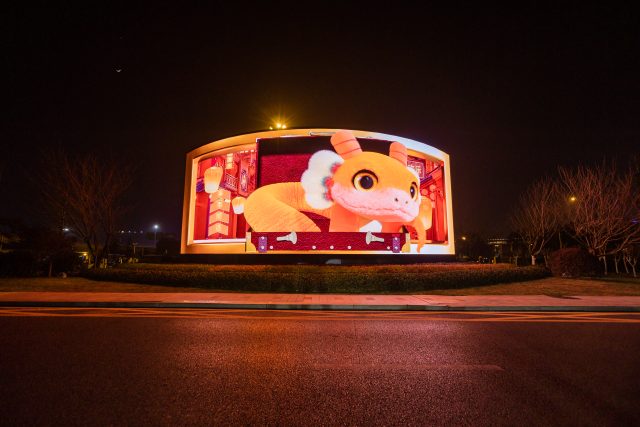
Infiled

Naked-Eye 3D: The Illusion, the Viewpoint, and the Geometry

3D LED billboards (often called “naked-eye 3D”) use forced perspective and anamorphic content to create depth without glasses. The screen is still flat. The depth comes from content that is rendered for a specific viewpoint, then displayed on a physical LED surface that supports the illusion.

Key terms that matter:

  • Apex viewing angle: the intended “sweet spot” where the illusion looks most convincing. For corner installs, this is usually near the building corner where two planes meet.
  • Viewing cone: the practical zone where the illusion still reads as 3D. Outside it, the content looks stretched or wrong.
  • Anamorphic content: intentionally distorted visuals designed to look correct from the apex viewpoint.
  • Screen geometry: flat, L-shape (two planes), curved, or multi-faceted. Geometry controls how wide the illusion can play.
  • Pixel pitch: governs whether edges and depth cues stay sharp at the real viewing distances.

A practical explainer of how the illusion is created through perspective rendering is summarized well in AVIXA’s overview of 3D illusions on LED walls. 

Designing for Real Traffic: Apex, Viewing Cone, Daylight, and Cameras

High-performing 3D LED billboards are designed around how people move through the space, not around a single static viewpoint.

Step 1: Start with traffic behavior, then pick the apex

Before pixel pitch or brightness is discussed, define:

  • the primary pedestrian flow direction
  • the dominant vehicle approach direction and stopping zones
  • typical dwell time (walking past, waiting at lights, queueing)
  • the distance range where the billboard must read (near, mid, far)

The apex viewing angle should be placed where people naturally look and pause. If the apex is in a physically awkward location, the 3D effect will only “work” for a few people, and the social capture rate will be lower than expected.

Step 2: Choose geometry that matches the story and viewing cone

Most successful 3D LED billboards use either:

  • L-shaped corner geometry: two planes meeting at a corner. This increases perceived depth and gives content a physical “stage edge.”
  • Curved or faceted geometry: helps widen the viewing cone but raises complexity in mechanical design and content mapping.

The trade-off is simple: more complex geometry can widen the effect, but it increases structural, service, and calibration complexity.

Step 3: Pixel pitch is not about “resolution,” it is about depth cues

3D illusions rely on sharp edges, clean occlusion, and stable gradients. If pixel structure is too coarse for the real viewing distances, depth cues break down first. Viewers may still see “something cool,” but the illusion will not feel convincing, especially on thin lines, typography, and object edges.

A practical way to frame pitch selection is to identify the closest meaningful viewing distance and ensure fine details still read. Then validate with test content, not just charts.

Step 4: Brightness and contrast must be engineered for daylight perception

Outdoor 3D LED billboards compete with sun, reflections, and local lighting. But the goal is not maximum brightness all day. Overdriving brightness can wash out shadow detail, which is exactly what the illusion depends on.

In practice, the illusion needs:

  • stable black level performance at the intended operating brightness
  • enough brightness headroom for sunlit hours
  • automatic brightness control that preserves highlight and shadow separation

Step 5: Camera capture can ruin viral value if PWM behavior is ignored

A large part of “impact” today is how the screen looks on phone video. Rolling shutter artifacts and banding often appear when PWM dimming interacts with camera readout timing. Even when the human eye sees a stable image, cameras can record stripes or flicker.

For a grounded explanation of why PWM and rolling shutters create banding, see this technical breakdown on PWM banding behavior.

Turning Creative Into a Repeatable System: Content, Compliance, and Service

To design 3D LED billboards that hold up in the real world, you need to align creative ambition with engineering constraints.

Content pipeline is a first-class technical requirement

Many teams treat content as a final step. For 3D LED billboards, the content pipeline determines whether the investment works at all:

  • 3D scenes must be rendered with the correct virtual camera matching the apex viewpoint
  • the content must be mapped to the exact LED geometry and pixel canvas
  • color and gamma choices must preserve depth cues in daylight

If content teams do not have repeatable templates and testing methods, results become inconsistent campaign to campaign. A practical overview of how 3D DOOH is produced, including perspective and creative technique considerations, is outlined here.

Reliability and safety requirements matter more than most creatives expect

3D LED billboards are often installed in prominent public locations. That raises compliance and risk questions that affect design decisions: electrical safety, mounting, wind loading, access, and service procedures.

In the US, electric signs are commonly assessed under UL 48 and installed under NEC Article 600, which is why many venue operators and municipalities care about UL listing status.

This is not paperwork. It affects enclosure choices, cable routing, grounding, and service access design.

Weather protection is more than an IP number

Outdoor systems are exposed to water jets, dust, condensation, and temperature cycles. An IP rating is a useful shorthand, but buyers should translate it into actual test expectations and exposure conditions. IEC 60529 defines the IP code framework and how protection levels are categorized.

For 3D LED billboards specifically, environmental stability matters because uniformity and calibration drift are more visible when the content relies on subtle shading for depth.

Serviceability determines whether the illusion stays “clean”

The illusion often breaks when:

  • replacement modules do not match neighboring color and luminance
  • one section ages faster due to heat or sun exposure
  • maintenance requires partial shutdowns during peak hours

A practical system integration approach is to specify a spare strategy and a post-service uniformity check procedure from day one.

This is one area where INFiLED’s engineering-led installs typically focus: designing for repeatable calibration behavior and fast module replacement so the billboard remains visually coherent over time, not just on opening night.

A technical checklist for 3D LED billboards that actually perform

Define measurable success criteria

Before hardware procurement, lock:

  • target apex viewpoint coordinates and height
  • minimum acceptable viewing cone width (in degrees)
  • minimum readable distance range (near and far)
  • camera capture acceptance (no visible banding on common phone settings)

Build a test pack and validate on a real or simulated canvas

High-performing teams test with:

  • a depth-heavy object scene (strong occlusion)
  • a fine-edge scene (thin lines, typography)
  • a gradient and shadow scene (subtle depth cues)
  • a high-motion scene (motion blur perception and judder)

Run tests at day and night brightness profiles, from multiple approach angles, and on phone cameras.

Engineer brightness profiles around depth cue preservation

Instead of running full output, define profiles that preserve:

  • highlight detail
  • mid-tone separation
  • shadow visibility

Depth illusions depend heavily on shadow structure. Crushing blacks or clipping highlights makes “3D” look like flat HDR noise.

Plan signal chain stability

For large canvases, signal integrity and processing stability matter. Glitches that are tolerable on standard DOOH become obvious on 3D LED billboards because straight edges and object continuity are part of the trick. Specify how the system behaves on processor reboot, signal loss, or partial cabinet failure.

Make the Illusion Durable, Not Just Impressive

Designing high-impact 3D LED billboards is less about chasing a trendy format and more about aligning viewpoint, geometry, pixel structure, brightness control, and content production into one predictable system. The apex viewing angle and viewing cone should be derived from real traffic behavior. Pixel pitch and processing should be chosen to preserve edge fidelity and subtle shading, because that is where the illusion lives. Camera capture matters because it affects earned media, and reliability matters because service swaps and weather exposure can quickly degrade uniformity. When these factors are engineered from the start, 3D LED billboards stop being a one-off stunt and become a repeatable platform. INFiLED’s most durable results in this category typically come from treating the billboard as a long-life visual system with defined testing, calibration, and maintenance routines, not as a single “wow” asset.

User registration
Join us to download our content. It only takes a moment!

    I have read and accept the privacy policy

    This site is protected by reCAPTCHA and Google.

    It looks like you are visiting the website from
    Select your region: