Confirm

LED Display Trends for 2026: What Will Actually Be Adopted (and What Won’t)

03.03.2026

The hardest part of buying LED in 2026 is not identifying new ideas. It is separating what looks impressive at a trade show from what improves performance, uptime, serviceability, and total project value in the field. That distinction matters because buyers are now evaluating LED systems in a more operational way. AVIXA’s 2026 trend coverage points to sustainability, AI, and workflow change as real themes across pro AV, while its LED signage guidance emphasizes practical gains such as brightness, viewing angles, energy efficiency, and cloud-based management rather than novelty alone.

The result is a market where the technologies most likely to be adopted are not necessarily the ones getting the most hype. Buyers are gravitating toward improvements that reduce maintenance risk, improve manageability, support finer pitch where it is actually needed, and fit into existing operating environments. By contrast, technologies that still carry manufacturing, cost, workflow, or standardization uncertainty are attracting attention but not broad deployment. Display Daily’s assessment of MicroLED at the end of 2025 described 2026 as a crossroads year and noted that growth remained tied to specialized applications and scale-up challenges, which is a good example of the difference between excitement and mainstream adoption.
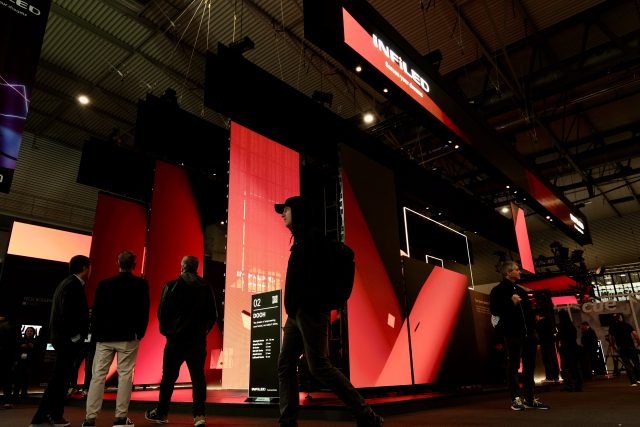
Infiled

Photo Credit © Jarvis Luo

Context and buyer challenge

For most commercial buyers, the challenge is no longer “Should we use LED?” It is “What kind of LED system will still make sense in five to seven years?” That is a different question, and it leads to different decisions. A corporate client, a retail network, a control room operator, and an event provider may all want fine visuals, but their actual buying criteria usually come down to resilience, front-serviceability, power behavior, content management, repair cycles, and whether the product fits the use case without overspecifying it. Industry guidance increasingly reflects this broader shift toward operational fit and lifecycle thinking, rather than pure spec-sheet comparison. AVIXA’s LED signage overview is still useful here, but it is only one part of the wider picture.

This is why some highly visible trends will be adopted faster than others. Buyers are more likely to adopt improvements that solve known pain points, such as durability in high-touch environments, centralized management across networks, or more energy-aware system design. They are less likely to adopt technologies that promise a leap forward but still require major cost compression, ecosystem maturity, or new workflow habits before they become practical at scale. That is the key lens for 2026: not what is technically possible, but what is decision-relevant now.

Technical or operational considerations

The trends most likely to stick are the ones tied to reliability and manageability. One of the clearest examples is the continuing move toward cloud-based content management and remote control in signage environments. Buyers increasingly need to update, monitor, and coordinate multiple displays in real time rather than treat each installation as an isolated endpoint. That is not a flashy trend, but it is exactly the kind of operational capability that gets adopted quickly because it reduces friction and scales well. In parallel, software is taking a more central role in digital signage decision-making, with the market moving beyond hardware-only thinking. Invidis’ ISE 2025 trend report is especially relevant on that point.

Another trend with real adoption momentum is more robust packaging and surface protection in fine-pitch environments, especially where service calls and accidental contact are recurring concerns. Even when discussed in narrower applications, the same operational logic carries across corporate, retail, and public-facing LED projects: buyers adopt durability when it directly lowers handling risk, maintenance exposure, and service disruption. That is one reason ruggedization and practical survivability matter more in real projects than new buzzwords.

Energy and power behavior are also becoming more visible in decision-making, even if they are not always marketed as “trends.” Procurement teams are increasingly looking at the wider display ecosystem, not just the cabinet itself. In the EU, networked-standby rules already form part of the regulatory environment for connected electronic equipment, which matters because signage stacks often include media players, gateways, and other connected devices beyond the display surface itself.

What will not be adopted nearly as broadly in 2026 is “future-standard” connectivity just because it sounds more elegant. New standards can be strategically interesting, but most buyers still prioritize reliability, installed-base compatibility, and predictable workflow integration over early adoption. The same caution applies to MicroLED in mainstream commercial LED buying. It remains strategically important and technically promising, but the market is still constrained by investment, manufacturing scale, and commercialization realities, especially outside specialized use cases.

Performance, reliability, and long-term value

The most durable 2026 trend is not a specific feature. It is the shift toward buying LED systems as operating assets rather than visual trophies. In practice, that means the long-term winners are usually systems that simplify maintenance, reduce downtime, and fit realistic service models, even when another product looks more dramatic on a trade-show floor. Buyers are placing more value on supportability, service logic, and long-term operating confidence than on launch-day visual impact alone.

That is also why finer pixel pitch will continue to be adopted, but selectively. The market is not moving toward “the smallest pitch possible” as a universal rule. It is moving toward finer pitch where viewing distance, content type, and room function justify it. In corporate lobbies, high-end brand spaces, control environments, and certain premium meeting spaces, finer pitch can clearly improve usability and perceived quality. But the broader adoption pattern is smarter specification, not indiscriminate miniaturization.

A second long-term theme is software and workflow maturity. The strongest signal from the market is that software is becoming more central, while AI is more likely to improve workflow behind the scenes than to transform the display itself. In other words, AI may influence how displays are managed, automated, and optimized, but it is not replacing the fundamentals of good system design, good content planning, or solid hardware decisions.

Virtual production is another category where the adoption story is narrower than the hype. The space is advancing quickly, but successful deployment still depends on synchronization, color management, rendering, and operational skill, not just the wall. SMPTE’s current standards and engineering work around synchronization and media infrastructure underline exactly that point.

Common mistakes and decision guidance

One common buyer mistake is assuming that whatever is most discussed at a major trade show is also the safest place to invest. That is often wrong. Trade-show visibility usually favors novelty, while field adoption favors reliability. MicroLED is the clearest example here: high interest, real long-term potential, but still limited by manufacturing and commercialization realities. Buyers who confuse strategic importance with immediate deployment readiness can end up solving the wrong problem.

Another mistake is treating the display as the whole system. In practice, many performance issues come from the surrounding stack: processors, media players, network behavior, CMS choices, standby power, service access, and content workflow. A good cabinet inside a weak operating environment is still a weak deployment. That is why buyers should evaluate the full ecosystem, including software dependencies, power behavior, and service model, not just the visible screen.

A third mistake is overbuying resolution and underbuying durability or manageability. Finer pitch is easy to market because it is visually legible. Durability, remote management, and serviceability are harder to dramatize, but they are often what determine whether the system performs well over time. Some of the most valuable innovations in 2026 are not about “more wow,” but about fewer failures, fewer service interruptions, and fewer compromises in daily use.

The most practical takeaway for 2026 is simple. The trends that will actually be adopted are the ones that improve real-world outcomes: tougher fine-pitch systems in the right environments, better remote management, more disciplined power and sustainability thinking, and software-driven control that makes large deployments easier to run. The trends that will not be adopted broadly, at least not yet, are the ones that still depend on ecosystem immaturity, manufacturing scale-up, or unclear operational benefit. Buyers should therefore evaluate new LED technology with one question in mind: does it reduce risk and improve long-term performance, or does it mainly improve the sales pitch?

For an engineering-led buyer, that is the right standard. In 2026, the winning LED decisions are not the loudest ones. They are the ones that remain serviceable, efficient, supportable, and fit for purpose after the excitement of the demo disappears.

User registration
Join us to download our content. It only takes a moment!

    I have read and accept the privacy policy

    This site is protected by reCAPTCHA and Google.

    It looks like you are visiting the website from
    Select your region: