Confirm

How Big Should Your LED Wall Be? Sizing for the Room, the Audience and the Content

24.10.2026

Most LED walls are sized to fill the wall they are going on. The brief says “as big as fits”, the quote follows, and the result is a screen the back row cannot read or one paying for pixels nobody can resolve. How big should an LED wall be? Start with the people and the content, and let the room set the limits.

LED wall size comes out of five decisions: how far the farthest viewer sits, how close the nearest gets, what the content demands, what the room allows, and how cabinet dimensions turn the answer into buildable steps.
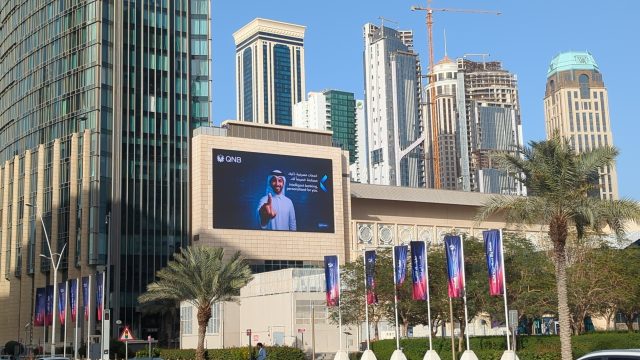
MVmk2 Series LED screen on a building in Doha in full daylight

The farthest viewer sets the minimum image height

One published method for LED wall size is AVIXA’s DISCAS standard, Display Image Size for 2D Content in Audiovisual Systems. AVIXA’s explainer stresses that image size is about what is shown, not the size of the screen, and defines the farthest viewer as the one at the greatest distance within the viewing area (AVIXA’s explainer on display image size). The standard sorts content into basic decision making, where viewers grasp presentations or documents, and analytical decision making, where they make pixel-level judgements such as studying detailed data (invidis DISCAS explainer, in German).

For analytical work the arithmetic is short. AVIXA lists 3,438 as the acuity factor, and the invidis worked example gives the farthest viewer as image height divided by vertical pixel count, times 3,438. Rearranged, minimum image height is the content’s vertical resolution multiplied by the farthest viewer’s distance, divided by 3,438. For 1,080-line content and a farthest viewer 15 m away, 1,080 × 15 ÷ 3,438 gives an image at least 4.7 m high, or about 8.4 m wide at 16:9, before any compromise.

For basic decision making, AVIXA’s table sets a minimum element height of 0.5% to 5% of image height, rising with the viewing ratio (the farthest viewer’s distance divided by image height). At a ratio of 4 to 5 it is 2.5%: on a 3 m image, 75 mm for the smallest element viewers must read.

Any LED video wall size calculator, from AVIXA’s free DISCAS calculators to a supplier’s configurator, is arithmetic that is only as good as the distances and content type you enter.

The closest viewer and the content set the pixel pitch

The closest viewer decides how fine the pixels must be. INFiLED’s pixel pitch guide gives a working rule: the minimum comfortable viewing distance in metres is roughly the pitch in millimetres, so a front row 4 m away points to about 4 mm or finer (pixel pitch and viewing distance). The guide calls this approximate, so use it to avoid overspecifying, not to fine-tune.

Content then moves the target, because fine text asks more of a wall than video does. Sign legibility research summarised by the US Access Board found average legibility of about 35 ft per inch of letter height, falling to 17 to 22 ft per inch for the poorest-performing groups (Access Board legibility research). At 15 m (about 49 ft), the weaker figures need capitals of 55 to 75 mm. The guide to creating content for an LED video wall suggests a more cautious 8 mm per metre, or 120 mm at 15 m (content for an LED video wall).

Pitch decides how many pixels build each letter. The same Access Board page notes that message signs commonly use a 5 × 7 matrix of character elements, with 7 × 9 needed for reasonable lowercase. On an LED wall an element is roughly a pixel: at 2.5 mm pitch a 70 mm capital is 28 pixels tall, at 10 mm only 7, workable for capitals and poor for lowercase. Dense dashboards therefore need a finer pitch than video, even at the same LED wall size and from the same seat.

The room sets the limits

Geometry then trims the LED wall size. AVIXA’s explainer also defines image offset, the height of the bottom edge relative to viewers’ viewing height, so where the image sits matters as well as how big it is.

  • Ceiling and bottom edge. Image height is capped by the ceiling height, less the bottom-edge height and any clearances for lighting and services.
  • Sightlines over heads. In a flat room, front-row heads block the lower part of a low wall. Raising the bottom edge fixes that but costs image height, so solve the two together.
  • Structure. A larger wall weighs more and the building has to carry it. Give the structural engineer the total weight early.
  • Power and cooling. Connected load rises with area and brightness. Ask for maximum power, which sizes the circuits, and average power at your target brightness, the more useful running figure.

If the room caps the image below the farthest-viewer minimum, settle the trade openly: move the farthest seats, simplify the content, or send detail to supporting screens. The guide to university auditorium and hall installations covers sightlines, back-row distance and steep halls.

How cabinet sizes force the final dimensions

A target of 8.4 m by 4.7 m cannot be built as stated. LED wall size moves in cabinet-sized steps, and the steps differ by series. INFiLED’s series pages publish them: the DBmk2 mostly uses 500 × 500 mm cabinets, the MVmk2 1,000 × 1,000 mm, and the WP series 16:9 cabinets 600 × 337.5 mm. Snapping 4.7 m to 500 mm steps gives either 4.5 m, a little under the minimum, or 5 m, so the rounding direction is a decision, not a detail.

Square 500 mm cabinets make an exact 16:9 wall only at multiples of 16 columns by 9 rows: 8 m by 4.5 m, then 16 m by 9 m. Between those you land near 16:9, not on it: 7 m by 4 m (14 columns by 8 rows) is 1.75:1 against 1.78:1. A native 16:9 cabinet changes the rule: any wall with equal columns and rows is exactly 16:9.

Native resolution follows from size and pitch: dimension divided by pixel pitch, on each axis. An 8 m by 4.5 m wall at 2.5 mm pitch is 3,200 × 1,800 pixels. That is a 16:9 canvas but not 1,920 × 1,080 or 3,840 × 2,160, so creative has to be built to the wall’s own pixel grid rather than scaled.

The wall configurator is a practical way to test these steps: it sizes by width and height, panel array or fit to wall, and lists cabinet count, dimensions, weight, resolution, viewing distance and power, labelled as for reference and estimation. On cost, the same site’s page on configuration and installation planning says pricing depends on resolution, screen size, installation environment and structural requirements.

A sizing worksheet, step by step

Work through these in order, writing down the answer to each, to settle LED wall size before the first supplier call.

  1. Map the viewers. Record the farthest and closest distances, eye heights, and whether people sit, stand or are on tiers.
  2. Classify the content. Separate video from the text, drawings and dashboards that must be read, and note the smallest type.
  3. Find the minimum image height. For detailed content, multiply vertical resolution by the farthest distance and divide by 3,438. For simpler content, test candidate heights against AVIXA’s element-height table.
  4. Set the pitch. Treat the closest distance in metres as a rough ceiling on pitch in millimetres, then check that the smallest text gets at least a 5 × 7 pixel grid for capitals and 7 × 9 for lowercase.
  5. Apply the room. Subtract bottom-edge height and clearances from the ceiling height. If the room cannot give the step 3 minimum, decide what gives.
  6. Snap to cabinets. Round width and height to whole cabinets, check the rounded height against the step 3 minimum, and pick the shape closest to your content’s aspect ratio.
  7. Calculate native resolution. Divide each dimension by the pitch and hand the creative team the pixel grid.
  8. Take it to a supplier. Send distances and content types, not just a wall width, and ask for weight, maximum and average power, and structural loads. Rank the answers with the guide to specifications that actually matter.

So how big should an LED wall be? A range with reasons attached, and a supplier who quotes for the audience, not the gap in the wall.

User registration
Join us to download our content. It only takes a moment!

    I have read and accept the privacy policy

    I agree that INFiLED EUROPE, SL processes my personal data to review and, where appropriate, investigate and reply to the message I have sent, according to the privacy policy, which I have read and accept without reservation, and which gives additional information on this processing and on how to exercise my rights of access, rectification, restriction, erasure, objection and portability of my data.

    This site is protected by reCAPTCHA and Google.

    It looks like you are visiting the website from
    Select your region: