Confirm

Best Pixel Pitch for Virtual Production LED Walls (And Why It Matters)

07.04.2026

Virtual production has moved from experimental filmmaking technique to mainstream infrastructure in less than a decade. LED volumes are now permanent fixtures in major studio facilities, and temporary builds are being assembled for commercial shoots, music videos, and episodic television productions around the world. With that growth has come a wave of procurement decisions that conflate the display specifications used for signage or broadcast confidence monitors with the fundamentally different requirements of a camera-facing LED volume.

Pixel pitch is the specification that attracts the most attention in these discussions, and also the one most frequently misunderstood. Choosing the wrong pitch does not simply result in a slightly softer image. It can produce visible moiré patterns on camera, restrict the lens choices available to the director of photography, force compromises on shooting distance, or waste significant budget on resolution that the production workflow will never capture. Understanding how pixel pitch behaves in a virtual production context, not in a spec sheet comparison, is what allows studios and production teams to make decisions they will not regret once shooting begins.
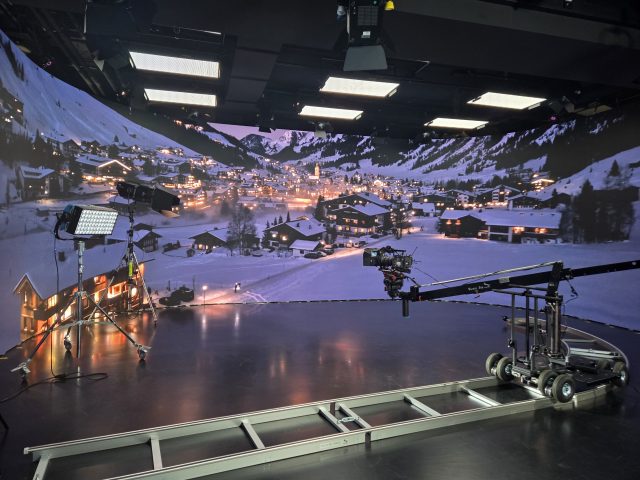
Infiled

Photo Credit © Florian Schlecht

What Pixel Pitch Means in Virtual Production

Pixel pitch is the distance in millimeters between the centers of adjacent LED pixels. A 1.5mm pitch means each pixel sits 1.5mm from its neighbor. A 2.9mm pitch doubles that spacing. Smaller numbers mean more pixels per square meter, higher resolution, finer detail capability, and higher cost per square meter of LED panel.

In traditional display applications, pixel pitch is selected primarily based on minimum viewing distance for the human eye. The standard calculation establishes that a viewer cannot resolve individual pixels beyond a certain distance, and pitch is chosen accordingly. This logic does not transfer cleanly to virtual production because the camera is not the human eye. A camera lens, depending on its focal length, aperture, and distance to the wall, can resolve spatial frequencies very differently than a viewer standing in the same position would.

The relevant concept is the optical interaction between the camera sensor and the LED pixel grid. When the spatial frequency of the pixel pitch aligns with or approaches the sampling frequency of the camera sensor, moiré interference patterns appear. These are the rolling, shimmering bands of artifact that are extremely difficult to remove in post-production and can make footage unusable. Moiré is not a theoretical risk. It is a practical problem that surfaces regularly on sets where pixel pitch was chosen without camera testing.

How Camera Distance Changes Requirements

The distance between the camera and the LED wall is the single most important variable in determining whether a given pixel pitch will perform acceptably on set. As the camera moves closer to the wall, individual pixels become larger in the frame relative to the scene content, and the risk of visible pixel structure or moiré increases substantially.

A 2.6mm pixel pitch that performs cleanly when the camera is positioned six meters from the wall may show pixel structure or moiré artifacts when the camera moves to three meters with a wide lens. The same wall, with the camera at eight meters on a longer focal length, may perform without any visible issues. This variability is what makes blanket pixel pitch recommendations unreliable without knowing the specifics of a production’s shooting style.

Productions that favor wide lenses and close camera-to-wall distances, common in commercial and music video work, place the greatest demand on pixel pitch fineness. Productions shooting at longer distances with telephoto lenses have more tolerance for coarser pitches because the depth of field naturally softens the LED wall while the foreground subject remains sharp.

The key factors to assess before specifying pixel pitch include:

  • Minimum camera-to-wall distance expected across the shoot
  • Lens range the DP intends to use, particularly the widest focal lengths
  • Camera sensor resolution and whether anamorphic capture is planned
  • Whether the floor LED volume will also be camera-facing, which often demands finer pitch than the curved wall

Anamorphic lenses introduce additional complexity because their horizontal and vertical resolution characteristics differ, which affects how moiré presents in the frame and at what pixel pitch thresholds it becomes problematic.

Fine Pitch vs Cost: Finding the Balance

The relationship between pixel pitch and cost is not linear at the fine end of the scale. Moving from a 2.6mm pitch to a 1.9mm pitch increases pixel density by roughly 88 percent. Moving from 1.9mm to 1.2mm increases it by another 151 percent. Each step into finer territory carries compounding cost increases because manufacturing precision requirements scale with density, and yield rates on finer pitch panels are lower, which is reflected in market pricing.

For most virtual production applications, the practical sweet spot sits between 1.5mm and 2.8mm, with the specific choice driven by the camera and lens profile of the production rather than a desire to achieve the finest available resolution. A 1.5mm pitch used primarily in productions shooting at 4K with lenses longer than 35mm may be producing resolution that the camera pipeline cannot meaningfully capture, while a 2.6mm pitch used thoughtfully on a production with controlled shooting distances may outperform it practically because the budget difference was reinvested in better color calibration, processing hardware, and extended rental duration.

INFiLED’s experience across VP stage configurations consistently reinforces that calibration quality and color uniformity across the full wall surface matter more to final image quality than pushing to the finest available pixel pitch. A poorly calibrated 1.2mm wall will produce worse on-camera results than a well-calibrated 1.9mm wall at appropriate shooting distances.

Common Pixel Pitch Mistakes Studios Make

Several recurring errors appear in virtual production planning, many of which originate from applying display industry logic to a camera-facing context.

The most common is specifying pixel pitch based on human viewing distance rather than camera behavior. A 2.0mm pitch that looks visually clean to a crew member standing on set may still produce moiré on a specific camera and lens combination at a specific distance. Human observation is not a reliable proxy for camera testing.

A second common mistake is treating the LED wall as a single-pitch decision when the volume includes multiple surfaces. The ceiling LED, for example, is rarely camera-facing and can often use a coarser pitch without any image quality consequence. Over-specifying the ceiling to match the main wall adds cost without adding value.

A third mistake is purchasing or renting panels without conducting a camera test with the actual lens set and camera body planned for the production. Camera manufacturers including ARRI have published guidance on testing LED volumes before committing to a build, and the process is not complicated. Running a moiré test with a focus chart and the intended camera configuration at the intended minimum shooting distance takes a matter of hours and can prevent days of unusable footage.

A fourth is ignoring refresh rate in favor of focusing exclusively on pixel pitch. At standard cinema frame rates, a wall with a refresh rate below 3,840Hz can produce banding in footage shot at higher shutter speeds or with rolling shutter sensors. Pixel pitch and refresh rate are both camera-relevant specifications, and both need to meet the production’s technical requirements.

Choosing the Right Pitch for Different Productions

Different production scales and formats have meaningfully different pixel pitch requirements, and understanding those differences allows facilities and production companies to avoid both overspending and underspecifying.

High-budget feature film and premium streaming productions typically justify investment in 1.5mm to 1.9mm panels for the primary shooting wall. These productions shoot at high resolutions, use a wide range of lens focal lengths including wide primes, and have post-production workflows capable of resolving fine detail. The budget to support finer pitch is usually available, and the image quality ceiling of the production warrants it.

Mid-budget commercial and episodic television productions often find that 2.0mm to 2.6mm pitch performs adequately when shooting distances are controlled and lens choices are reviewed in advance. These productions benefit from establishing clear minimum distance protocols for the camera team and conducting a moiré test before the main shoot day.

Smaller studio builds, event-based virtual production, and educational or corporate virtual environments frequently operate at shooting distances and with camera configurations where 2.6mm to 3.0mm pitch performs without visible issue. Specifying finer pitch for these applications displaces budget that would deliver more value spent on the content generation pipeline, the LED processor, or the real-time rendering system.

Why Overbuying Specs Can Waste Budget

The instinct to specify the finest available pixel pitch is understandable. It removes one variable from an already complex technical environment, and it satisfies the psychological comfort of having the best available hardware. In practice, overbuying pixel pitch in virtual production regularly displaces budget from components that have a more direct effect on final image quality.

The rendering engine, the LED processing chain, the camera color science workflow, and the calibration process all contribute to the quality of the final composite image. A production running a 1.2mm LED wall through an under-powered render pipeline will produce worse results than a production running a 2.0mm wall through a well-engineered, properly calibrated system with adequate GPU resources.

Content platform technical requirements, including those published by major streaming services, specify minimum camera and image quality thresholds but do not prescribe LED pixel pitch directly. What they require is the absence of visible artifacts in the final image, which is an outcome determined by the whole system, not by pixel pitch in isolation.

INFiLED supports virtual production projects by helping production teams define the full technical chain from render to camera before a pixel pitch is selected. That sequence, evaluating the system as a whole before specifying any single component, is what prevents the common and costly error of optimizing one number while leaving others unexamined.

User registration
Join us to download our content. It only takes a moment!

    I have read and accept the privacy policy

    This site is protected by reCAPTCHA and Google.

    It looks like you are visiting the website from
    Select your region: