Confirm

Camera-Ready LED: What Broadcast Studios in the UAE Should Test Before They Buy

11.05.2026

LED video walls have replaced traditional studio backdrops across most UAE broadcasters, from major networks in Abu Dhabi and Dubai to growing regional channels and corporate studios. The technology offers obvious creative advantages, but the specifications that matter for on-camera performance differ sharply from those that matter for direct viewing.

Many studios procure LED panels based on pixel pitch, brightness and aesthetic appeal, and discover only at the first live shoot that the wall flickers under certain shutter speeds, generates moiré at the wrong camera angles, or shifts colour unpredictably during HDR production. This article looks at the tests every UAE broadcaster should run before signing off on a studio LED specification.
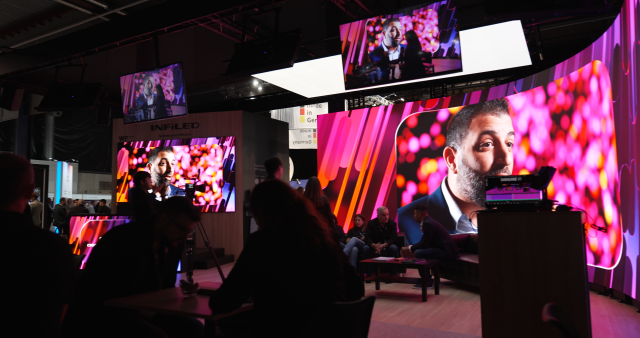
Infiled

The Specifications That Matter for Cameras

For direct viewing, an LED panel that runs at 1,920 Hertz refresh rate looks perfectly clean. To a broadcast camera, the same panel can produce visible banding, flicker and scan lines that ruin the shot. The fundamental issue is that cameras sample the LED at discrete intervals determined by shutter speed and frame rate, and any mismatch between camera sampling and LED refresh creates artefacts.

Industry guidance for broadcast-grade LED walls consistently points to a minimum refresh rate of 3,840 Hertz for standard production, with 7,680 Hertz or higher recommended for HDR, virtual production and high-frame-rate work. Detailed broadcast-camera pairing guidance explains why this matters: refresh rate determines how cleanly the camera can integrate light from the wall across the exposure window. Scan rate, often expressed as a fraction such as 1/16 scan or 1/8 scan, governs how many lines of the panel are active at any instant and directly affects flicker visibility on rolling-shutter cameras.

Colour depth is the second under-specified parameter. A panel quoted at 14-bit or 16-bit processing depth delivers smoother gradients in dark scenes, more accurate skin tones and cleaner HDR performance than an otherwise identical panel running 12-bit processing. The difference is subtle on still images and dramatic in motion.

Moiré, Flicker and Real-World Studio Behaviour

Moiré is the interference pattern that appears when a camera’s sensor grid samples the LED’s pixel grid at unfortunate spatial frequencies. It depends on pixel pitch, camera resolution, focal length and angle, and it can appear or disappear with small camera movements. Practical mitigation techniques include adjusting focus, depth of field, camera-to-wall distance and using tighter pixel pitches that are physically closer to the camera’s sampling resolution. No specification alone eliminates moiré; it has to be tested in the actual studio with the actual cameras.

Flicker shows up differently. Where moiré is spatial, flicker is temporal: visible banding that scrolls through the frame or pulses at frame boundaries. It is most often caused by inadequate refresh rate, by scan-rate mismatches with shutter speed, or by power-supply ripple that modulates LED brightness within a single frame. UAE studios shooting Arabic news, talk shows and entertainment content typically operate at multiple shutter speeds across a single production, and the LED wall must behave cleanly across all of them.

Genlock and synchronisation are the third element. High-end broadcast LED systems can lock the wall refresh to the camera frame timing, eliminating most timing-related artefacts. This requires both LED processor and camera support, and it is worth confirming at procurement rather than discovering at first shoot.

Practical Tests Before Sign-Off

UAE broadcasters should insist on a structured test protocol before final acceptance. Five tests cover most failure modes.

The wall should be filmed at every shutter speed the studio will use in production, with the camera panning slowly across the surface. Visible banding, flicker or scan lines under any production shutter speed is a problem that needs resolution before sign-off, not after.

It should be filmed at a range of camera-to-wall distances, particularly at the closest distance any production will require. Moiré that appears at three metres but disappears at five metres still constrains creative choices. Buyers should know the safe operating envelope.

Colour should be measured across the full panel surface, not just at the centre. Uniformity tolerances of within plus or minus three percent for both luminance and colour are achievable with good calibration; significantly larger variances will be visible on camera under wide shots.

Black-level performance should be evaluated under studio lighting. Many panels look excellent in a darkened test room and underwhelming under broadcast lighting, where ambient light raises perceived black levels and reveals any inconsistency in the off-state of individual modules.

Finally, HDR pipelines should be tested end-to-end. Wider colour spaces such as Rec. 2020 demand more from the LED than Rec. 709 production, and the wall needs to deliver consistent colour volume across its full surface without clipping highlights or crushing shadows.

INFiLED’s broadcast deployments across the region have consistently shown that studios which test against this kind of protocol at acceptance have far fewer surprises in their first six months of production than those that rely on supplier datasheets alone.

Common Misconceptions in Studio LED Procurement

Three misconceptions appear repeatedly in UAE studio procurement discussions. The first is that finer pixel pitch always improves on-camera performance. In practice, pixel pitch should match the closest camera-to-wall distance any production will use. Pitches finer than the camera can resolve at typical operating distance add cost without delivering visible improvement, and tighter pitches can actually increase moiré risk with high-resolution cameras at certain angles.

The second is that brightness in nits is what cameras need. Studio LED rarely runs at peak brightness; it operates in a window calibrated to the studio lighting environment, typically a few hundred to a thousand nits depending on the look. What matters is consistent brightness across the surface, accurate response across the operating range, and clean low-light behaviour. The third misconception is that calibration is a one-time event. As INFiLED’s broadcast experience across the region shows, studios that schedule periodic recalibration and budget for it as a real operational cost are the ones whose walls continue looking professional at year three and beyond.

A Test Plan Beats a Spec Sheet

Studio LED is fundamentally a system that has to behave well in front of specific cameras under specific shutter speeds and lighting. No single number on a datasheet captures that behaviour. UAE broadcasters who treat acceptance testing as seriously as procurement specification consistently end up with walls that perform reliably across years of changing productions. The investment in a structured test protocol pays back the first time a high-profile broadcast goes to air without the wall calling attention to itself.

User registration
Join us to download our content. It only takes a moment!

    I have read and accept the privacy policy

    This site is protected by reCAPTCHA and Google.

    It looks like you are visiting the website from
    Select your region: