Confirm

Control Room Display Downtime: The Hidden Cost of Choosing the Wrong LED System

14.04.2026

In a control room, display failure is not a minor AV issue. It is an operational risk. When a critical LED wall goes dark, shows unstable content, or becomes partially unusable, the impact spreads quickly across monitoring, coordination, and response workflows. That is why control room display decisions should be treated as business continuity decisions, not just hardware procurement exercises.

A common buying mistake is to compare control room LED systems mainly on upfront cost, brightness, or resolution. Those factors matter, but they do not tell decision-makers how a system will behave after years of continuous use. In mission-critical environments, the wrong display choice often costs far more through downtime, service disruption, delayed response, and avoidable maintenance events than it ever saved on the initial quote. By the end of this article, readers will have a clearer framework for evaluating control room LED systems based on uptime, resilience, and operational impact.
Infiled

Why Downtime Is More Expensive Than Buyers Think

Most display procurement discussions still focus too heavily on capital expense. In control rooms, the more relevant figure is the cost of interruption. ITIC’s 2024 Hourly Cost of Downtime Report found that for over 90% of mid-size and large enterprises, the average cost of a single hour of downtime exceeds $300,000, and 41% reported hourly downtime costs between $1 million and over $5 million. Those numbers are not specific to display walls alone, but they explain why any critical visualization layer inside a real-time operations environment should be evaluated through the lens of continuity, not price alone. ITIC’s downtime report is useful here because it puts a hard financial frame around what many operations teams already know from experience.

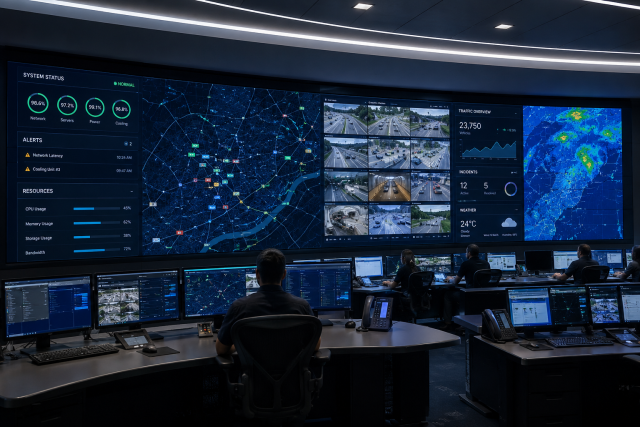
Control rooms are especially sensitive because the display environment is not decorative. It is where operators consolidate CCTV feeds, maps, alarms, dashboards, SCADA views, or incident data into a shared visual field. AVIXA’s control and command center guidance notes that a central LED video wall often functions as the focal point for real-time monitoring and quick decision-making. If that display layer becomes unstable, teams do not just lose pixels. They lose shared awareness. AVIXA’s command center guidance reinforces how central the video wall is to operational clarity.

There is also a less visible financial cost: degraded confidence. When operators stop trusting the wall because of intermittent failures, unstable inputs, inconsistent brightness, or recurring maintenance events, they begin to work around it. That usually means more dependence on local monitors, more fragmented decision-making, and slower escalation during abnormal conditions. In mission-critical environments, those are process costs, not just technical annoyances.

Common Causes of LED Display Failure

Control room LED systems usually do not fail for one dramatic reason. More often, they degrade through a chain of smaller weaknesses: unstable power architecture, poor thermal management, low-quality receiving components, calibration drift, inaccessible service design, or inadequate system monitoring. The problem is rarely just the panel face. It is the overall system design and how well it supports 24/7 use.

One recurring issue is underestimating the importance of electronics and processing stability. Buyers sometimes assume that if the wall looks good during handover, long-term reliability is assured. In reality, control room performance depends on signal distribution, processor behavior, low-latency handling, and how the display system integrates with the room’s wider AV and operational stack. AVIXA specifically calls out low latency and flexible source management as key command-center display requirements, which is a reminder that performance is not only about image quality. It is also about dependable system behavior under continuous operational load.

Another common cause is service difficulty. If a system is hard to access, difficult to diagnose, or dependent on long-lead spare parts, even a minor component issue can become a prolonged outage. This is where seemingly small design decisions matter. Front access versus rear access, modular replacement logic, power redundancy, controller failover, and cabinet consistency all affect how quickly teams can recover from a fault.

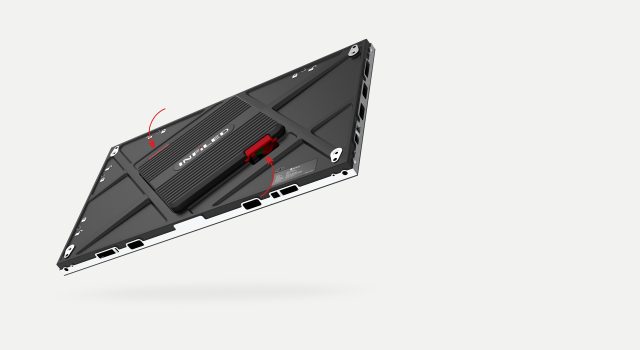
For example, some control room LED platforms are designed with separate service paths for different components. INFiLED’s WT Series allows LED modules to be serviced from the front while critical electronics—including the receiving cards and power supplies—can be maintained from the rear. This approach enables technicians to access the component that requires attention without unnecessarily disturbing the rest of the display, helping reduce maintenance time and operational disruption.

INFiLED’s engineering approach is relevant in this context because control room buyers typically benefit more from serviceable, predictable systems than from aggressive cost trimming at the specification stage.

There is also the maintenance strategy itself. NIST’s work on maintenance economics found that heavier reliance on reactive maintenance is associated with materially worse outcomes, including 3.3 times more downtime than the bottom quartile, along with more defects and more lost sales due to maintenance-related delays. While that research comes from manufacturing, the maintenance principle transfers cleanly to critical display infrastructure: waiting for failures is almost always more expensive than designing for prevention. 

Operational Impact in Mission Critical Environments

In a mission-critical room, downtime does not exist in isolation. It interrupts coordination. Operators rely on the main display wall to align around the same information at the same time. If that common visual surface is compromised, teams often lose speed first, then consistency, and sometimes accuracy.

That matters most in environments such as utilities, transportation monitoring, security operations, industrial process control, and emergency management. These rooms often depend on simultaneous visibility across multiple sources. AVIXA notes that multiwindow capability, low latency, and rapid source switching are central to control room effectiveness. If the wall cannot maintain those functions reliably, staff may be forced into slower workflows that increase cognitive load and reduce collective awareness.

The operational damage can also outlast the outage itself. A control room that has just experienced a display issue may enter the next incident with lower confidence in its primary visualization layer. Operators may hesitate to rely on the wall or shift important viewing tasks back to local workstations. That fragmentation reduces one of the core advantages of control room architecture: shared visibility and coordinated action. Uptime Institute’s 2025 outage analysis emphasizes that complexity and external threats continue to introduce new risks, and that preventing outages remains a strategic priority for operators of critical infrastructure. The lesson for control rooms is clear: the display layer has to be designed as part of that resilience strategy, not outside it.

There is also a stakeholder impact. When leadership teams invest in a command environment, they are often expecting a system that supports confidence under pressure. A display wall that repeatedly fails, drifts, or requires emergency interventions undermines that expectation quickly.

INFiLED’s experience in reliability-focused LED environments reflects this priority. For example, the recent Port of Los Angeles control room modernization—featuring INFiLED LED video walls integrated with VuWall‘s TRx platform—was designed to improve reliability, simplify video wall operations, and enable operators to switch layouts quickly during critical incidents.

The deployment helps multiple agencies coordinate more effectively while reducing operational complexity and supporting faster decision-making under pressure. This reinforces a practical truth across the market: stability and maintainability are often more valuable to end users than theoretical specification advantages that do not hold up under continuous 24/7 operation.

Infiled

INFiLED LED video walls installed in The Roll Call Room and the Threat Detection Center of Port of Los Angeles control room.

Redundancy, Monitoring, and Preventive Maintenance

Uptime in control rooms is not achieved by hoping components last. It comes from planning for failure, monitoring for drift, and reducing the impact when faults occur. That starts with redundancy. Not every system needs full duplication of every element, but critical rooms should at minimum think carefully about redundant power paths, backup processing, failover controllers, spare modules, and maintenance access that allows service without taking the full wall offline.

Monitoring matters just as much. NIST has noted that two established strategies for reducing the impact of system failures are periodic performance monitoring and preventive maintenance scheduling. In a control room LED context, that means watching more than obvious faults. It means tracking brightness consistency, calibration drift, thermal behavior, controller status, power irregularities, and error events before they escalate into visible disruption. NIST’s discussion of monitoring and preventive maintenance is a useful reminder that resilience is built through early detection, not post-failure response.

Preventive maintenance should also be formalized rather than informal. NIST’s maintenance economics analysis found that higher investment in maintenance was associated with 44% less downtime on average, along with lower defect rates and fewer lost sales from delays. Again, the exact percentages come from industrial maintenance research, but the operational logic applies directly to control room displays: inspection, cleaning, recalibration, firmware discipline, parts rotation, and planned replacement cycles all reduce the cost of ownership over time.

This is also where system vendors and integrators separate themselves. A low-priced wall with weak monitoring tools, inconsistent parts availability, or unclear service workflows can become difficult to support within a few years. By contrast, a system designed around maintainability tends to preserve uptime more effectively and lower the stress placed on internal technical teams.

What Reliable Systems Have in Common

Reliable control room LED systems usually share a few traits, and none of them are especially glamorous. They are designed to be stable, serviceable, and predictable over long duty cycles. That often includes high-quality power and signal handling, tight cabinet tolerances, accessible module replacement, consistent calibration behavior, strong thermal design, and a support model that matches the room’s criticality.

They also tend to be specified around workflow, not just image specs. A dependable control room wall needs the right resolution and pixel pitch for the content being viewed, but it also needs low latency, dependable multi-source presentation, and integration that does not introduce fragility. AVIXA’s guidance on video wall design generally reinforces this broader point: display technology has to be matched to application realities rather than judged in isolation. 

Another shared characteristic is operational transparency. Reliable systems are easier to inspect, easier to troubleshoot, and easier to support with documented maintenance workflows. They do not require guesswork to keep running. That becomes increasingly important as control rooms age, staffing changes, and the original install team is no longer in the room every day. Infiled’s position in these environments tends to align with that engineering philosophy: systems should be chosen for how they behave over years of use, not just how they look during procurement demos.

Buying for Uptime Instead of Lowest Price

A control room LED wall should not be treated as a commodity display purchase. The better buying question is not “Which option is cheapest?” but “Which option creates the lowest operational risk over its service life?” That shift sounds simple, but it changes how proposals are compared.

A practical evaluation should include expected uptime, maintenance access, redundancy options, parts strategy, service response, monitoring tools, thermal and power resilience, and the operational consequences of partial failure. It should also include how easily the system can be kept consistent over time as components age or are replaced. These are not secondary technical details. In a mission-critical room, they are part of the business case.

Initial hardware savings can disappear quickly if the system introduces even a small number of avoidable outages, slower response workflows, or persistent maintenance burden. That is why reliability should be treated as a financial decision as much as a technical one. The control room teams that buy well are usually the ones that define success in terms of uptime, recoverability, and operational trust, then choose the LED system that best supports those goals.

User registration
Join us to download our content. It only takes a moment!

    I have read and accept the privacy policy

    This site is protected by reCAPTCHA and Google.

    It looks like you are visiting the website from
    Select your region: