Confirm

LED Walls for Vienna’s CEE Headquarters Market: Design Standards, AV Integration and Why Vienna Is Different

26.06.2026

Vienna occupies a genuinely distinctive position in the European corporate headquarters landscape. Austria’s investment promotion agency reports that 412 international companies use Vienna as the base for their Central and Eastern European operations, with 133 of them having German parent companies and significant numbers from the United States, Switzerland and France. These are not representative offices but operational headquarters managing business across a twelve-country region whose combined consumer market exceeds 50 million people within a 400-kilometre radius.

The display infrastructure in these headquarters is visible to the full range of stakeholders these companies manage: regional leadership teams, CEE country managers, visiting clients from Budapest, Prague and Warsaw, and Austrian business partners who apply their own standards of presentation quality to what they see. This article covers what corporate LED specification in this market actually requires.
Infiled

Vienna as a Regional Headquarters Hub: What It Means for Display Specification

The concentration of CEE regional headquarters in Vienna is not accidental. Austria’s strategic location, political stability and well-developed infrastructure for managing CEE business relationships have made it the preferred gateway for international groups managing operations from Central Europe to the Balkans and beyond. The companies headquartered here typically operate multi-country management structures with frequent internal meetings, videoconferencing with country offices in multiple time zones, and regular executive visits from both Western European parent companies and CEE regional leaders.

This usage pattern means Vienna corporate display walls serve a distinctly international audience with a wide range of professional seniority. A lobby wall seen by a visiting CEO from a parent company in Munich is evaluated against German corporate standards. The same wall seen by a regional partner from Warsaw or Bucharest is evaluated against whatever the visitor has seen in the most impressive offices they have visited. These are not lower standards. They are different ones, and designing for both simultaneously requires a wall that performs at a premium level without looking like it is trying too hard.

The Viennese Design Aesthetic and What It Means for LED

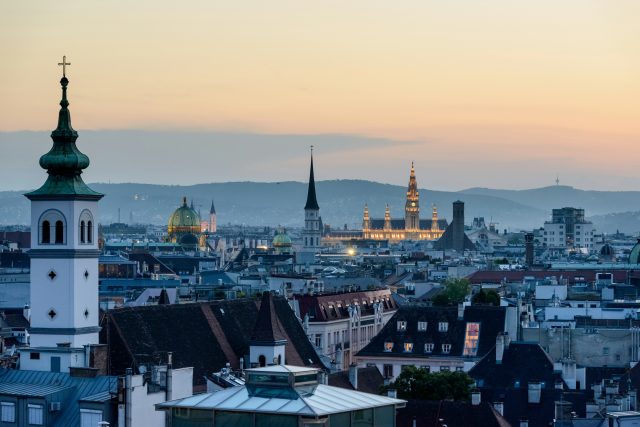
Vienna has a strong architectural and design identity, rooted in the late nineteenth-century Ringstrasse tradition but expressed in contemporary corporate interiors that blend classical building fabric with modern fit-out. Corporate headquarters in Vienna’s first district and the immediate surroundings frequently occupy historic buildings where LED walls need to integrate with heritage interior architecture rather than dominate it. This creates specific requirements for surface finish, cabinet depth and ambient light sensitivity that differ from a purpose-built glass-and-steel office tower.

Matte anti-reflective surfaces are often essential in Vienna offices where natural light from large historic windows falls across the display at angles that would produce distracting reflections on a glossy or semi-gloss panel surface. Cabinet depth and wall-mount flexibility matter when a display needs to fit into a panelled or plastered wall reveal rather than protrude from a modern drywall surface. These are not unusual customisation requests in the Vienna market: they come up routinely and suppliers who cannot address them simply are not competitive for a significant share of the city’s premium corporate work.

AV Integration in Vienna’s International Business Environment

Vienna’s CEE headquarters typically run sophisticated AV environments by the time they consider a LED upgrade, with existing infrastructure covering HDMI, DisplayPort and increasingly AV-over-IP distribution, unified communications platforms, and video conferencing systems from major enterprise vendors. LED walls need to integrate into this infrastructure cleanly, since a display wall that requires an entirely new signal chain or that creates compatibility problems with existing conferencing hardware does not pass the IT evaluation in a Vienna CEE headquarters even if it passes the visual quality evaluation.

Infiled’s display product lines integrate with the major enterprise AV and UC platforms encountered in Vienna’s international headquarters market. The company’s EMEA sales and support infrastructure covers Austria directly, which matters when a Vienna-based regional headquarters needs local technical support rather than having to route a service request through a distant European logistics hub. CEE headquarters buyers who evaluate supplier capability rather than just product specification consistently treat local service responsiveness as a decision factor rather than an afterthought.

Managing Display Networks Across the CEE Region

Many Vienna-headquartered companies want their display infrastructure to extend eventually beyond the Vienna headquarters to regional offices in Budapest, Prague, Warsaw or Bucharest. A centralised content management system that allows the Vienna team to push consistent brand content to offices across the CEE region, while allowing individual country offices to manage locally relevant content, is increasingly a standard expectation rather than a premium feature request.

This expectation shapes how buyers in Vienna evaluate display investments: not just as a single installation decision but as the first deployment in what will become a regional display network. Suppliers who offer a credible answer to the multi-country deployment question, including how color consistency between installations in different countries will be maintained and how the CMS will be managed across different language environments, are at an advantage in this market over suppliers who treat each installation as a standalone project. London, Paris and Berlin ranked as the top three European cities for investment and development prospects in PwC and ULI’s Emerging Trends in Real Estate Europe 2026 report, but Vienna’s CEE gateway position gives it a distinct and durable corporate real estate logic that is not well captured in pan-European rankings focused on investment volume alone.

Specifying LED for Vienna’s Corporate Standard

Vienna’s corporate LED market rewards suppliers who understand that a CEE regional headquarters is not simply a large company office. It is the visual and operational face of an organisation managing relationships across a dozen countries, and the display technology in its lobbies and boardrooms is evaluated by visitors from all of those countries against their own professional standards. Specifying for that audience requires premium integration, a design sensibility that matches the building and the brand, and a supplier relationship that will hold across the full service life of the investment.

For Vienna buyers beginning an LED evaluation process, the most useful first step is separating the lobby specification from the boardroom specification, confirming the supplier’s Austrian logistics and service capability with documented evidence rather than general claims, and asking specifically how a multi-country CEE deployment would be managed from the Vienna headquarters in terms of both hardware consistency and CMS operations. Infiled’s conversations with Vienna-based CEE headquarters clients consistently start from exactly these three points, which is why the company’s European product line and service infrastructure were designed with this specific deployment logic in mind.

User registration
Join us to download our content. It only takes a moment!

    I have read and accept the privacy policy

    This site is protected by reCAPTCHA and Google.

    It looks like you are visiting the website from
    Select your region: