Confirm

How High Can You Ground-Stack an LED Wall? Safety Factors Explained for Event Crews

02.09.2026

Ask three riggers how high you can ground-stack an LED wall and you will often get three different answers. Some quote a manufacturer’s maximum cabinet count as if it were a universal law. Others assume that number holds regardless of the floor, the venue or the weather. Neither is quite right. A ground-stacked LED wall is only as tall as its weakest link on that specific day, and the number on a spec sheet describes a best case, not a guarantee.

This matters because ground-stacking is one of the most common build methods in touring and corporate AV, yet it is also where crews most often improvise under time pressure. Manufacturers, INFiLED included, publish a rated maximum for a reason, but that number only protects a crew that also understands what it assumes. Understanding what a safety factor actually represents, and what really limits how high you can stack, turns a guess into a decision you can defend afterward.

By the end of this article you will know what safety factor 10 means in practice, which variables actually cap stack height, and what to check before the first cabinet goes up.
What Ground-Stacking Actually Means

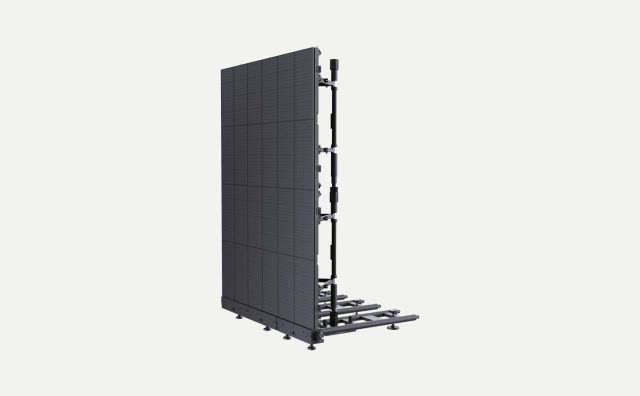
Ground-stacking is exactly what it sounds like: LED cabinets are locked together vertically and horizontally, starting from a base on the floor, rather than suspended from an overhead truss or motor. It is the default method for most rental and touring builds because it needs no rigging point above the stage and can go up and come down fast.

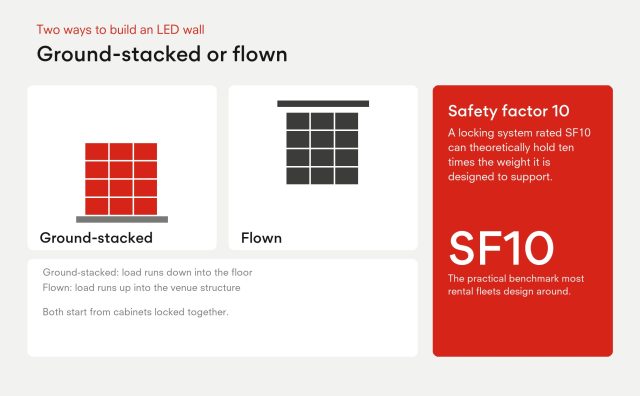
The alternative is flying the wall, meaning the panels hang from a truss using purpose-built hanging bars, and the load path runs upward into the venue’s structure instead of downward into the floor. A safety factor is the ratio between what a structure or component can withstand before failure and the load it is actually expected to carry in normal use. A locking mechanism rated to a safety factor of 10, or SF10, can theoretically hold ten times the weight it is designed to support. Entertainment rigging has long debated whether 5:1, 8:1 or 10:1 is the right minimum, drawing on the same design factor principles used across lifting and load-bearing equipment, and SF10 has become the practical benchmark most rental fleets design around, a point riggers continue to argue over in detail.

Ground-stacked LED walls lock together from a base on the floor and the load runs down into the floor; flown walls hang from a truss and the load runs up into the venue structure. A locking system rated safety factor 10 can theoretically hold ten times its design load.

What Actually Limits Stack Height in Real Builds

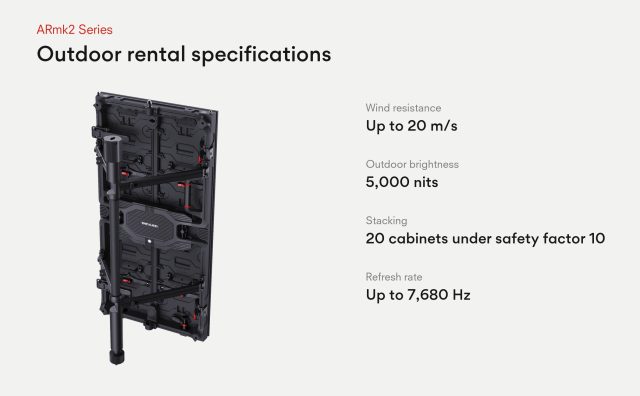
A manufacturer’s rated stack height, for example the twenty cabinets high at SF10 that INFiLED rates for a properly built ARmk2 rental LED panels stack, assumes a specific set of conditions. Change one of those conditions and the safe height changes with it, even though the cabinets themselves have not.

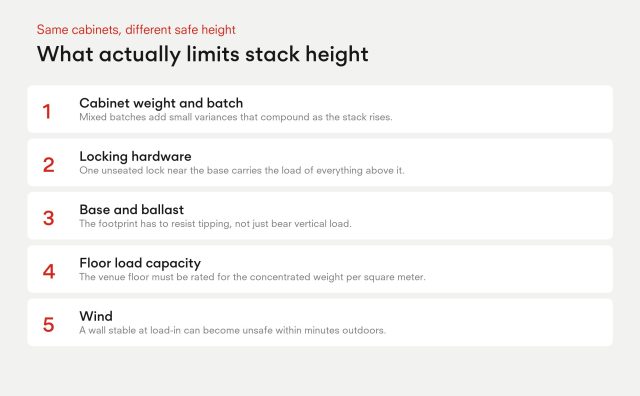
The first variable is cabinet weight and how consistently it is distributed. A wall built from one matched batch of cabinets behaves predictably. Mix batches, and you introduce small variances in weight and fit that compound as the stack rises. The second is the locking hardware itself. Quick-locks with visual indicators let a crew confirm every connection at a glance, but that only helps if someone actually checks each one before moving to the next row, since a single unseated lock near the base carries the load of everything above it.

Base and ballast come next. A ground-stacked wall needs a footprint wide enough, and often weighted enough, to resist tipping, not just to bear vertical load. Floor load capacity is frequently overlooked entirely: a rigging plan can be sound on paper and still fail if the venue floor was never rated for that concentrated weight per square meter. Wind is the variable that changes fastest. A wall that is stable at load-in can become unsafe within minutes if wind picks up outdoors, which is why stack height and wind planning are really the same conversation, not two separate ones.

Five things that limit ground-stack height: cabinet weight and batch, locking hardware, base and ballast, floor load capacity and wind.

Ground Stack, Flown, or Somewhere In Between

Not every build should default to a ground stack simply because it is faster. The decision genuinely depends on the venue and the show.

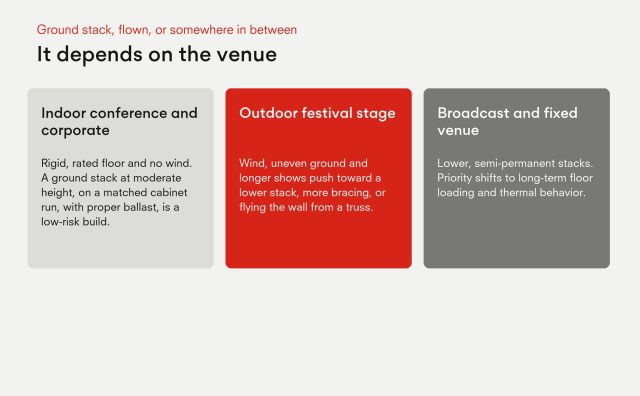
Indoor conference and corporate rooms with a rigid, rated floor and no wind exposure are usually the easiest case: a ground-stacked LED wall at moderate height, on a matched cabinet run, with proper ballast, is a low-risk build. Outdoor festival stages change the calculation immediately, since wind, uneven ground and longer show durations all push toward either a lower stack, additional bracing, or flying the wall from a truss instead. Broadcast and fixed-venue work sits in between: stacks tend to be lower and semi-permanent, so the priority shifts toward long-term floor loading and thermal behavior rather than fast load-in.

Cost and crew time follow directly from this choice. A taller ground stack needs more ballast, more inspection time per row, and often a larger crew to move safely. None of that shows up on a spec sheet, but it shows up on a call sheet.

Ground stack or flown by venue: indoor conference rooms suit a moderate ground stack; outdoor festival stages push toward a lower stack, bracing or flying; broadcast and fixed venues use lower semi-permanent stacks.

A Pre-Build Checklist for Ground-Stacking an LED Wall

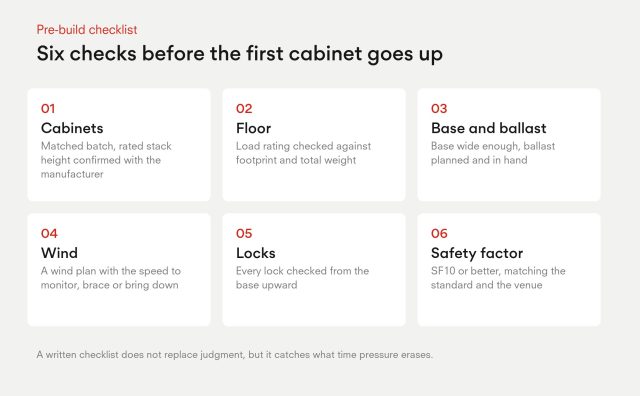
Before the first cabinet goes up, a crew should be able to answer each of these:

  • Is the cabinet batch matched, and has the rated stack height for that specific batch and locking hardware been confirmed with the manufacturer?
  • Has the venue floor’s load rating been checked against the stack’s footprint and total weight, not just estimated?
  • Is the base wide enough, and is ballast planned and in hand, not assumed to arrive later?
  • What is the wind plan, including the wind speed at which the build is monitored, braced, or brought down?
  • Has every lock been visually and physically checked from the base upward, not just at the top row?
  • Does the safety factor rating for the locking system, ideally SF10 or better, match what OSHA’s hoisting and rigging standard and the venue’s own requirements expect for the application?

A written checklist does not replace judgment, but it catches the details that time pressure tends to erase.

The Real Question Isn’t the Maximum, It’s the Margin

How high you can ground-stack an LED wall is never a single number. It is a question with a different answer for an indoor conference room, a festival field and a semi-permanent install, because the floor, the weather and the hardware are different in each case. Safety factor 10 gives a locking system real margin, but that margin only holds if the conditions behind the rating hold too.

INFiLED builds ARmk2 with that margin in mind, from the locking hardware to how a cabinet behaves after hundreds of stack cycles, because a rated number is only useful to a crew that understands what it assumes. The safest ground stack is not the tallest one a spec sheet allows. It is the one a crew can explain, row by row, if anyone ever asks why it was built that way.

User registration
Join us to download our content. It only takes a moment!

    I have read and accept the privacy policy

    This site is protected by reCAPTCHA and Google.

    It looks like you are visiting the website from
    Select your region: