Confirm

How Location Impacts DOOH LED Display Performance and Revenue

18.04.2026

A DOOH screen is often judged first by hardware specs, yet location usually has a greater effect on outcome than panel quality alone. Buyers can spend heavily on brightness, pixel pitch, and control systems, then place the display where sightlines are weak, traffic moves too fast, or the audience simply does not match the advertiser. In practice, that is where performance and revenue start to separate.

One of the most common misconceptions in DOOH is that more traffic automatically means better returns. It does not. A strong location is not just busy. It is visible, readable, contextually relevant, and positioned where the audience has a real opportunity to notice the message. By the end of this article, readers will have a clearer framework for evaluating how location shapes both DOOH LED display performance and long-term commercial value.
Infiled

Why Location Matters More Than Many Buyers Realize

In DOOH, location influences almost every meaningful performance variable. It affects how long the audience sees the display, from what angle they encounter it, what ambient light conditions the system must overcome, and whether the content can be understood in time. That means location is not just a media-buying issue. It is also an engineering and design issue.

This matters because a DOOH LED display does not operate in isolation. The display, content strategy, traffic behavior, and physical surroundings work together as one system. A high-brightness screen in direct sunlight may still underperform if it sits too far from the traffic stream or if the approach angle makes content hard to read. Likewise, a modest screen in a transit concourse may generate better campaign value because the audience is closer, slower-moving, and more exposed to repeated impressions.

Industry guidance also reflects this reality. Outdoor digital signage must contend with ambient light and harsher environmental conditions, while audience measurement frameworks increasingly look beyond raw passing traffic to exposure and noticeability. That is why location assessment should come before product selection, not after it. A useful starting point is understanding how circulation and precise unit location are measured, and how noticeability differs from simple opportunity to see.

Traffic Volume vs Audience Quality

High traffic counts are easy to market because they sound objective. For buyers, though, traffic volume is only the first filter. The more important question is whether that traffic creates usable audience exposure.

A roadside placement with heavy vehicle flow may produce a large number of theoretical impressions, but it can still be weak if vehicles pass too quickly, lane geometry limits visibility, or the audience is poorly aligned with the advertiser. By contrast, a transit, retail, or mixed-use urban location may deliver fewer gross impressions while generating better results because dwell time is longer and the context supports message retention.

In DOOH measurement, impressions are not just headcounts. They are tied to the audience’s opportunity to see and notice a message, calibrated against dwell time. That distinction matters commercially. It helps explain why two sites with similar traffic levels can perform very differently in revenue terms. Operators who price inventory only on circulation often overestimate the value of poorly contextualized sites. Advertisers who buy that inventory often discover the gap after campaigns underdeliver.

For a DOOH LED display, the lesson is simple: quality exposure beats abstract volume. Audience composition, repeat visits, traffic speed, and site purpose all matter. A screen near office towers, premium retail, or a major transit interchange may support stronger advertiser demand than a busier but less relevant corridor. OAAA’s DOOH guidance notes that impressions incorporate both opportunity to see and dwell time, which is a more useful planning lens than traffic counts alone.

Visibility, Viewing Angles, and Readability

Even a well-targeted site can underperform if the screen is difficult to see or hard to read. For DOOH LED display performance, visibility is shaped by approach angle, setback, mounting height, competing visual clutter, and content legibility at speed.

Viewing distance is especially important. Pixel pitch should be selected based on how far the audience is from the display, not based on the smallest pitch a budget can stretch to. AVIXA notes that acceptable viewing distance can be estimated through visual acuity and comfort formulas, including the well-known shortcut of roughly 10 times pixel pitch for a quick minimum-distance reference. In practice, that means a screen designed for close pedestrian viewing is not automatically right for roadside placement, and vice versa.

Brightness also has to be interpreted in context. Outdoor environments demand higher brightness to remain visible in direct sun, but nits alone do not guarantee readability. If reflections, poor orientation, or excessive viewing angle distortion are present, the display may still struggle. The same goes for refresh rate and color calibration. They matter, but they matter differently depending on the environment and content type.

There is also a content-speed relationship that buyers sometimes overlook. Research on digital billboard distraction found that simpler content and longer dwell times were associated with less negative impact on driving outcomes than more complex content and shorter dwell windows. That does not just have safety implications. It reinforces a commercial truth: if drivers only have a brief look, the location demands concise creative and a screen position that supports instant recognition, not detailed storytelling.

Urban, Roadside, and Transit Placement Differences

Not all DOOH environments reward the same design logic. Urban, roadside, and transit sites each create different performance constraints for a DOOH LED display.

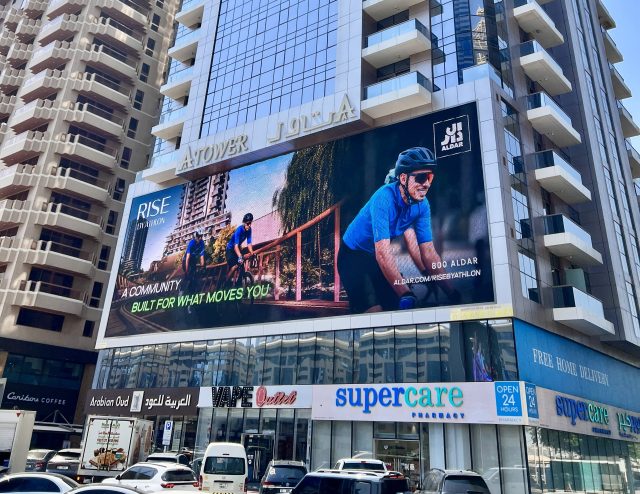
In dense urban environments, sightlines are often interrupted by buildings, street furniture, trees, and competing signage. Audiences may be close to the screen, but they also arrive from multiple directions and at different speeds. That typically favors finer pixel pitch, careful brightness tuning, strong calibration, and content designed for angled viewing.

Roadside environments are different. The audience is generally farther away, moving faster, and often exposed for only a short interval. Here, readability usually matters more than visual detail. Over-specifying resolution can add cost without improving outcomes if the viewing distance is long and the content is intentionally simple. What matters more is dominant positioning, clean approach visibility, stable brightness control, and creative discipline.

Transit environments tend to offer stronger dwell time and repeat exposure. That makes them commercially attractive, but only if the display placement matches movement patterns. A screen buried behind pillars or positioned outside natural queueing areas may look good on paper yet miss the best audience pockets. INFiLED’s experience across different LED deployment scenarios reflects this broader industry reality: the screen itself can only do so much if the placement fails to align with real human movement and attention behavior.

Common Location Mistakes That Reduce ROI

Some location mistakes are easy to identify after installation, but expensive to fix.

The first is prioritizing traffic count over real noticeability. A site may have strong circulation data and still be visually weak because the approach angle is poor or the display is outside the audience’s natural line of sight.

The second is underestimating environmental context. Direct sunlight, nearby reflective surfaces, seasonal foliage, nearby competing signs, and nighttime spill light can all change how a display performs across the day. A DOOH LED display that appears bright enough in a showroom can behave very differently on site.

The third is mismatching hardware to location behavior. Buyers may choose pixel pitch, cabinet size, or brightness ranges based on generic assumptions instead of actual viewing distance, dwell time, and audience speed. This is where system-level thinking matters. The display should be specified around the location, not the other way around.

Another common mistake is treating all advertisers as interchangeable. Not every site is equally monetizable. A placement that works for broad brand awareness may not support premium retail, automotive, or enterprise campaigns if the surrounding audience profile is misaligned. INFiLED typically approaches these decisions from a performance-and-reliability perspective, but the same principle applies commercially: technical fitness and audience fit both determine revenue potential.

How to Evaluate a DOOH Opportunity Properly

A disciplined DOOH site evaluation should combine media logic with display engineering. The right questions are practical.

Who is actually passing the site, and in what mode?
How fast are they moving?
From what angle do they first see the display?
How long is the effective viewing window?
What ambient light conditions dominate throughout the day?
What content complexity is realistic for that environment?
What maintenance access, calibration stability, and service constraints come with the site?

Those questions lead to better decisions than comparing screen specs in isolation. They also reduce the risk of buying premium hardware for an average site, or undervaluing a high-quality location because raw traffic is modest.

For operators and property owners, this is where revenue planning becomes more credible. For advertisers, it improves campaign fit. For integrators and consultants, it produces more defensible recommendations. INFiLED’s engineering-led approach is relevant here not as a sales point, but as a reminder that DOOH success comes from balancing visibility, reliability, readability, and site realities together.

A DOOH LED display can be technically excellent and still commercially average if the location is wrong. The stronger strategy is to begin with audience behavior and physical context, then build the display system around those constraints. That is usually where durable performance and revenue begin.

User registration
Join us to download our content. It only takes a moment!

    I have read and accept the privacy policy

    This site is protected by reCAPTCHA and Google.

    It looks like you are visiting the website from
    Select your region: