Confirm

24/7 Color Stability and Operator Ergonomics: Why French Control Rooms Are Moving to Micro-LED Pixel Pitch

05.06.2026

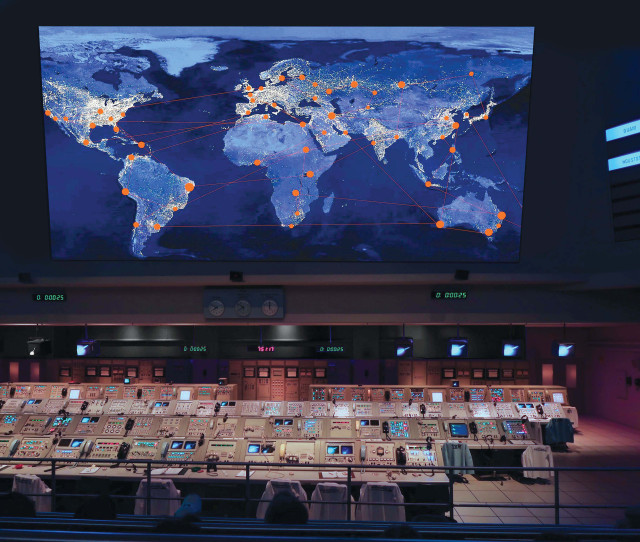
French infrastructure operators run some of the most demanding control rooms in Europe. SNCF traffic management centres, EDF grid supervision rooms and emergency dispatch centres all rely on operators working eight-hour shifts in front of large-format displays, where small problems in color stability or flicker compound into measurable fatigue over a full shift. Buyers in this market are increasingly specifying fine pixel pitch LED walls with documented color uniformity and flicker performance, rather than accepting general claims about image quality.

This article explains the science behind that shift and what French control room procurement teams should actually measure.
Infiled

Color Uniformity, Gray-Scale Tracking and Why They Matter

Color uniformity describes how consistently a display reproduces the same color across its full surface. The standard way to quantify this is Delta u’v’, a measure of chromatic non-uniformity calculated across multiple sample points on a panel. A low Delta u’v’ value means the color of the display does not shift noticeably depending on where on the panel, or from what angle, it is viewed, which matters directly in a control room where operators view the same wall from multiple seating positions across a shift.

Gray-scale tracking is the companion concept for color accuracy specifically in the low-saturation tones that dominate dashboard and map displays. A wall with poor gray-scale tracking can show a faint green or red cast in supposedly neutral grays, an artefact that is subtle enough to go unnoticed in a showroom demo but becomes a persistent low-level distraction across a full operator shift. Both metrics should be requested as measured data from any supplier, not as a qualitative claim of accuracy.

Viewing angle compounds both issues in a control room layout where operators are rarely seated dead-centre in front of the wall. A panel that holds its color uniformity and gray-scale accuracy only within a narrow cone directly ahead of it will show visibly inconsistent color to an operator seated off to one side, which is precisely the seating arrangement most multi-position control rooms actually use.

How French Operators Are Specifying Around This

SNCF’s modernisation of its Lyon-Part-Dieu station operations centre offers a useful reference point. The deployment used a video wall architecture purpose-built for the kind of 24/7, multi-source environment typical of French rail control rooms, combining real-time train status, surveillance feeds and passenger information into a single coherent display. The project’s technical partners reported enhanced decision-making and information-sharing once the new wall was in place, a result that depended as much on consistent image quality across the full wall as on the processing behind it.

Pixel pitch selection in French deployments tends to follow operator viewing distance closely, with control rooms specifying in the P1.25 to P1.9 range depending on how close the front row of consoles sits to the wall and how dense the displayed content is. Specifying tighter pitch than the viewing distance rewards adds cost without delivering perceptible benefit, while specifying too coarse a pitch for close viewing produces visible pixel structure that becomes distracting over a long shift.

Infiled’s fine pitch control room panels have been specified into French infrastructure environments precisely because the buying teams in this sector ask for measured Delta u’v’ and gray-scale tracking data upfront, rather than evaluating a wall on a brief showroom impression. That documentation requirement, more than any single feature, has become the standard against which French control room procurement now operates.

Flicker, Fatigue and the Science Behind Operator Comfort

The flicker fusion threshold is the frequency above which a flickering light source appears continuous to the human eye, typically falling between 50 and 60 Hz under normal viewing conditions. This threshold is not fixed: research shows it drops as visual fatigue increases, which means a display that flickers imperceptibly at the start of a shift can become noticeably more bothersome to a tired operator eight hours later. This is part of why refresh rate and PWM dimming frequency matter more in control rooms than in most other LED applications: the wall has to stay comfortable across the full duration of a shift, not just on first impression.

High refresh rates, typically above 3,840 Hz on modern fine pitch LED, push the effective flicker frequency well above any threshold likely to be perceived even under fatigue, and combined with PWM dimming schemes that avoid abrupt brightness transitions, this produces a display that genuinely reduces the visual load on operators across a long shift rather than just performing well in a brief demonstration.

What Counts as Micro-LED, and What Is Marketing

The term Micro-LED is used loosely across the industry, and French buyers should be precise about what they are actually being offered. True Micro-LED uses individual diodes typically below 50 micrometres, a technology still mostly confined to premium, high-cost deployments. Most of what is marketed as next-generation control room LED is in fact fine pitch conventional LED, using improved packaging and driving electronics rather than true microscopic diode arrays. Both can deliver excellent control room performance, but buyers comparing quotes should ask suppliers to be specific about diode size and packaging technology rather than accepting the Micro-LED label at face value.

Specifying for the Full Shift, Not the Demo

French control rooms increasingly evaluate LED walls against the standard their operators actually experience: eight hours of continuous viewing, not a five-minute showroom walkthrough. That shift in evaluation criteria, more than any single new technology, is what is driving demand toward fine pixel pitch LED with documented color uniformity and flicker performance. Infiled’s deployments in the French infrastructure sector have consistently shown that walls specified against gray-scale tracking and Delta u’v’ data, rather than general image quality claims, are the ones that still look right to tired operators a year into service.

Procurement teams structuring a tender for a French control room should request this data as a standard part of the technical submission rather than leaving it to be discovered during installation. A supplier that can readily provide measured Delta u’v’, gray-scale tracking results and PWM dimming frequency, rather than only headline brightness and resolution figures, is signalling that its product line was engineered with exactly this kind of demanding, multi-shift environment in mind.

User registration
Join us to download our content. It only takes a moment!

    I have read and accept the privacy policy

    This site is protected by reCAPTCHA and Google.

    It looks like you are visiting the website from
    Select your region: