Confirm

LED Video Walls for Luxembourg Control Rooms: Creos Grid Operations, Luxembourg Airport and EU Institution Facilities

08.07.2026

Luxembourg’s control room market is small by European standards but concentrated around organisations whose operational significance exceeds what the Grand Duchy’s size might suggest. Creos Luxembourg, the national electricity and natural gas network operator, manages grid infrastructure that sits at the intersection of the Belgian, French and German power markets, making its dispatching centre a genuinely strategic node in the broader European energy interconnection. Luxembourg Airport handles passenger volumes that make it one of the busiest cargo hubs in Europe.

The European Investment Bank, the European Court of Justice and a number of EU agencies headquartered in Luxembourg’s Kirchberg district operate their own monitoring and coordination facilities. For LED buyers in this market, the relevant questions are less about scale than about the service and supply chain reliability a small market demands from any supplier it depends on.
Infiled

Creos Luxembourg: Grid Operations at Europe’s Crossroads

Creos Luxembourg operates the electricity and natural gas networks of the Grand Duchy, managing high, medium and low-voltage electricity infrastructure alongside high, medium and low-pressure gas pipelines. The company’s dispatching centre is the operational nerve centre of Luxembourg’s energy supply, monitoring grid flows that connect to Belgium, France and Germany simultaneously. Creos describes its mission as ensuring security of energy supply through developing and digitalising efficient grid infrastructure, a mandate that is growing more complex as Luxembourg increases its renewable energy share and its cross-border power flows become more dynamic in line with European electricity market integration.

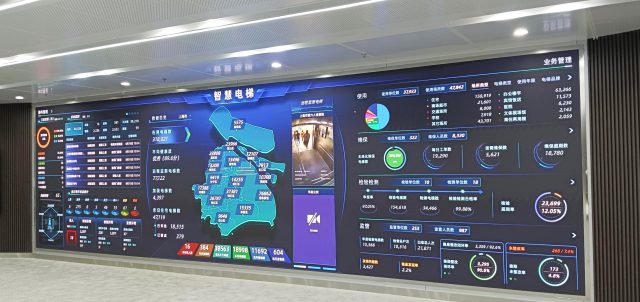
The display wall in Creos’s dispatching operations monitors data streams from multiple interconnected national grids, making it a genuinely multi-source environment where color coding and visual hierarchy directly affect how quickly operators can parse grid state information under time pressure. Fine pitch LED with documented Delta u’v’ color uniformity and stable gray-scale tracking is not an overcautious specification for this environment. It is the appropriate baseline for a 24/7 operations room where the display must be read reliably by operators who may be working through a full shift before a significant grid event demands rapid decision-making.

Luxembourg Airport: Multi-Zone Operations Display

Luxembourg Airport is one of the largest cargo hubs in Europe by volume, handling more freight traffic than its passenger terminal might suggest and operating complex ground handling, customs coordination and air traffic support functions from a centralised operations environment. Airport operations centres typically combine aircraft movement tracking, cargo status, ground vehicle coordination and security feeds across a large wall configuration, with different operational teams sharing a common situational display from different positions in the room.

For this use case, the LED wall specification must accommodate different content types viewed from different distances simultaneously. A pixel pitch appropriate for the detailed text in cargo manifest feeds viewed close-up may be unnecessarily fine, and therefore unnecessarily expensive, for the geographic movement map visible to the whole room from the back row. A zoned specification approach, where the primary data zone is specified more tightly than the overview map zone, often produces a better value outcome than a single specification applied uniformly across the full wall.

EU Institutions and the Kirchberg Monitoring Environment

The European Investment Bank, the European Court of Justice and several EU agencies headquartered in Luxembourg’s Kirchberg quarter operate monitoring, coordination and information display facilities that differ from industrial control rooms in one important respect: they often need to serve both a continuous operations monitoring function and a presentation function for meetings and executive briefings. An EIB monitoring centre might display live market data and project tracking information during day-to-day operations while switching to presentation mode for board briefings without requiring a different display infrastructure for each function.

LED walls handle this dual-use requirement well because they maintain consistent image quality across the full range of content types from dense data displays to high-quality video and presentation slides. The critical specification for a dual-use installation is that the content management system can switch smoothly between data-feed mode and presentation mode without visible artefacts or delay, since a wall that hesitates during a mode transition in front of a senior audience undermines confidence in the technology regardless of how well it performs in each mode individually. EU institutional procurement processes typically require documented evidence of this switching capability from real installations in comparable environments, not from a vendor demonstration using ideal source material.

Service Reliability in a Small Market

Luxembourg’s small market size creates a specific supply chain challenge that buyers should address directly during procurement: who will provide on-site service in Luxembourg when a module fault occurs outside business hours? The organisations operating Luxembourg’s grid, airport and institutional facilities cannot wait for service teams to travel from Paris, Brussels or Frankfurt. Infiled’s European service logistics cover Luxembourg through its Benelux regional infrastructure, and buyers in this market should ask any supplier to specify response time commitments to a Luxembourg City address specifically, not just a general claim of European coverage. The EU Ecodesign framework, which confirms that professional displays are subject to reduced reparability and material efficiency obligations rather than full consumer energy labelling, also supports specifying suppliers who commit to long parts availability periods as a baseline requirement for a small market where replacement sourcing takes longer than in larger neighbouring countries.

Specifying LED for Luxembourg’s Critical Environments

Luxembourg’s control room buyers operate in environments where the consequences of display failure are real but the supplier ecosystem is thin compared to larger European markets. The procurement discipline this demands is straightforward: specify more rigorously on reliability, service response and parts availability than a larger market might require, and verify those commitments in writing before contract rather than discovering their limits during an incident.

Infiled’s Benelux logistics infrastructure treats Luxembourg as a primary service territory with dedicated spare parts stocking and documented service response commitments, not as an overflow extension of the Belgian or French service area. For Creos, Luxembourg Airport and EU institution buyers whose procurement processes require supplier service commitments in writing, that distinction matters practically rather than being a marketing formality.

User registration
Join us to download our content. It only takes a moment!

    I have read and accept the privacy policy

    This site is protected by reCAPTCHA and Google.

    It looks like you are visiting the website from
    Select your region: