Confirm

LED Video Walls for Corporate Communication: Beyond Aesthetics

13.03.2026

For many companies, LED video walls still get evaluated as visual statement pieces. They are seen as lobby upgrades, architectural features, or branding surfaces that make a workplace feel modern. That view is too narrow. In corporate environments, LED walls can become communication infrastructure that helps organizations distribute information faster, visualize business data more clearly, and connect physical spaces with enterprise platforms already used every day. The real opportunity is not simply to make a space look better. It is to make communication more visible, more timely, and more actionable.

That distinction matters because many deployments underperform for the same reason. Companies invest heavily in hardware quality, brightness, and resolution, but spend too little time defining what the screen should actually communicate, who it should serve, and how its content should be governed. As Microsoft’s documentation around real-time dashboards and digital signage makes clear, enterprise display environments now sit much closer to operational systems than to static signage alone. Microsoft’s guidance on real-time streaming in Power BI and Microsoft’s documentation for digital signage on Teams Rooms show how live data, shared spaces, and communications workflows are increasingly connected. By the end of this article, readers will have a clearer framework for using LED video walls as communication tools that create business value rather than as isolated design upgrades.
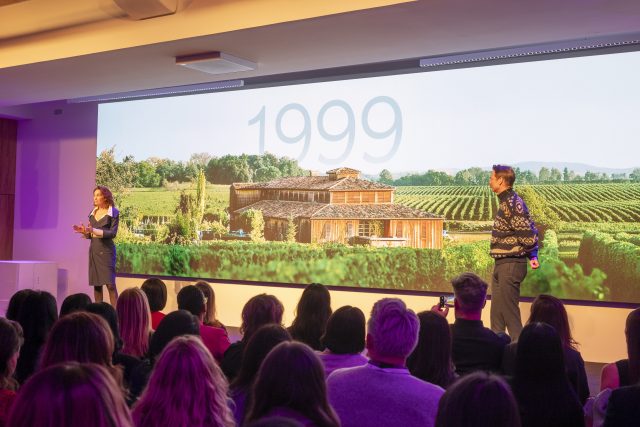
Infiled

Photo Credit © Caudalie

Why LED Walls Are Becoming Communication Tools

Corporate communication has changed in both speed and format. Information now moves across hybrid teams, distributed offices, digital workplaces, and shared environments where attention is fragmented. In that context, LED video walls are becoming more important because they create a persistent, high-visibility communication layer inside the physical workplace. Instead of relying only on email, intranet posts, or chat notifications that can easily be missed, organizations can use large-format displays to reinforce updates, surface live metrics, and keep key messages visible in common areas.

This shift is not just about display technology becoming more advanced. It is also about organizations rethinking how internal information reaches employees, leadership teams, and visitors. Nielsen Norman Group’s intranet research has long noted that digital signage can complement intranets and newsletters by pushing information into visible shared environments rather than waiting for employees to actively seek it out. That is especially relevant in offices, campuses, executive briefing centers, manufacturing spaces, and control-oriented business environments where shared awareness matters.

For corporate teams, this means LED walls should be evaluated less like décor and more like part of a broader communications ecosystem. That changes the buying conversation. Resolution, pixel pitch, and brightness still matter, but they matter in service of communication clarity, not as ends in themselves. A technically capable system with no message strategy will be underused. A well-planned system, by contrast, can support announcements, cultural messaging, dashboards, executive communication, and operational transparency in one connected environment.

Key Use Cases in Corporate Environments

Internal communication and announcements

One of the most immediate uses of an LED wall in a corporate setting is internal communication. This can include company news, leadership updates, employee recognition, onboarding content, event reminders, workplace safety messaging, and campaign rollouts. In practice, the value comes from visibility and repetition. Important internal information often competes with inbox overload and notification fatigue. A well-placed LED wall helps reinforce priority messages in locations where employees naturally pass through or gather.

The key is not to treat the screen like a generic slideshow. Internal communication on LED walls works best when content is designed for glanceability, timing, and relevance. Employees should be able to understand the message quickly, even if they only see the screen for a few seconds while walking by. That means concise headlines, clear motion hierarchy, scheduling logic, and context-aware placement. A screen in a lobby, for example, may combine employer brand messaging with visitor-facing announcements, while a screen near work areas may focus on operational updates or internal milestones.

This is also where corporate LED walls can support consistency across distributed environments. When content workflows are tied into enterprise tools, communications teams can update messaging centrally while still tailoring specific content to office, department, or audience needs. INFiLED becomes relevant here not as a branding exercise, but because display performance has to support legibility, reliability, and visual consistency if the wall is going to function as a serious communication asset instead of a sporadic showcase.

Data visualization and dashboards

A second major use case is live data visualization. In many organizations, the LED wall becomes most valuable when it surfaces business information that would otherwise stay buried inside dashboards, BI tools, or departmental systems. Sales performance, service levels, occupancy, production metrics, energy usage, ESG indicators, logistics KPIs, customer support queues, and executive scorecards can all become more visible when displayed in shared spaces.

This is not a theoretical shift. Microsoft explicitly supports real-time data streaming and real-time dashboards in Power BI, allowing organizations to update visualizations continuously from live sources. That capability matters because the more current the information, the more useful the screen becomes for management visibility and collective awareness. A display showing yesterday’s numbers may inform reporting. A display showing live conditions can influence decisions in the moment.

The mistake many companies make is assuming that any dashboard can simply be enlarged for a video wall. In reality, dashboards designed for desktop use often fail on large public-facing displays because they include too much detail, weak hierarchy, or small text intended for close viewing. Effective LED-based dashboard communication requires simplification. Only the most important signals should dominate the screen, and layouts should be structured around viewing distance, dwell time, and the decision context of the audience.

Integration with Corporate Systems and Platforms

The value of a corporate LED wall increases significantly when it integrates with systems the organization already depends on. Without integration, the screen risks becoming a manually updated content loop that quickly loses relevance. With integration, it becomes a live communication endpoint tied into the digital workplace.

Common enterprise integrations include business intelligence platforms, room and workplace systems, collaboration tools, intranet feeds, scheduling platforms, visitor management tools, and custom internal applications. Microsoft’s documentation is especially useful here because it shows how shared-space devices and Teams Rooms can support digital signage modes, while Power BI supports real-time streaming and continuously updating visual layers. Together, those capabilities illustrate how physical displays can sit much closer to corporate workflows than many buyers assume.

From a project standpoint, integration also changes technical requirements. A corporate LED wall used for enterprise communication should not be judged only on picture quality. IT and workplace teams should ask questions such as:

  • Which content sources need to connect to the wall?
  • Who owns publishing rights and approval workflows?
  • How often is the content expected to refresh?
  • What systems need API, dashboard, or signage compatibility?
  • How will the display behave during outages, updates, or room-mode changes?

These questions often determine long-term success more than the hardware shortlist alone. For that reason, display selection and enterprise integration planning should happen together, not in separate phases. INFiLED systems in corporate projects are most effective when the discussion includes not only the LED surface itself but also how the display will fit into the organization’s communication stack, governance model, and operational expectations.

Content Strategy for Maximum Impact

A strong content strategy is what turns an LED wall from an impressive object into a useful communication tool. The first principle is clarity of purpose. A single wall cannot effectively do everything at once. If one screen tries to act as brand theater, internal newsboard, KPI dashboard, event screen, and executive presentation surface simultaneously, the result usually becomes diluted. The content plan should define primary use cases, audience priorities, publishing cadence, and ownership.

The second principle is designing for the context of attention. Corporate LED walls are often viewed in transit, at distance, or in peripheral vision. That means content should be built for recognition rather than deep reading. Short headlines, strong information hierarchy, minimal competing elements, and carefully paced motion matter more than dense layouts. What works in a PowerPoint slide, intranet page, or desktop dashboard may not work on a large-format wall in a lobby or open workplace.

The third principle is balancing evergreen and live content. Most successful deployments use a structured mix. Evergreen material may include cultural messages, employer brand themes, or recurring wayfinding content. Live material may include announcements, campaign countdowns, meeting information, or dashboard tiles. A wall that shows only evergreen content quickly becomes background noise. A wall that shows only live feeds can become visually chaotic. The content strategy should create a rhythm between stability and change.

This is also where cross-functional planning helps. Communications teams usually own messaging, but IT, workplace experience, facilities, and business operations often control the systems feeding the content. A corporate LED wall performs best when these groups align on standards rather than treating the display as a last-mile output device. For technical buyers, that is one reason vendor conversations should move beyond display specifications and into content workflows, integration requirements, and lifecycle management.

Measuring Engagement and Business Value

One of the reasons corporate LED wall projects are sometimes underestimated is that their impact is measured too vaguely. If success is defined only as whether the installation looks impressive, then the business case stays weak. If success is defined in communication terms, the value becomes easier to defend.

Measurement can happen at several levels. At the simplest level, companies can track operational metrics such as update frequency, uptime, content turnaround time, and the percentage of content sources integrated into the display workflow. At a communication level, teams can measure recall, employee awareness, event participation, content interaction through linked channels, or traffic lift to related intranet pages and campaigns. At a business level, the wall may support better visibility of KPIs, faster escalation of issues, stronger executive storytelling, or more consistent communications across locations.

This broader view aligns with a larger enterprise reality. Gartner reported in late 2024 that only 48% of digital initiatives meet or exceed business outcome targets, which underscores why technology projects need clearer outcome framing from the start. In the case of LED walls, that means moving from “we installed a premium display” to “we improved how people see, understand, and act on information in the workplace.”

The strongest corporate LED wall projects are therefore the ones that connect hardware, integration, and content strategy to actual communication outcomes. That might mean more visible internal messaging, more useful real-time dashboards, or better support for executive and workplace communications. It also means selecting a display partner that understands the communication role of the screen, not just the visual one. INFiLED fits that conversation best when viewed through system thinking: display quality matters, but business value comes from how the wall functions inside the enterprise communication environment.

LED video walls in corporate environments are no longer just aesthetic upgrades. They are becoming part of how organizations communicate in physical space, connect live information to everyday operations, and make internal messaging more visible and actionable. Companies that treat them only as design features tend to underuse them. Companies that define purpose, integrate the right systems, and plan content strategically are far more likely to turn the display into a working communication asset. That is the real shift buyers should plan for.

User registration
Join us to download our content. It only takes a moment!

    I have read and accept the privacy policy

    This site is protected by reCAPTCHA and Google.

    It looks like you are visiting the website from
    Select your region: