Confirm

Museum LED Displays: How to Create Immersive Visitor Experiences Without Distraction

21.04.2026

Museums occupy a unique position in the world of LED display deployment. Unlike stadiums, retail environments, or broadcast studios, where the display is often the primary focus, a museum’s LED installation succeeds only when visitors do not notice it as technology at all. The screen should dissolve into the story. When it does not, when brightness is miscalibrated, pixel structure is visible at natural viewing distances, or content transitions feel mechanical, the display pulls attention away from the exhibit rather than drawing it deeper in.

That tension between presence and restraint defines almost every successful museum LED project. The installations that earn consistent praise from curators and visitor experience teams are not the ones with the highest resolution or the largest surface area. They are the ones where every technical decision, from pixel pitch to color temperature to content pacing, was made in service of a specific narrative goal rather than a general specification target.

This article examines how museums can use LED effectively, where the technology genuinely enhances exhibit design, and where the most common mistakes are made.
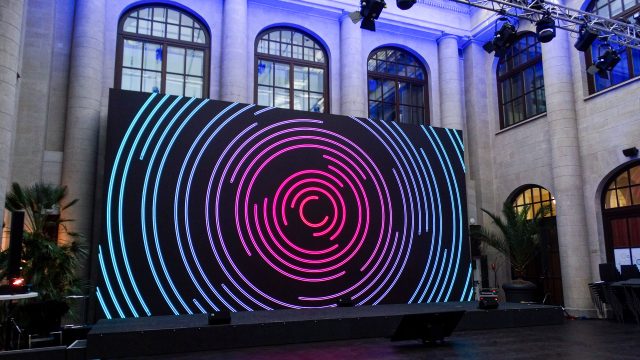
Infiled

Photo Credit © Kuchem

Why Museums Are Investing in LED Technology

The case for LED in museum environments is not primarily about visual spectacle. It is about operational flexibility and the quality of light that LED can produce when properly configured.

Traditional exhibit lighting and static printed graphics impose fixed interpretive frameworks. Once installed, they are expensive and disruptive to change. An LED display integrated into an exhibit environment can shift the atmospheric conditions of a gallery space, introduce motion and temporal depth to a narrative, and be updated with new content without physical reconstruction. For museums managing rotating collections or traveling exhibitions, that operational agility has concrete budget value.

LED has also become viable in museum contexts because of advances in low-brightness performance. Early LED panels struggled with visible flickering and color shift at the dim output levels that gallery environments require. Contemporary fine-pitch panels can operate at 100 nits or below while maintaining color accuracy and uniformity, which opens up application contexts in spaces where any brighter source would damage artifacts or overwhelm ambient conditions.

The longevity profile of LED hardware also aligns well with museum procurement cycles. A well-specified installation can operate reliably for ten years or more under the controlled environmental conditions typical of climate-managed gallery spaces, which compares favorably against projection systems requiring regular lamp replacement and alignment.

Storytelling First, Technology Second

The most important discipline in museum LED design is sequencing the creative and technical decisions correctly. Display specifications should follow from narrative requirements, not the other way around.

A common failure mode is when exhibit design teams select hardware first, often based on budget availability or a vendor demonstration, and then ask the content team to fill it. The result is frequently a display that is too large for the story being told, too bright for the surrounding artifacts, or positioned in a way that creates viewing conflicts with the physical objects in the space.

The correct sequence begins with a clear articulation of what role the display plays in the visitor journey. Is it providing contextual information that supplements a physical artifact? Is it creating an environmental atmosphere that transports visitors to a historical period or geographic location? Is it the primary exhibit element, with the display surface itself being the experience? Each of these roles implies different technical requirements and different content design approaches.

The American Alliance of Museums emphasizes that technology in exhibit design should always serve interpretive goals, not function as a demonstration of institutional resources. That principle has direct technical implications: it means brightness levels should be set relative to the surrounding gallery, not maximized; it means content transitions should be timed to visitor attention patterns, not technical capability; and it means the physical integration of the display into the architecture should be invisible to the casual visitor.

INFiLED works with exhibit designers and AV integrators on museum projects where the first conversation is always about the interpretive goal rather than the panel specification. That sequencing is not incidental. It is what determines whether the hardware investment ultimately serves the institution.

Managing Brightness, Color, and Atmosphere

Brightness calibration is the technical variable that most directly affects whether a museum LED installation enhances or damages the visitor experience. It is also the variable most consistently underspecified in museum project briefs.

Gallery environments typically maintain ambient light levels between 50 and 200 lux to protect light-sensitive artifacts and create a contemplative atmosphere. An LED display operating at even 500 nits in such an environment will dominate the visual field of the entire room, pulling attention from everything else and creating an uncomfortable luminance contrast for visitors whose eyes have adjusted to the lower ambient level.

For most gallery contexts, LED displays should be configured to operate between 80 and 300 nits depending on ambient conditions, with the specific output level determined by on-site measurement rather than estimated in advance. The Illuminating Engineering Society publishes lighting standards for museum and gallery environments that provide useful reference benchmarks for integrators calibrating LED output alongside conventional gallery lighting systems.

Color temperature consistency between the LED display and the gallery lighting is equally important and frequently overlooked. A display rendering with a 6500K color temperature in a gallery lit at 2700K to 3000K warm white will produce a visually jarring shift that visitors experience as discomfort without necessarily understanding why. Color temperature matching between display and ambient light should be a defined calibration target, not an afterthought.

High-quality LED panels also support smooth dimming without color shift, which allows displays to be dynamically adjusted across the day as natural light conditions change in spaces with exterior windows. This capability matters significantly in atrium installations or historic buildings where controlling daylight is impractical.

Interactive and Immersive Exhibit Use Cases

The strongest use cases for LED in museum environments fall into two broad categories: contextual enhancement and full immersion.

Contextual enhancement uses the display as a supporting element alongside physical artifacts. A panel mounted behind a historical document can display film footage from the same period. A display integrated into an archaeological exhibit can show the original site in its complete form while fragmentary physical objects occupy the foreground. In these applications, the display extends what the artifact alone cannot communicate.

Full immersion treats the LED surface as the primary exhibit environment. Floor-to-ceiling and sometimes floor-inclusive LED volumes allow visitors to enter a rendered scene, whether that is an ecosystem, a historical event reconstruction, or an abstract visual artwork. These installations have become a significant draw for natural history museums, science centers, and art institutions, particularly when paired with spatial audio that reinforces the environmental quality of the content.

Interactive applications, where visitor movement or input modifies what the display shows, add a layer of engagement that passive displays cannot match. Touch-integrated LED surfaces, camera-tracked interaction systems, and sensor-driven content responses all extend the dwell time visitors spend with an exhibit and deepen the interpretive connection.

For immersive floor-to-ceiling environments, pixel pitch selection is critical. Visitors in an immersive environment may approach any surface at very close range, which means pixel structure becomes visible at pitches that would be perfectly acceptable at conventional viewing distances. Pixel pitches of 1.5mm or finer are typically warranted for immersive environments where visitors will be within one to two meters of any display surface.

Common Mistakes That Hurt Visitor Experience

Several recurring errors appear across museum LED projects, and most of them originate from applying commercial display logic to a cultural institution context.

Running displays at full brightness is the most common. Museums frequently receive LED hardware configured for retail or events environments where high brightness is a competitive advantage. Without deliberate recalibration for the gallery environment, these settings will overwhelm the space.

Using looping content with abrupt transitions is a close second. Visitors who remain in a gallery space for several minutes will notice the loop point of a content cycle, and a hard cut or jarring transition breaks the atmospheric quality that the installation was designed to create. Content designed for museum environments should use long-form, seamlessly looping sequences with transitions that match the pace of the surrounding interpretive experience.

Ignoring acoustic integration is a less obvious but equally damaging mistake. LED panel hardware, particularly when cooled actively, generates noise that can disturb gallery environments designed for quiet contemplation. Fan noise specifications should be reviewed against gallery ambient sound requirements, and passively cooled or low-noise panel configurations should be prioritized for spaces where silence is part of the experience.

Positioning displays to compete with artifacts rather than complement them is the final and most costly mistake, because it usually cannot be corrected without reinstallation. Display placement should be resolved in the exhibit design phase with full knowledge of sightlines, visitor flow, and the visual hierarchy of the space.

Designing Displays That Respect the Space

Immersive LED environments in cultural institutions succeed when the technology earns the visitor’s trust quietly. The display surface should feel like a window or a portal, not a screen. That quality is not achieved by selecting the finest available hardware. It is achieved by calibrating every element of the system, brightness, color temperature, content pacing, sound, and physical integration, to the interpretive goal of the specific exhibit.

INFiLED approaches museum and cultural institution projects with the understanding that restraint is a technical discipline, not a limitation. Specifying a display that operates at lower brightness, integrates cleanly into its architectural context, and supports long-form narrative content requires more careful engineering judgment than specifying hardware for maximum performance. The result, when the process is followed correctly, is technology that serves the story without ever announcing itself.

User registration
Join us to download our content. It only takes a moment!

    I have read and accept the privacy policy

    This site is protected by reCAPTCHA and Google.

    It looks like you are visiting the website from
    Select your region: