Confirm

Coastal Climate, High Stakes: Choosing Outdoor LED That Survives Doha’s Heat and Salt Air

08.05.2026

Doha’s climate is unforgiving to outdoor electronics. Sustained summer temperatures above 45 degrees Celsius combine with humidity that frequently exceeds eighty percent and constant exposure to salt-laden air from the Gulf. Outdoor LED displays installed along the Corniche, around West Bay or near Lusail face a corrosive environment that quietly erodes performance long before the warranty expires.

Many buyers in Qatar select displays based on standard outdoor specifications and discover, within two to three years, that brightness has fallen, modules are failing intermittently, and colour uniformity has drifted. This article examines why coastal Gulf conditions are different, and what buyers in Qatar should ask before specifying.
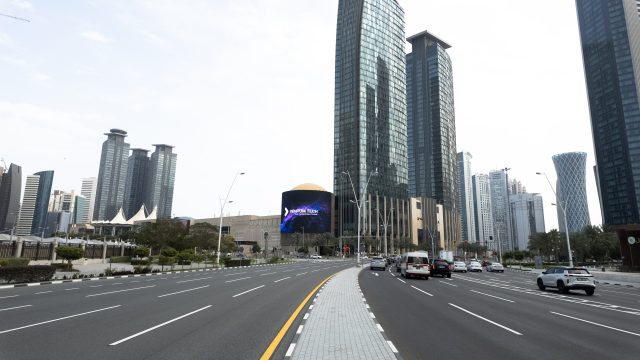
Infiled

Photo Credit © Ventum Tech

Salt Air Is the Quiet Problem

Salt is hygroscopic, meaning it absorbs and retains moisture from the surrounding air. In a coastal city like Doha, fine salt particles settle on every outdoor surface, including the front face and rear vents of LED cabinets. Even on apparently dry days, salt deposits hold moisture against electronics, creating conditions for electrochemical migration and corrosion of solder joints. ASTM B117 salt fog testing was developed specifically to simulate this environment in accelerated form, and is widely used to qualify components for coastal deployment.

This matters because conventional IP65 testing does not address salt corrosion. A panel can be fully dust-tight and rated against water jets while still failing within a few years on a coastal site, because the failure mechanism is not water ingress but slow chemical degradation of internal components. Buyers in Qatar should treat salt resistance as a separate specification from IP rating, and ask suppliers explicitly how their products are protected: typically through conformal PCB coatings, sealed power supply housings, corrosion-resistant fasteners, and cabinet materials selected for marine-grade durability.

How Coastal Conditions Shape Practical Performance

Three performance characteristics drift faster in coastal climates than spec sheets suggest.

Brightness uniformity is the most visible. Individual LED packages age at slightly different rates, and corrosion or moisture exposure accelerates the divergence. After two to three years on a coastal site, a panel that was uniform at commissioning can show subtle bands or patches of brightness variation. Regular calibration helps, but calibration cannot fully compensate for hardware-level drift in degraded components.

Colour stability is the second. The red, green and blue emitters in an LED package age at different rates, and elevated temperatures accelerate the shift. In Qatar’s climate, where panel surface temperatures regularly exceed 60 degrees in summer, colour drift over time is greater than in moderate climates. Displays that looked neutral on installation can develop a warm or cool cast within three to five years.

Reflectivity is the third and least discussed. The Gulf sun produces extreme ambient glare on outdoor displays, particularly on south and west-facing sites. Panel surface treatments that look matte indoors can become measurably reflective under direct sun, reducing perceived contrast. High-quality outdoor panels use front mask materials and surface treatments engineered specifically to suppress reflection at high angles of incidence.

Practical Decisions for Qatari Buyers

Qatar’s outdoor LED market matured rapidly around the 2022 World Cup, and many of those installations are now entering their fifth or sixth year of service. Operators in the Qatari market have shared two consistent observations. First, displays specified for permanent coastal install need engineering choices closer to industrial outdoor equipment than to conventional billboard LED. Coastal-specific design choices such as COB packaging, three-proof PCB coatings, immersion-gold plating, and die-cast aluminium cabinets significantly outperform standard outdoor designs over time.

Second, lifecycle planning matters more than initial procurement. A panel that costs twenty percent less upfront but degrades faster will, over a six-year service life, deliver substantially less value than a more conservatively engineered alternative. Buyers should model total cost of ownership including expected derating, calibration cycles, module replacement rates and downtime costs, not just acquisition price.

Across Gulf coastal deployments, INFiLED’s installations have shown that buyers who specify against documented coastal-environment test data, rather than generic outdoor specifications, see substantially more consistent performance at five years and beyond.

Lifecycle Strategy and Local Service Support

Doha’s outdoor LED market is small enough that local service capability genuinely matters. Unlike larger markets where multiple service providers can support any major brand, Qatar’s smaller integrator and service ecosystem means that hardware choice and service support are tightly coupled. Buyers should evaluate not just the panel specification but the service network that will support it across a five to seven year service life: technician availability in Doha, spare parts inventory held locally, and engineering support response times for non-trivial faults.

INFiLED’s installations across the Gulf have consistently demonstrated that the panels which retain their performance longest are those backed by a service relationship that treats deployment as the start of a long engagement rather than the close of a transaction. For Qatari buyers procuring outdoor LED for permanent installations, the supplier conversation should cover the next five years, not just the next quarter.

Specifying for the Climate You Actually Have

Outdoor LED in Qatar should be specified against the actual operating environment, not against a generic outdoor profile. That means asking suppliers for salt-fog test data, humidity cycling results, documented thermal derating at 45 and 50 degree ambient temperatures, and clear evidence of corrosion-resistant component selection. It means choosing pixel pitch against real viewing distance rather than competing on brochure numbers, and prioritising serviceability so that the inevitable component failures over a six-year life cycle do not become extended outages.

Doha’s climate is not a problem to be solved with one rating or one feature. It is a continuous load on outdoor hardware that rewards engineering discipline at the design stage and punishes shortcuts. Buyers who understand this from the start tend to deploy displays that still look right at year five, when the displays specified on price alone are already showing their age.

User registration
Join us to download our content. It only takes a moment!

    I have read and accept the privacy policy

    This site is protected by reCAPTCHA and Google.

    It looks like you are visiting the website from
    Select your region: