Confirm

Surviving the Desert: How Heat, Dust and Humidity Reshape DOOH LED Lifespan in the UAE

02.05.2026

Outdoor LED displays in the UAE face a punishing combination that few spec sheets describe honestly. Summer surface temperatures on a Sheikh Zayed Road billboard routinely exceed sixty degrees Celsius, fine desert dust permeates the smallest gaps in any enclosure, and coastal humidity in Dubai and Abu Dhabi drives moisture deep into electronics that look perfectly dry.

Many buyers procure DOOH displays based on quoted brightness, pixel pitch and IP rating alone, and discover within eighteen months that real performance has drifted far from what the brochure promised. This article looks at how Gulf conditions actually shape outdoor LED lifespan, what specifications mislead buyers, and what to ask suppliers before signing off on a deployment.
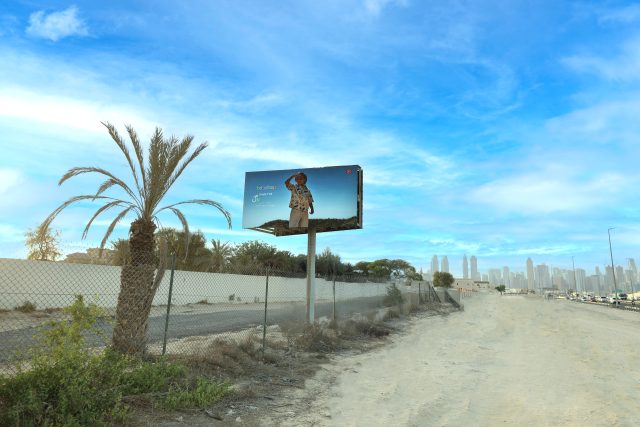
Infiled

What an IP Rating Really Tells You

Ingress Protection ratings are defined by the international standard IEC 60529, prepared by the IEC and used worldwide to grade enclosures against the intrusion of solid objects and water (see the IEC’s own overview of the standard). The first digit covers solids on a scale of zero to six, and the second covers liquids on a scale of zero to nine. An IP65 rating means the enclosure is dust tight and protected against low-pressure water jets from any direction.

This is useful information, but it is not a complete description of how a display behaves outdoors in Dubai. IP testing is conducted at controlled laboratory temperatures and humidities, often around 25 degrees Celsius. It does not address salt-laden air, ultraviolet degradation of seals, repeated thermal expansion and contraction of cabinets, or moisture vapour ingress over years of operation. A cabinet rated IP65 on day one can lose effective sealing as gaskets age in UV and gaskets compress unevenly across hot and cool cycles. Buyers should treat IP ratings as a baseline qualification, not a guarantee of long-term weatherproofing in Gulf conditions.

How Heat, Dust and Humidity Actually Degrade Outdoor LED

Three failure mechanisms dominate Gulf outdoor deployments, and they tend to compound rather than act in isolation.

Heat is the most direct enemy. LED packages, driver ICs and power supplies all derate as junction temperatures rise. Sustained operation above design temperature shortens diode life, accelerates colour shift between red, green and blue emitters, and increases the rate at which power supplies fail. Many outdoor LED installations in the UAE quietly reduce panel brightness during peak afternoon hours to protect the hardware, which means the displays are dimmest precisely when ambient light is highest.

Dust is the second factor. Fine desert particulates settle on heat sinks, restrict airflow through cooling channels and gradually coat front masks. The effect is a slow loss of effective brightness and a steady rise in internal temperature. Even a sealed cabinet relies on conducting heat out through its exterior surfaces, and a dust-coated cabinet is a less efficient radiator.

Humidity is the most underestimated. Coastal cities like Dubai, Abu Dhabi and Sharjah see overnight relative humidity routinely above eighty percent, sometimes approaching condensation point on cooler panel surfaces. Water vapour molecules are small enough to migrate through seals that block liquid water, and once inside a cabinet they drive electrochemical migration, corrosion of solder joints and progressive failure of fine-pitch components. This is one reason why coastal LED installations increasingly specify COB packaging and three-proof PCB coatings rather than relying on enclosure sealing alone.

Practical Implications for UAE Buyers

The buyer’s question is not whether a panel can survive a summer in the UAE. Most credible outdoor products will. The question is how performance degrades over a five to seven year service life, and whether the total cost of ownership justifies the upfront price.

Brightness derating matters more than headline nits. A 7,500 nit panel that throttles to 5,000 nits in July afternoons to protect its hardware is, for half the year, a 5,000 nit panel. Buyers should ask suppliers for documented thermal derating curves and request guaranteed minimum brightness under specific ambient conditions, not peak laboratory figures.

Maintenance access shapes long-term cost. Front-serviceable modules, accessible power supplies and on-site spare strategies determine whether a panel failure becomes a two-hour repair or a two-week outage. In the UAE’s high-visibility DOOH locations, downtime carries direct revenue penalties that quickly outweigh modest savings on hardware.

INFiLED’s experience deploying outdoor LED across Gulf climates has consistently shown that the products that age well share three traits: conservative thermal headroom built into the panel design, conformal coating on critical PCBs, and serviceable architectures that allow operators to maintain real-world brightness over years rather than months.

Questions to Ask Before Specifying an Outdoor LED Display

Before signing a purchase order, buyers and integrators should request more than a datasheet. Useful questions include whether the panel has been tested in cyclic salt-fog conditions per ASTM B117 or equivalent corrosion standards, what the documented colour shift is between zero and twenty thousand operating hours, how the cooling system is designed to handle ambient temperatures above fifty degrees, and what spares and service support are available locally in the UAE. Suppliers that answer these questions clearly tend to be the same ones whose installations are still performing five years later.

It is also worth asking how a manufacturer responds when an installation underperforms in the field. Outdoor LED is not a transactional product, and the suppliers worth working with for a five to seven year deployment are those who engage with on-site engineering issues rather than referring buyers back to specification compliance. The strongest engineering relationships in the Gulf market are built around honest discussion of how products behave in real conditions, including their limitations.

Power infrastructure is the consideration that buyers tend to underestimate. Outdoor LED installations in the UAE draw substantial power, particularly during peak brightness operation, and the supply infrastructure feeding them must be sized for sustained load with appropriate surge protection. Inadequate power conditioning is one of the more common causes of premature power supply failure across Gulf deployments. International electrical and protection standards provide useful guidance, but local conditions and project specifics still require engineering judgement. Across years of Gulf deployments, INFiLED has consistently found that displays specified with conservative power headroom and proper supply conditioning outperform identical hardware run on marginal infrastructure.

What Survives Lasts Because of Engineering, Not Marketing

Outdoor LED in the UAE is a system-level problem, not a panel-level one. Brightness specifications, IP ratings and pixel pitch are necessary but insufficient inputs. The displays that hold their performance across Gulf summers are those designed with conservative thermal margins, real moisture defences and serviceability built in from the start. For buyers, the most reliable path is to look past peak specifications and ask how a product is expected to behave at year three and year five. That perspective, more than any single number on a spec sheet, separates DOOH investments that pay back from those that quietly disappoint.

User registration
Join us to download our content. It only takes a moment!

    I have read and accept the privacy policy

    This site is protected by reCAPTCHA and Google.

    It looks like you are visiting the website from
    Select your region: