Confirm

Why Schools and Universities Are Replacing Projectors with LED Displays

30.04.2026

Projectors have served educational environments for decades, and for most of that time they were the only viable option for large-format shared display in a classroom or lecture hall. That context has changed substantially. LED display technology has matured to the point where direct-view panels are accessible at price points that institutional procurement budgets can justify, and the operational case for making the switch is increasingly difficult to argue against.

The resistance to that shift is usually framed as a cost objection. Projectors cost less to purchase than LED panels of equivalent display area, and that upfront gap is real. What tends to be underexamined in that comparison is what projectors cost to operate over a five-to-seven-year horizon, and what they cost in terms of lost instructional quality when ambient light conditions are poor, bulbs are aging, or maintenance cycles create downtime in active learning environments.

This article examines why the shift from projectors to LED is accelerating in education, where the operational and pedagogical arguments are strongest, and where projectors retain a legitimate case for continued use.

Infiled

Why Traditional Projectors Are Losing Relevance

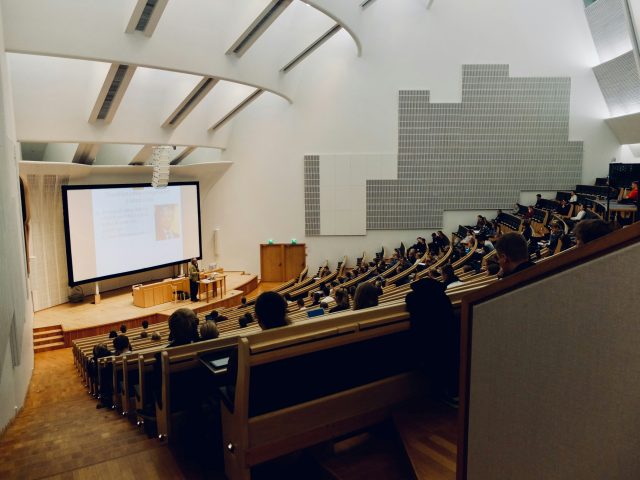
The projector’s fundamental limitation in modern educational environments is its dependence on controlled ambient light. A projector works by throwing light onto a reflective surface. The image quality degrades in direct proportion to how much competing ambient light exists in the room. In a purpose-built dark lecture theater with blackout blinds, a projector can produce a serviceable image. In a classroom with windows, overhead fluorescent lighting, and no blackout capability, the same projector delivers a washed-out image that students in more than the first few rows struggle to read clearly.

Modern school and university building design has moved away from the artificially darkened classroom model for sound educational reasons. Natural light, open layouts, and flexible room configurations improve student wellbeing and support a wider range of learning activities. Those design priorities are fundamentally incompatible with projector performance requirements.

Beyond ambient light, projectors introduce logistical friction that compounds over time. Bulbs degrade gradually, meaning image quality declines slowly rather than failing suddenly, and instructors often adapt to worsening image quality without registering it as a maintenance issue until the problem is severe. Alignment drift, fan noise that interferes with quiet study environments, and the physical limitations of fixed throw distances all constrain how rooms can be used and reconfigured.

EDUCAUSE research on learning space design consistently identifies display visibility and flexibility as top priorities for instructors, and projector systems frequently score poorly on both dimensions in post-occupancy evaluations of educational facilities.


Infiled

Projector delivers a washed-out image that students in more than the first few rows struggle to read clearly.

Brightness and Visibility Advantages of LED

Direct-view LED displays produce their own light rather than reflecting a projected source. This fundamental difference means that ambient light is not an adversary to image quality but an irrelevant variable. A well-specified LED panel configured for an educational environment will deliver consistent, legible image quality under full overhead lighting, in rooms with uncovered windows, and in gymnasium or cafeteria spaces where ambient conditions are effectively uncontrollable.

For educational content specifically, the visibility benefit is not primarily about brightness in absolute terms. It is about contrast and legibility under variable conditions. Text-heavy content, which constitutes the majority of what is displayed in classrooms, depends on clean contrast between foreground characters and background fields. LED panels maintain that contrast across a wide range of ambient conditions. Projectors do not.

The brightness specification relevant to educational LED installations typically falls between 400 and 1,200 nits, depending on room size, ambient light levels, and the distance of the farthest viewer from the screen. This is substantially lower than the peak brightness capability of most LED hardware, which means panels can be run at a comfortable fraction of their maximum output, extending hardware lifespan and reducing energy draw simultaneously.

Pixel pitch selection for educational environments is generally less demanding than for virtual production or broadcast applications. For classrooms and lecture halls where the nearest viewer is unlikely to be within two meters of the screen surface, a pixel pitch between 1.5mm and 2.5mm typically provides resolution that exceeds what any viewer in the room can resolve at their seated distance.

Larger auditorium or multi-purpose hall installations at greater viewing distances can use pitches in the 2.5mm to 4mm range without visible quality compromise.

Infiled

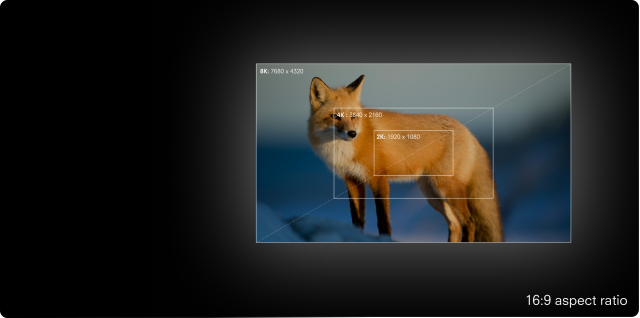
WT Series is INFiLED’s most precise indoor fine-pitch display — available from 0.78 mm pixel pitch. True 16:9 aspect ratio supports seamless 2K, 4K, 8K, and 16K builds without aspect ratio distortion.

Lower Maintenance and Longer Lifespan

The maintenance profile of LED displays compared to projectors is one of the clearest operational advantages, and one that is often underweighted in initial procurement comparisons because it manifests over time rather than at point of purchase.

A typical projector lamp has a rated lifespan of 3,000 to 5,000 hours under standard brightness settings, with brightness degrading measurably before the rated end of life. In a school environment where a projector operates for six hours per day across a forty-week academic year, a lamp will require replacement every two to three years. Lamp costs for institutional projectors typically range from $150 to $400 per unit, and replacement requires either internal technical staff or a service call. Across a campus with fifty or one hundred projectors, lamp replacement becomes a recurring budget line that is easy to underestimate at the time of original procurement.

LED display hardware carries no consumable components that degrade on a fixed schedule. The LED elements themselves are rated for 50,000 to 100,000 hours of operation before reaching half of their original brightness, which under the same six-hours-per-day academic year usage pattern represents twenty to forty years of functional operation. Practical institutional replacement cycles are typically driven by technology generation changes rather than hardware failure.

Filter cleaning, alignment recalibration, and lamp inventory management disappear as operational requirements. For facilities management teams in school districts or university estates managing large numbers of display devices, that reduction in maintenance overhead has concrete staff time and budget value that does not appear in hardware specification comparisons.

Infiled

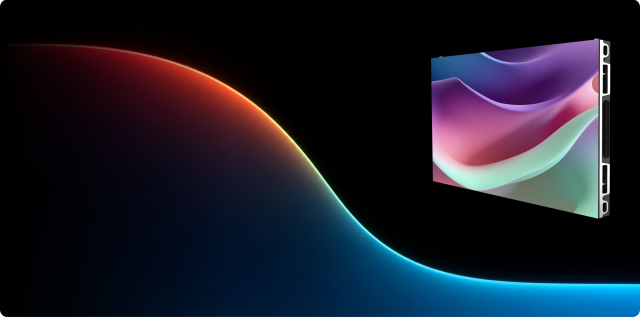
Powered by ColdLED Technology, the WT Series delivers lower power consumption and an extended lifespan beyond industry standards.

Use Cases in Schools and Universities

The case for LED in educational environments is not uniform across all use cases. Some applications produce a clearly superior outcome compared to projectors. Others are more situational.

Classrooms with fixed seating and a defined primary display wall represent the strongest use case. A wall-mounted LED panel in this configuration replaces the projector and screen infrastructure entirely, requires no alignment, produces no fan noise, and eliminates the sightline interruptions that ceiling-mounted projectors sometimes create in rooms with lower ceilings or obstructing ceiling elements.

Lecture theaters with large audiences and long throw distances benefit from LED’s brightness consistency across the full viewing area. Projectors in large lecture environments often require very high-lumen units to serve rear seats adequately, and those units carry proportionally higher lamp costs and greater noise output from cooling systems.

Multi-purpose halls, cafeterias, and gymnasia represent an environment where projectors have historically been particularly poorly suited, because the ambient light, surface inconsistency, and variable room configurations make it nearly impossible to maintain consistent image quality. LED panels like INFiLED’s WP Series installed in these spaces provide reliable display capability regardless of how the room is being used.

Infiled

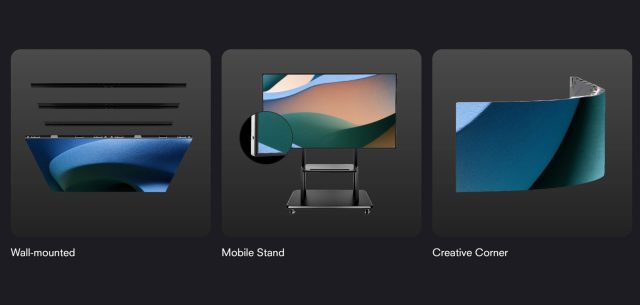
INFiLED’s WP Series delivers premium fine-pitch LED performance up to 8K, with flexible installation options—regardless of how the room is being used.

Library and collaborative learning spaces are a growing application where smaller LED panels in 2:1 or 21:9 aspect ratios support group work sessions and presentations without the setup friction of a projected environment.

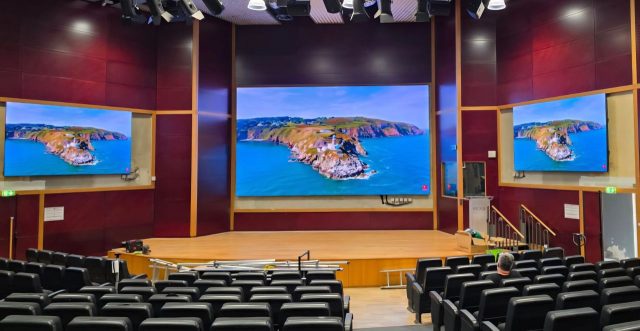
INFiLED has supported educational campus installations across these use case categories, for example the one as shown below in KEDGE Business School in France. With the consistent observation that faculty adoption rates increase significantly when the display technology removes barriers rather than creating them. A panel that turns on instantly, requires no warmup, and delivers a legible image without room preparation changes instructor behavior in ways that benefit students directly.

Infiled

WT Series at KEDGE Business School Marseille

Total Cost of Ownership Comparison

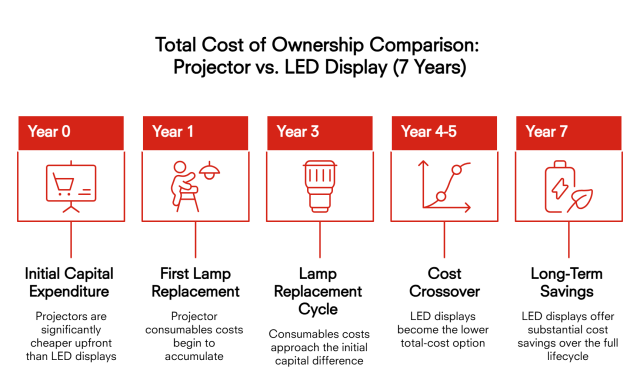
A rigorous total cost of ownership comparison between projector and LED display systems over a seven-year horizon typically involves four cost categories: initial capital expenditure, lamp and consumables replacement, maintenance labor, and energy consumption.

Infiled

Capital expenditure favors projectors at the point of purchase, with the gap varying significantly by display size and LED panel specification. For a classroom requiring a 2.5-meter-wide display surface, a commercial-grade projector and screen combination may cost 40 to 60 percent of what a comparable LED panel installation costs upfront.

Lamp and consumables replacement begins narrowing that gap from the first replacement cycle onward. At three lamp replacements over seven years across a large campus installation, the consumables cost alone begins to approach or exceed the original capital cost difference.

Energy consumption data consistently shows LED displays operating at lower wattage than projectors producing equivalent lumen output, with the difference becoming more pronounced as projector lamps age and require higher drive current to maintain rated brightness.

Maintenance labor costs are the most variable factor and the most institution-specific. Districts and universities that have quantified their internal AV support costs consistently find that projector infrastructure consumes disproportionate staff time relative to LED infrastructure.

By year four or five of a deployment, the total cost curves for projector and LED systems typically cross, and LED becomes the lower total-cost option for the remainder of the operational life of the hardware.

When Projectors Still Make Sense

Intellectual honesty in this comparison requires acknowledging the use cases where projectors remain the practical choice.

Very large throw distances in purpose-built auditoriums or performing arts spaces, where the display surface spans twelve meters or more, present an engineering challenge for direct-view LED that projection can address at lower cost. At extreme display sizes, the panel count, structural requirements, and cabling infrastructure of LED installations can make projection economically competitive even on a total cost basis.

Portable and temporary applications where display hardware must be transported, set up, and broken down frequently still favor projectors for their compact form factor. A single projector and a tensioned screen can be deployed by one person in minutes. A portable LED panel system of comparable display area requires substantially more labor and handling infrastructure.

Budget-constrained new installations in spaces with adequate ambient light control remain a context where projector systems allow institutions to deploy display capability across more rooms within a fixed capital budget, accepting the ongoing operational costs as a known trade-off.

The key discipline in making this decision is applying it room by room and use case by use case rather than adopting a single institutional policy. The environments where LED delivers clear operational and pedagogical advantages are well defined. So are the environments where projectors remain viable. The institutions that achieve the best outcomes are those that evaluate each space on its own terms rather than defaulting to either technology across the board.

User registration
Join us to download our content. It only takes a moment!

    I have read and accept the privacy policy

    This site is protected by reCAPTCHA and Google.

    It looks like you are visiting the website from
    Select your region: