Confirm

Fine-Pitch LED for Conferences and Trade Shows: When 1.5mm Is Worth It and When It Isn’t

07.09.2026

The instinct on almost every LED spec sheet is that a smaller pixel pitch is simply better, sharper, more premium. For a conference or trade show wall, that instinct leads buyers toward the finest pitch on the price list even when the room, the audience and the budget do not call for it.

Fine-pitch LED, generally under about 2.5mm, exists to serve close viewing and camera work well. Whether 1.5mm specifically is worth it for a given event depends on how close people will actually stand, whether a camera is involved, and what a step up in resolution costs against a step down.

By the end of this article you will know how viewing distance and camera use should actually drive a pixel pitch decision, and when 1.5mm earns its price over 1.9mm or 2.6mm.

Visitors looking closely at fine-pitch LED screens on the INFiLED booth at InfoComm 2025 in Orlando

What Pixel Pitch Actually Controls

Pixel pitch is the distance between the centers of two adjacent LEDs, measured in millimeters. A smaller number means pixels sit closer together, which raises pixel density and lets a viewer stand closer before individual pixels become visible.

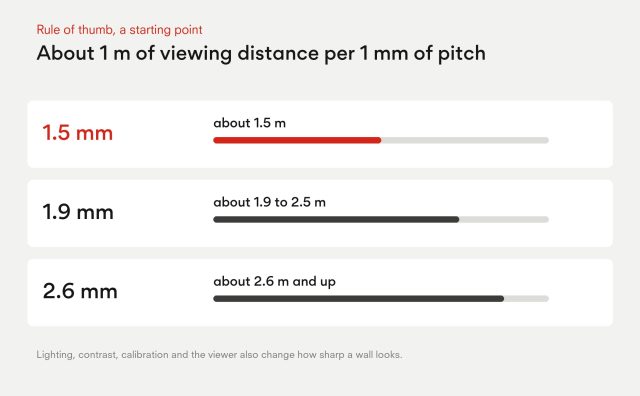
The common rule of thumb is roughly one meter of viewing distance for every one millimeter of pixel pitch, so a 1.5mm fine-pitch LED wall is comfortable from about 1.5 meters, while a 2.6mm wall wants closer to 2.6 meters or more. That rule is a useful starting point, not a hard boundary. Human visual acuity research shows the eye’s actual resolution limit depends on lighting, contrast and the individual viewer, which is why the same pitch can look crisp to one person and slightly soft to another standing at the same spot. Brightness, color accuracy and calibration all affect perceived sharpness too, so pixel pitch is one input into image quality, not the whole answer.

Rule of thumb of about 1 m of viewing distance per 1 mm of pixel pitch: 1.5 mm about 1.5 m, 1.9 mm about 1.9 to 2.5 m, 2.6 mm about 2.6 m and up.

Booth, Keynote Room, or Camera: Three Different Answers

The right pixel pitch changes with the room, and conferences and trade shows genuinely contain three different viewing situations under one event badge.

At a trade show booth, visitors stand one to three meters from the wall, often closer, which puts real pressure on pixel pitch. This is where 1.5mm fine-pitch LED for conferences and trade shows tends to justify its cost, because attendees are close enough to notice pixelation on a coarser pitch within seconds. A seated keynote room is a different problem entirely. Audiences there sit eight meters back or more, well beyond where 1.9mm or even 2.6mm would show any pixel structure, so paying for 1.5mm in that room buys resolution nobody in the seats can use.

Camera use changes the calculation again, independent of how close the live audience stands. IMAG and livestream feeds put a lens closer to the wall, in effect, than any human eye, and that is where refresh rate matters as much as pitch. A screen running at 7,680 Hz, the refresh rate INFiLED specifies across its fine-pitch rental range, stays flicker-free on camera, avoiding the scan lines and moiré patterns that lower refresh rates can introduce, an issue broadcast engineers have to design around directly whenever an LED wall sits in frame. A finer pitch generally helps camera reproduction too, but a high refresh rate with a moderate pitch can outperform a fine pitch running at a lower refresh rate once a camera is involved.

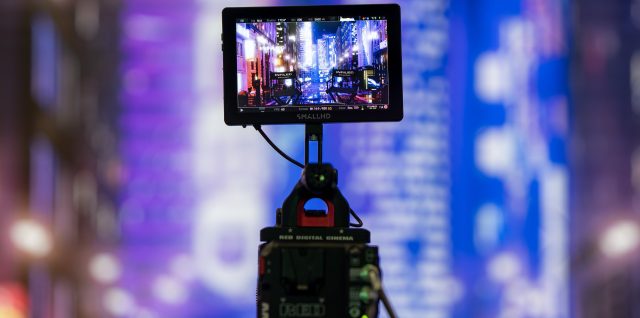
A cinema camera filming an LED wall on the INFiLED booth at NAB Show 2025

The Cost Side of the Decision

Cost per square meter rises as pixel pitch drops, and the gap between 1.5mm and 2.6mm on a large wall is not trivial. That is where the actual trade-off lives for most buyers.

For a booth or stand-sized wall, the area is usually small enough that the price difference between pitches is manageable, and the visual payoff is immediate since attendees are close. For a large keynote backdrop, the same price difference multiplied across a much larger surface can be substantial, and it buys resolution the room’s seating never uses. The practical guidance from AVIXA and other industry resources on choosing the right pixel pitch consistently comes back to matching pitch to minimum viewing distance first, then adjusting for camera needs, rather than defaulting to the finest pitch available and working backward.

1.5mm vs 1.9mm vs 2.6mm at a Glance

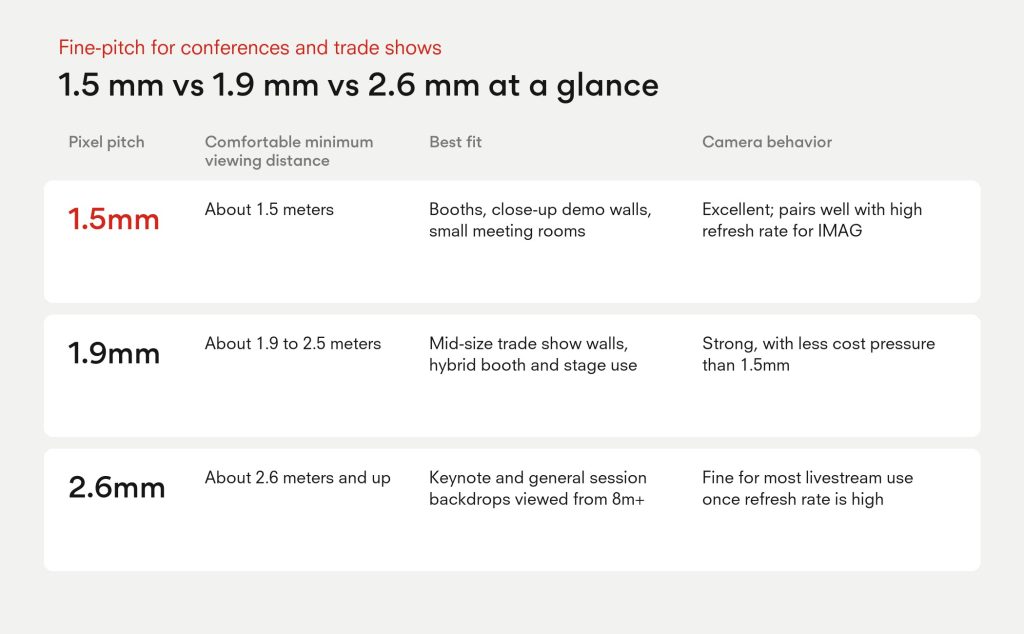
1.5 mm: about 1.5 m, booths and small meeting rooms, excellent on camera. 1.9 mm: about 1.9 to 2.5 m, mid-size trade show walls, strong on camera. 2.6 mm: about 2.6 m and up, keynote backdrops viewed from 8 m or more, fine for livestream with high refresh rate.
This is also the answer to two of the more common questions buyers ask. Is 2.6 pixel pitch good? For a seated keynote audience, yes, since the room’s own viewing distance makes finer pitch unnecessary. Is higher or lower pixel pitch always better? No; lower pitch only pays off when viewers or cameras are genuinely close enough to need it.

Matching the Wall to the Room, Not the Spec Sheet

Choosing between fine-pitch LED for conferences and trade shows is really a question of matching pixel pitch to how close people, and cameras, will actually get. A 1.5mm wall earns its premium at booth distance and under close-up camera work. A 1.9mm or 2.6mm wall often delivers the same experience for a keynote audience at a lower cost, without sacrificing anything the room could actually see.

INFiLED builds its EZmk2 fine-pitch rental LED panels across 1.5mm, 1.9mm and 2.6mm precisely because no single pitch serves every room on an event floor. Our earlier guide to how pixel pitch affects viewing distance, cost and image quality covers the underlying specification in more depth; for a conference or trade show specifically, it still comes down to the same question: pick the pitch the room and the camera actually need, and spend the difference where it will be seen.

User registration
Join us to download our content. It only takes a moment!

    I have read and accept the privacy policy

    This site is protected by reCAPTCHA and Google.

    It looks like you are visiting the website from
    Select your region: