Confirm

LED Bars vs LED Mesh vs Video Wall: Choosing the Right Format for Media Façades

16.09.2026

Most media facade projects start with the wrong question. Teams compare pixel pitch and brightness figures when the real question is what the building will tolerate: daylight, wind, added weight, the view from inside and the planning approval process. Bars, mesh and solid video walls can all turn a building into a display, yet they behave very differently once they are bolted to a real structure.

A common myth is that a solid video wall is the default choice and the other two formats are compromises. On glazed, open or heritage structures, the opposite is often true. This guide compares the three formats by the factors that actually decide a project, so you can choose a format before you commit to a specification.
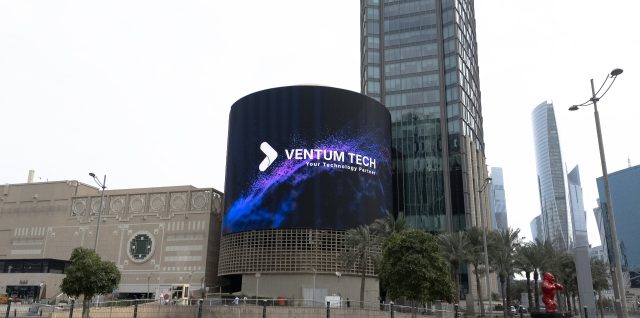
INFiLED MVmk2 Series curved LED screen on a building facade in Doha

Photo: Ventum Tech.

What Each Format Really Is

A media facade is a building envelope that carries dynamic light or video as part of its surface. The three main LED routes to get there are different tools for different jobs.

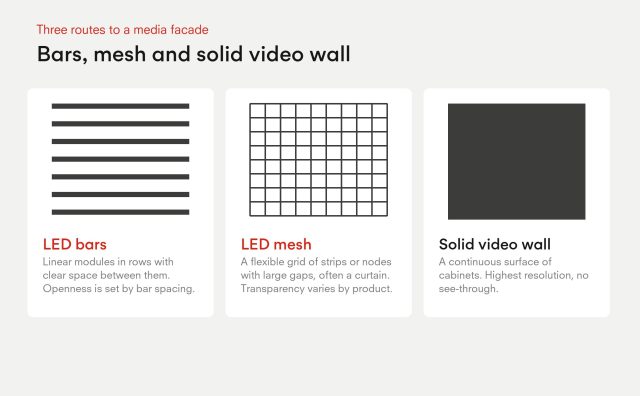
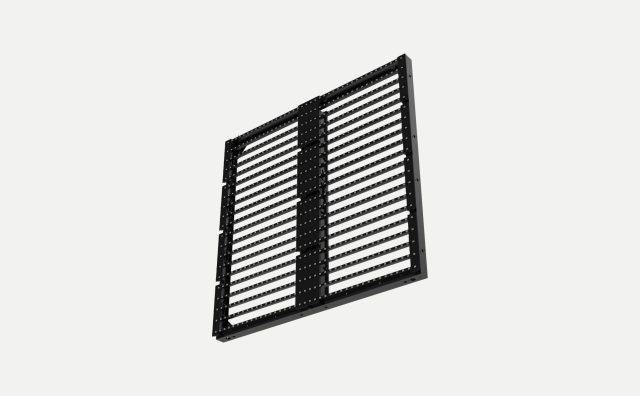
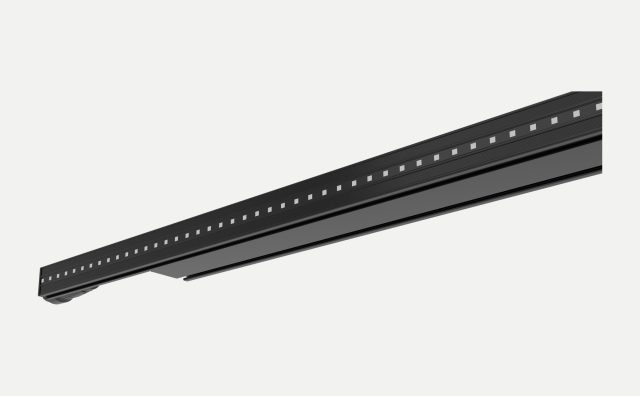
LED bars are linear modules mounted in rows, with clear space between them. The image is built from lines rather than a continuous surface, which is why bar systems suit graphics, gradients and abstract motion better than fine detail. Openness is set by how far apart the bars are spaced, so the same product can be dense or airy.

LED mesh is a flexible grid of LED strips or nodes with large gaps between them, often forming a curtain. Manufacturers quote transparency figures that range widely by product. The near-transparent LED mesh at Barclays Center is quoted at up to 90% transparency at 8,000 nits, while the stainless steel Mediamesh system from GKD is specified at up to 60%. Always ask which figure applies to the exact pixel pitch you plan to use.

A solid video wall is a continuous surface of LED cabinets with no see-through. It delivers the highest resolution and the best image continuity, and it blocks anything behind it.

INFiLED engineers see the same confusion again and again: buyers treat transparency and resolution as independent, when in practice they trade against each other.

Three media facade formats: LED bars are linear modules in rows with clear space between them; LED mesh is a flexible grid of strips or nodes with large gaps; a solid video wall is a continuous surface of cabinets with no see-through.

How the Three Formats Behave on a Real Building

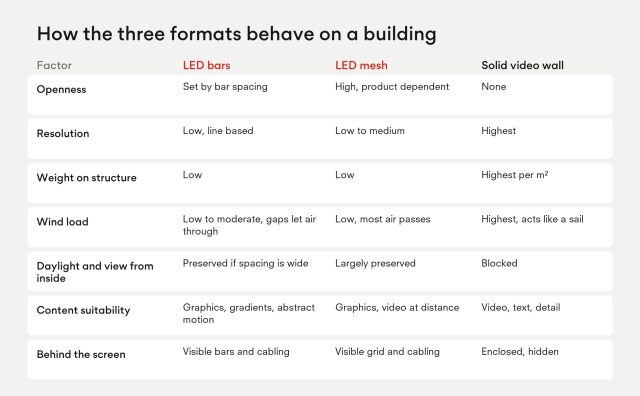
Specifications describe a panel. A media facade is a system that includes the structure, the weather, the occupants and the neighbours. The table below compares the factors that most often change the decision.

Comparison of LED bars, LED mesh and solid video wall: openness, resolution, weight on structure, wind load, daylight and view from inside, content suitability and what is seen behind the screen.

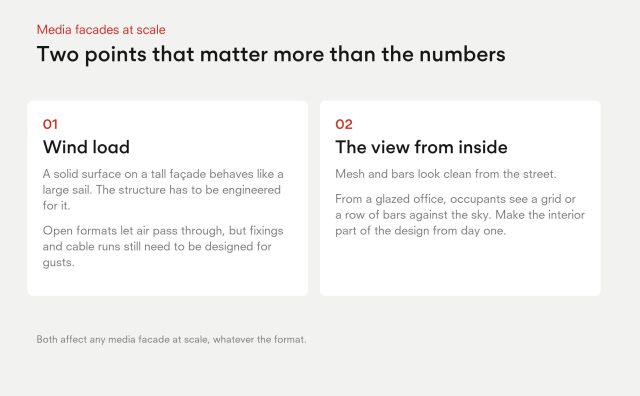
Two points in this table deserve more attention than the numbers, and both affect any media facade at scale.

First, wind load. A solid surface on a tall façade behaves like a large sail, and the supporting structure has to be engineered for it. Open formats let air pass through, which reduces load on the structure, though the fixings and cable runs still need to be designed for gusts. As the 3cinno overview of media facade challenges notes, wind resistance becomes critical at height, alongside waterproofing, temperature range and UV exposure.

Second, the view from inside. Mesh and bars look clean from the street, but the rear is a different story. Occupants of a glazed office will see a grid or row of bars against the sky, so the interior experience must be part of the design conversation from day one.

Practical Implications for Cost, Planning and Maintenance

People often ask how much a media facade costs. There is no honest single number, because the display is only part of the budget. Structure, cabling, power, control, installation access and content production can equal or exceed the hardware cost. What can be said is that solid walls cost the most per m² covered, while bars and mesh cost less per m² of facade because they cover less of it. Cost per visible pixel is a different comparison and can favour the solid wall. Ask for both figures.

Planning constraints also differ. Open formats generally meet less resistance from building owners and authorities because they preserve daylight and views, and can reduce the visual mass added to a heritage or glazed building. Solid walls often need stronger justification and may face brightness and advertising rules. Local rules vary, so check them early.

Maintenance access can quietly decide the winner. On a tall façade, every service visit means rope access or a lift. Formats with tool-free replacement, certified long cable runs and per-unit weights a single technician can handle reduce that cost over the life of the project. INFiLED’s experience across rental and fixed projects suggests that serviceability is often under-weighted at the specification stage and over-weighted after the first winter.

Which Format Fits Which Building

Glazed offices and towers: bars or mesh

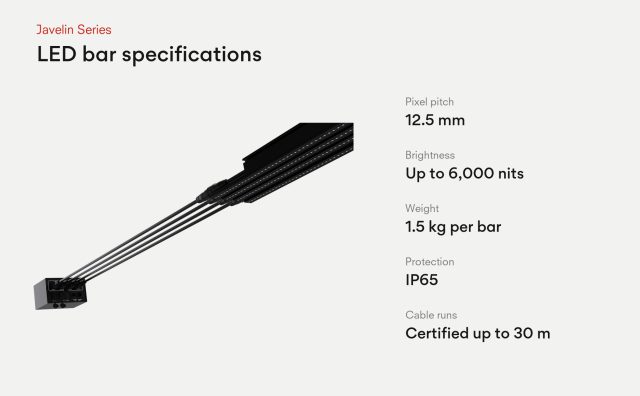
When occupants need daylight and outward views, open formats are usually the right answer. Bars work well where the goal is architectural rhythm and bold motion. Mesh suits larger surfaces that need more image content. The Javelin LED bar system is an example of the linear approach: 12.5mm pitch, up to 6,000 nits for daylight visibility, 1.5 kg per bar, IP65 and certified cable runs up to 30 m, which keeps structural loads and installation effort modest.

Parking structures and stadiums: mesh

Structures that already have open sections, ventilation requirements or large spans suit flexible mesh, because it drapes over the existing frame and lets air and light through. A related option is the MV Mesh series for fixed installations.

Retail podiums and advertising faces: solid video wall

Where the brief is high-resolution advertising, brand video or readable text, and there is nothing behind the display that needs light or a view, a solid video wall is the right tool. Its weight and wind load are the price of image quality. For a broader look at facade engineering, see the existing guide to architectural LED facades.

Choosing the Format Before the Specification

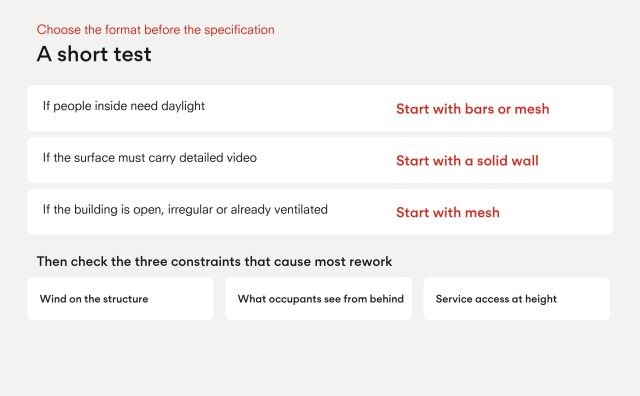
The format decision for any media facade should come first, because it sets everything downstream: structure, permits, content style and service plan. A short test works well. If people inside need daylight, start with bars or mesh. If the surface must carry detailed video, start with a solid wall. If the building is open, irregular or already ventilated, start with mesh.

Then check the three constraints that cause most rework: wind on the structure, what occupants see from behind, and how the display will be serviced at height. A format that satisfies those three is usually one the project can live with for years. INFiLED treats that as a more useful measure than any single specification, because a media facade is judged on the building it sits on, not on a datasheet.

A short test for choosing a media facade format: if people inside need daylight start with bars or mesh; if the surface must carry detailed video start with a solid wall; if the building is open, irregular or ventilated start with mesh. Then check wind, the view from behind and service access at height.
User registration
Join us to download our content. It only takes a moment!

    I have read and accept the privacy policy

    This site is protected by reCAPTCHA and Google.

    It looks like you are visiting the website from
    Select your region: