Confirm

What It Really Costs to Run a Digital Billboard 24/7 (and Where the Energy Goes)

14.09.2026

Most articles about digital billboard cost stop at the purchase price. The bill that arrives every month afterwards gets far less attention, even though a screen that runs around the clock for a decade spends a meaningful share of its lifetime budget on electricity, service and monitoring.

The most common mistake is reading LED billboard power consumption straight off the maximum figure on a specification sheet. That number describes a worst case that a real screen almost never reaches, so using it produces a running cost that is several times too high. Ignoring power altogether produces the opposite error.

This article separates typical from maximum LED billboard power consumption, walks through a worked 24/7 example, and looks at the rest of the operating cost stack so buyers can plan with realistic numbers.
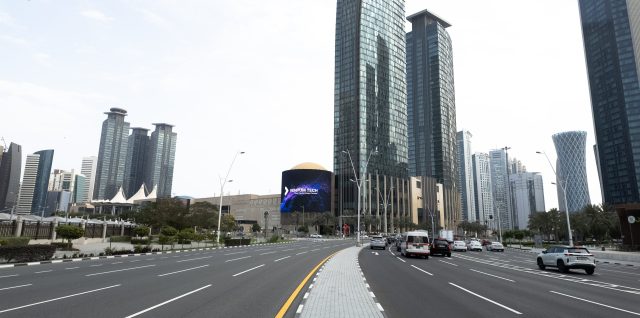
INFiLED MVmk2 Series curved outdoor LED screen beside a road in Doha

MVmk2 Series on a roadside in Doha. Photo: Ventum Tech.

Typical vs Maximum Power: The Most Misunderstood Spec

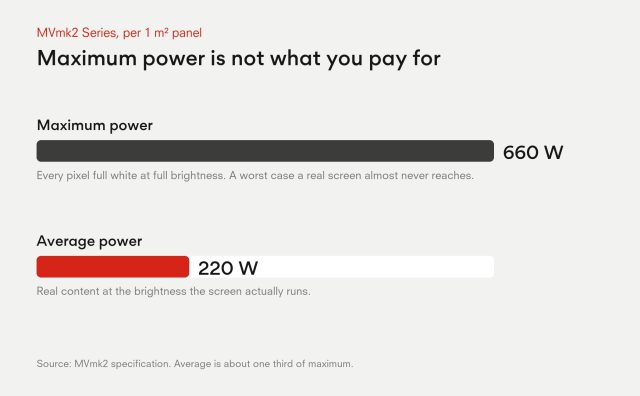
Maximum power is the draw when every pixel shows full white at full brightness. Typical or average power is what the screen draws while showing real content at the brightness it actually runs. The gap between them is large because most creative content contains darker areas, and because a well-managed screen spends much of the day below its peak.

Published studies show how wide the spread in LED billboard power consumption can be. A California ETCC digital billboard energy report from 2014 studied 14 × 48 ft billboards and estimated annual use between 29,000 and 94,000 kWh depending on product efficiency and operating conditions, with roughly 16 to 20 W per square foot and a full-sign draw near 15 kW. Its analysis assumed full brightness in daylight and about 40 percent at night, and it identified power reductions of up to 85 percent between the best and worst products.

Industry commentary sits lower. Billboard Insider’s response to critics puts a 14 × 48 ft digital face at about 24,000 kWh a year and argues that a widely quoted figure of 162,902 kWh was badly overstated. The two sources disagree because they assume different products, brightness and content, which is exactly the point. LED billboard power consumption is not a fixed number. It is the result of hardware efficiency, brightness settings and content, and each of those is a decision.

Both sources are also more than a decade old, so treat them as a “then” rather than a benchmark for current hardware.

MVmk2 Series power per 1 m2 panel: maximum power 660 W, average power 220 W, about one third of maximum.

A Worked 24/7 Example

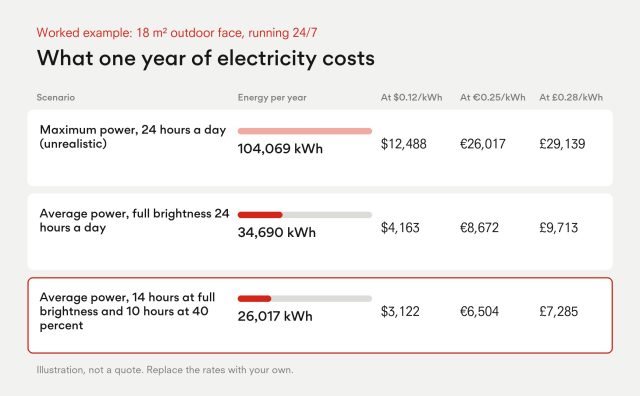
Consider an 18 m² outdoor face built from 1 m² cabinets. INFiLED’s MVmk2 specification lists a maximum power of 660 W and an average power of 220 W per panel. The calculation below uses those figures as a planning basis, assumes average power scales with brightness, and ignores fixed loads such as cooling and control electronics, so it is an illustration, not a quote.

Annual electricity for an 18 m2 outdoor face running 24/7: maximum power 104,069 kWh ($12,488, €26,017, £29,139); average power at full brightness 34,690 kWh ($4,163, €8,672, £9,713); average power with 10 hours at 40 percent 26,017 kWh ($3,122, €6,504, £7,285).

The first row is why maximum power is the wrong basis for a budget: it overstates running cost by roughly three times. The last row shows the effect of a simple dimming schedule, which cuts about 25 percent from the second row without changing the hardware. Electricity prices vary widely by market and contract, so replace the rates with your own before using the numbers.

Beyond Electricity: The Rest of the Operating Cost Stack

Energy is only one line. A fair running-cost model also includes several items that specifications rarely show.

  • Where heat has to be moved out of a cabinet or enclosure, fans or air conditioning add to the electricity bill and to the maintenance list. Efficient panels reduce this load at source, because power not drawn does not have to be removed as heat.
  • Service visits. Every visit to a screen carries technician time, travel, access equipment and sometimes traffic management. Faster repairs mean shorter visits.
  • Module swaps and spares. The cost of a repair depends on how long it takes and what it needs. A design where modules release and lock without tools, such as the 10-second swap on the MVmk2, shortens the time on site, and spare modules are a small stock item rather than a full cabinet.
  • Remote monitoring tells operators about a failing module or power supply before the advertiser notices. A cloud-based display management system replaces some visits with a diagnosis and sends the technician only when a part is needed.
  • Insurance and connectivity. Smaller line items, but they recur every year.

Truck rolls are the hidden multiplier. A screen with no remote visibility can lose days of advertising revenue while someone drives out to find the fault, and the cost of the lost airtime often exceeds the cost of the repair.

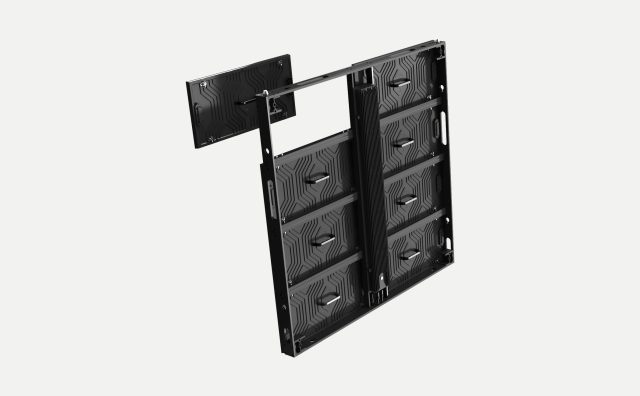
INFiLED MVmk2 Series outdoor LED cabinet with one module removed

MVmk2 Series cabinet with a module removed.

Design Choices That Reduce LED Billboard Power Consumption and Cost

Several choices made before installation change running cost for the life of the screen.

  1. Set a brightness schedule and ambient sensor from the start. Daytime and night-time limits, discussed in the companion article on billboard brightness, reduce both power and complaints. Seoul’s 2026 brightness rules are expected by city officials, according to invidis, to cut energy costs to roughly 85 percent of previous levels on average.
  2. Choose efficient hardware. A newer generation with lower power per square metre, such as the 16 percent reduction INFiLED reports for MVmk2 against the previous MV generation, applies on top of any schedule. On the 18 m² example that is about 5,000 kWh a year, or roughly €1,240 at €0.25.
  3. Design for serviceability. Front or rear access, toolless modules and easy spares all reduce the labour part of the bill.
  4. Monitor remotely. Alerts and remote power cycling cut unnecessary site visits.
  5. Think in total cost. The total cost of ownership of LED displays is the right frame, because an efficient screen that is hard to service can cost more than a slightly less efficient one that is easy to keep alive.

Buyers comparing energy-efficient outdoor LED screens should ask for average power at a defined brightness and content assumption, not just the maximum.

Are Digital Billboards Worth the Running Cost?

Whether a screen is worth it depends on revenue per slot against the full cost stack, and LED billboard power consumption is only one part of it, and the running cost is usually the smaller and more predictable side of that equation. A commonly quoted LED rating of 100,000 hours to half brightness equals more than eleven years of continuous operation, but real lifespan depends on brightness settings and thermal management, so a dimming plan protects both the power bill and the investment.

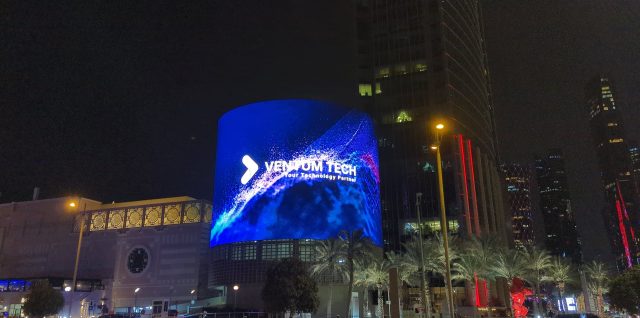
INFiLED MVmk2 Series curved outdoor LED screen in Doha at night

MVmk2 Series in Doha at night. Photo: Ventum Tech.

Plan the Bill You Will Actually Pay

Running a digital billboard around the clock is affordable when the budget starts from realistic LED billboard power consumption, includes the whole operating stack and reflects decisions about dimming, serviceability and monitoring. The worst budgets copy the maximum power figure or ignore the spread between products.

INFiLED’s approach to outdoor screens treats power, serviceability and remote visibility as one design problem, because the cheapest screen to run is the one that rarely needs a visit and never draws more power than the content requires.

User registration
Join us to download our content. It only takes a moment!

    I have read and accept the privacy policy

    This site is protected by reCAPTCHA and Google.

    It looks like you are visiting the website from
    Select your region: