Confirm

How Bright Should an Outdoor LED Billboard Be? Nits, Sunlight and Night-Time Dimming

11.09.2026

Brightness is the number buyers compare first and understand least. A higher nit rating looks like a safer purchase, so specifications drift upward until the screen is bright enough for a desert at noon and blinding on a city street after dark.

The real question is not how bright a screen can go, but how bright it needs to be at each hour of the day. Outdoor LED billboard brightness is a range that changes with sunlight, orientation, viewing distance and local rules. Overspend at the top of that range and you pay for it in power, heat and lifespan. Underspend and the content washes out exactly when the audience is largest.

This article explains how to size outdoor LED billboard brightness for daylight, how night-time limits work, and how to avoid buying capability you cannot legally or sensibly use.
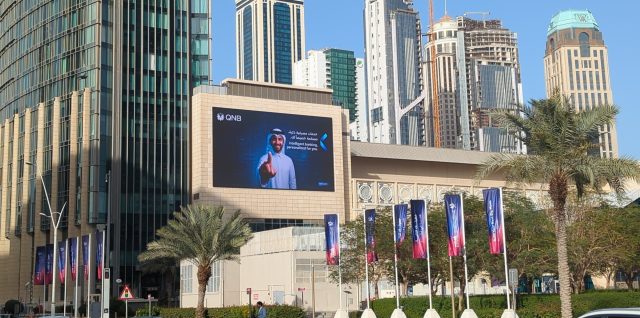
INFiLED MVmk2 Series outdoor LED screen on a building in Doha in daylight

MVmk2 Series in Doha. Photo: Ventum Tech.

What Nits Measure and Why Sunlight Sets the Bar

A nit is one candela per square metre, the amount of light a surface emits toward the viewer. Regulators in some regions write the same unit as cd/m². When people ask what nits mean on a display, this is the answer, and it applies equally to a phone and a 100 m² billboard.

The sun explains why the numbers are so high. The solar disc is commonly cited at around 1.6 billion nits, but a billboard never competes with that directly. It competes with the sunlight that lands on its face and the bright sky behind it. That ambient light reflects off the LED surface and lowers contrast, so the screen must emit enough light for the image to stay clearly above the wash of reflected daylight.

This is also why indoor and consumer figures mislead. Consumer outdoor TV guides talk about roughly 1,500 to 3,000 nits for full sun, but those screens are watched from a patio at a few metres. A billboard is read at tens of metres, on fast-changing content, often against a bright sky.

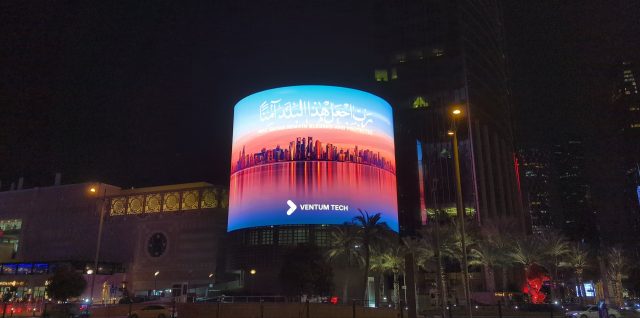
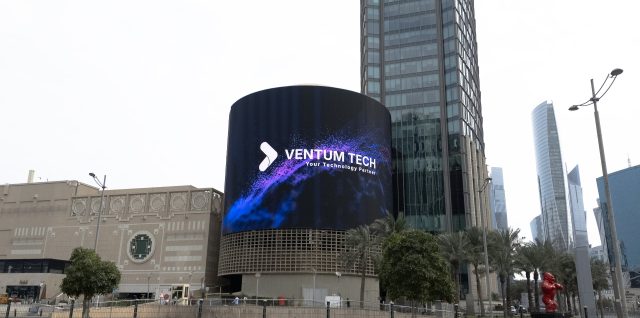
INFiLED MVmk2 Series curved outdoor LED screen on a building facade in Doha

MVmk2 Series on a curved façade in Doha. Photo: Ventum Tech.

How Bright Is Enough in Real Locations

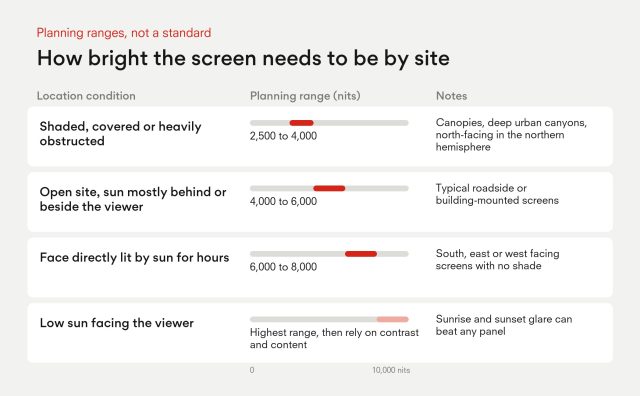
Daylight need depends on how much sun reaches the screen and where the viewer stands, so outdoor LED billboard brightness has to be set site by site. The ranges below are planning figures based on common industry practice, not a standard, and a site survey should confirm them.

Outdoor LED billboard brightness planning ranges: shaded, covered or heavily obstructed sites 2,500 to 4,000 nits; open sites with the sun behind or beside the viewer 4,000 to 6,000 nits; faces directly lit by sun for hours 6,000 to 8,000 nits; low sun facing the viewer needs the highest range plus contrast and content.

Planning brightness ranges by site condition.

Two points matter more than the table. First, orientation and shading change the requirement by a factor of two or more, so the same model does not need the same brightness at every site. Second, the top of the range is a ceiling, not a target. A screen rated for 10,000 nits peak gives headroom on the hardest sites, but most locations will run well below it for most of the day.

Content matters too. High-contrast content with dark backgrounds and bold type stays legible at lower luminance. Pale, low-contrast creative fails first in sunlight.

Night-Time Dimming and What the Rules Say

The opposite problem happens after dark. At 6,000 nits a screen is uncomfortable to look at in a dark street and often exceeds local limits.

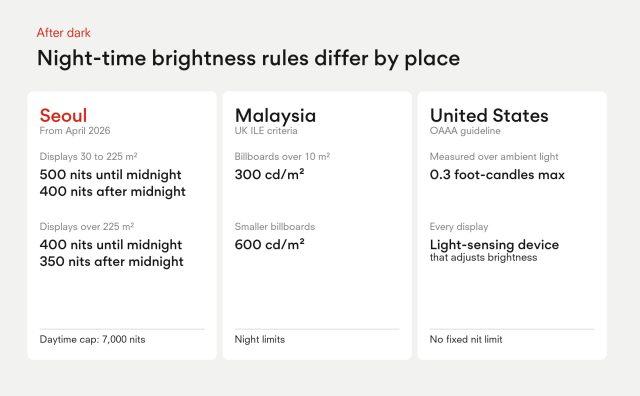
Regulators approach this in different ways. In April 2026, Seoul announced a daytime cap of 7,000 nits and lowered night limits for large outdoor displays, according to invidis reporting on Seoul’s billboard brightness rules. For displays of 30 to 225 m², the limit is 500 nits from one hour after sunset until midnight and 400 nits after midnight. Displays over 225 m² are limited to 400 nits before midnight and 350 after. The previous ceiling had been 1,500 nits, and officials estimated the change could cut energy costs to roughly 85 percent on average.

In Malaysia, a paultan.org measurement of urban billboards cites night limits of 300 cd/m² for billboards over 10 m² and 600 cd/m² for smaller ones, based on UK Institution of Lighting Engineers criteria.

The United States tends to work differently. The Outdoor Advertising Association of America recommends that lighting should not exceed 0.3 foot-candles over ambient levels, measured at a distance set by sign size, and its OAAA brightness guidelines explanation notes that this method is preferred to fixed nit limits because nits ignore ambient conditions. The same guidelines require each display to have a light-sensing device that adjusts brightness as ambient light changes.

The lesson is the same everywhere for billboard brightness: limits vary by country, city and sometimes street, so confirm the local rule before setting a brightness plan, and never assume a peak-brightness rating is permitted at night.

Night-time LED billboard brightness limits: Seoul 500 or 400 nits until midnight and 400 or 350 nits after midnight depending on size, daytime cap 7,000 nits; Malaysia 300 cd/m2 for billboards over 10 m2 and 600 cd/m2 for smaller ones; United States OAAA guideline of 0.3 foot-candles over ambient light with a light-sensing device.

Night-time brightness limits in Seoul, Malaysia and the United States.

How Automatic Dimming Works

A well-configured billboard does not run at one brightness, and good outdoor LED billboard brightness control is mostly about the sensor and the schedule. An ambient light sensor measures conditions at the screen, and the controller steps brightness up and down through the day. Many operators combine the sensor with a schedule and a hard night-time ceiling, so a sensor fault cannot push the screen past its limit.

Three practical points make this reliable:

  • Place the sensor where it reads the same light the screen receives, not in a shadow behind a bracket.
  • Set day, dusk and night limits separately, with smooth transitions so viewers do not notice steps.
  • Log brightness levels so you can show compliance if a complaint arrives.


INFiLED MVmk2 Series curved outdoor LED screen in Doha at night

MVmk2 Series in Doha at night. Photo: Ventum Tech.

The Cost of Too Much Brightness

Digital billboard brightness is not free. Higher output draws more power, produces more heat and, over years, accelerates the ageing of the LEDs. Running a screen at a moderate level for most of its life is one of the simplest ways to protect lifespan and reduce operating cost, which is why a dimming plan belongs in the specification, not as an afterthought.

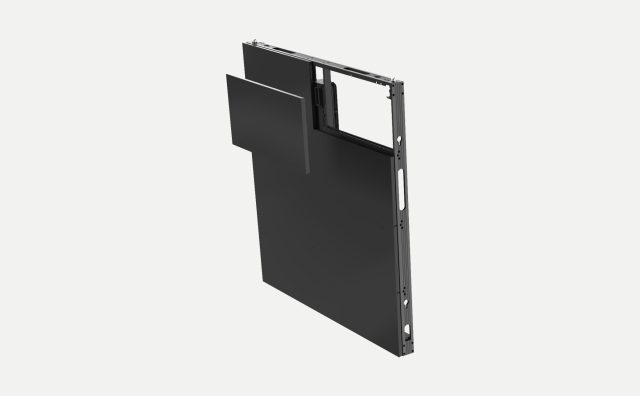
The MVmk2 series from INFiLED is designed for that kind of range. Models offer up to 10,000 nits peak with IP65 protection front and rear, giving headroom for the harshest sun-facing sites. Buyers assessing a high-brightness outdoor LED display should still specify the brightness schedule and the sensor arrangement, not only the peak number.

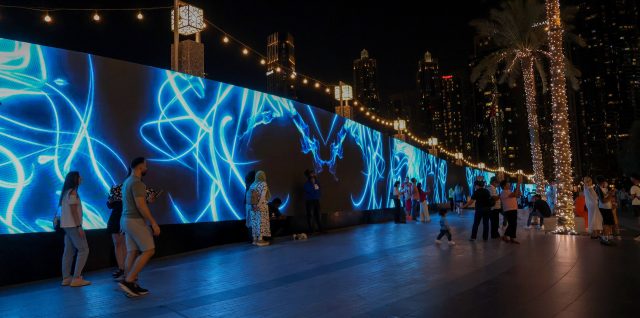
INFiLED MVmk2 Series LED wall along the Dubai Fountain promenade at night

MVmk2 Series at the Dubai Fountain, Dubai Mall.

A Practical Way to Set Brightness

  1. Survey the site at different times of day and note orientation, shade and sun angle.
  2. Set a daytime target for outdoor LED billboard brightness from the site conditions, then choose a panel with headroom above it.
  3. Check local night-time limits and write them into the controller as hard ceilings.
  4. Test content in real sunlight before sign-off, not only on a bench.
  5. Review logs after the first month and adjust.

Buy the Range You Will Actually Use

Good outdoor LED billboard brightness is measured across the whole day, not at the peak. The right specification gives enough output to hold contrast at noon, the discipline to dim after dark, and the sense to avoid paying for capacity the site never needs.

INFiLED’s experience with outdoor DOOH points to the same conclusion: headroom is useful, control is essential, and the best-performing screens are the ones set up around the location rather than around a headline number.

User registration
Join us to download our content. It only takes a moment!

    I have read and accept the privacy policy

    This site is protected by reCAPTCHA and Google.

    It looks like you are visiting the website from
    Select your region: