Confirm

LED Screen IP Ratings Explained: What IP65 Actually Tells You (and What It Doesn’t)

25.09.2026

A datasheet that reads IP65 gets translated into waterproof by most buyers, and that is where the trouble starts. An LED screen IP rating is the result of a defined laboratory test on a specific sample, not a promise about a specific rooftop, coastline or loading dock. It says nothing about salt, sunlight, impact or the rear of the cabinet unless the datasheet says so.

Buyers who treat the two digits as a guarantee tend to discover the gaps during the first monsoon season or the first winter of road salt. This article explains how to read the code, what each common rating tests, what it leaves out, and which questions to ask a supplier before the rating becomes a contract term.
How to Read an IP Rating: The Two Digits

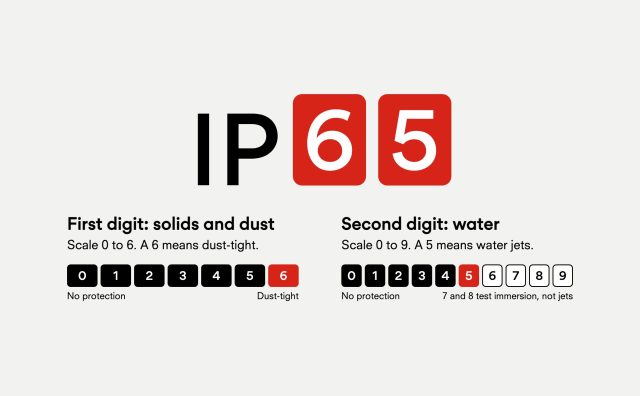
IP stands for ingress protection, and the code is defined in IEC 60529. The first digit describes protection against solid objects and dust on a scale of 0 to 6, where 6 means dust-tight. The second digit describes protection against water on a scale of 0 to 9. When a digit is replaced by an X, as in IPX5, that category was not tested, which is different from having no protection.

Two details catch buyers out. First, the water digits are not fully cumulative. Levels 1 to 6 build on each other, but 7 and 8 test immersion rather than jets, so an IP67 product has not automatically passed an IP66 jet test, as this IP ratings guide points out. Second, the rating applies to the enclosure as tested, using fresh water under set conditions, not to every variant that later reaches site.

Infographic explaining the IP65 code: first digit 6 means dust-tight on a 0 to 6 scale, second digit 5 means water jets on a 0 to 9 scale

IP65, IP54, IP67 and the Indoor Ratings, in Plain Terms

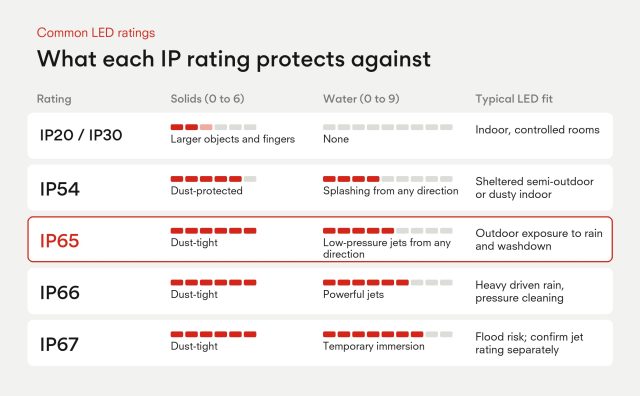
Most LED datasheets fall into a handful of codes, and the test parameters behind them are more specific than the labels suggest. IP65 is tested with water jets from a 6.3 mm nozzle at 12.5 litres per minute, from any direction. IP66 raises that to a 12.5 mm nozzle at 100 litres per minute, eight times the flow, according to this summary of the test parameters. IP67 replaces jets with temporary immersion, typically 30 minutes at one metre depth. IP54 is dust-protected rather than dust-tight, with protection against splashing.

IP ratings for LED screens: IP20/IP30 protects against larger objects and fingers, no water protection, for indoor controlled rooms. IP54 is dust-protected and resists splashing, for sheltered semi-outdoor or dusty indoor use. IP65 is dust-tight and resists low-pressure jets, for outdoor rain and washdown. IP66 is dust-tight and resists powerful jets, for heavy driven rain and pressure cleaning. IP67 is dust-tight and survives temporary immersion, for flood risk.

Indoor LED cabinets are commonly specified at low ratings such as IP20 or IP30. That level keeps out fingers and larger objects but offers no water protection, which is fine in a controlled room and a problem in a covered but humid space. The wider differences between the two environments are covered in indoor vs outdoor LED displays: key differences buyers must understand.

What the Rating Does Not Cover: Corrosion, UV, Salt, Heat, Impact and Wind

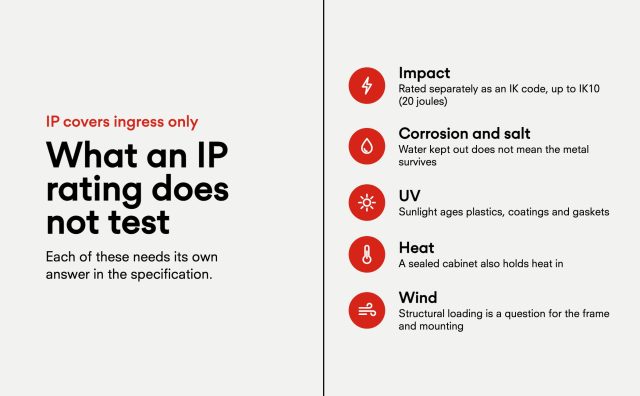
IP is an ingress test and nothing more. Several of the failures buyers blame on weather sit outside it:

  • Impact: resistance to knocks is rated separately under IEC 62262 as an IK code, and the IK scale tops out at IK10, which corresponds to 20 joules.
  • Corrosion and salt: water staying out does not mean the metal survives. A sealed enclosure in a chloride-rich marine setting can still corrode, which is why outdoor LED displays in Qatar’s coastal climate need a material strategy as well as a rating.
  • UV: sunlight ages plastics, coatings and the gaskets that earn the rating in the first place.
  • Heat: a sealed cabinet also holds heat in, and outdoor LED displays in the UAE show how heat, dust and humidity interact.
  • Wind: structural loading is an engineering question for the frame and mounting, not an ingress one.
Infographic of five conditions outside an IP rating: impact, corrosion and salt, UV, heat and wind

INFiLED treats the IP figure as the starting point of an environmental specification, not the whole of it. The useful question is what else the site will do to the screen, and whether the design answers it.

The Datasheet Traps: Front vs Rear, Module vs Cabinet vs System, Sealed vs Vented

Three habits of datasheets account for most misunderstandings.

Front versus rear. A rating quoted for the front face says nothing about the rear, where power, data and service access sit. Some products carry a lower rating on the back, which is acceptable when the rear is sheltered and a problem when it is not. Always check both faces.

Module, cabinet or system. A rated module inside an unrated cabinet takes on the weaker rating, and the same applies to power supplies, cables, connectors and distribution. Ask which level the number describes.

Sealed or vented. Fans and vents let air in, and sealed cabinets rely on conduction to shed heat. Neither is wrong, but the cooling approach determines how the rating behaves in summer, and how heat management impacts LED display performance and lifespan shows why. The rating also lasts only while gaskets are intact and reseated correctly after service. Moisture and condensation feature among the causes covered in what causes dead pixels in LED displays.

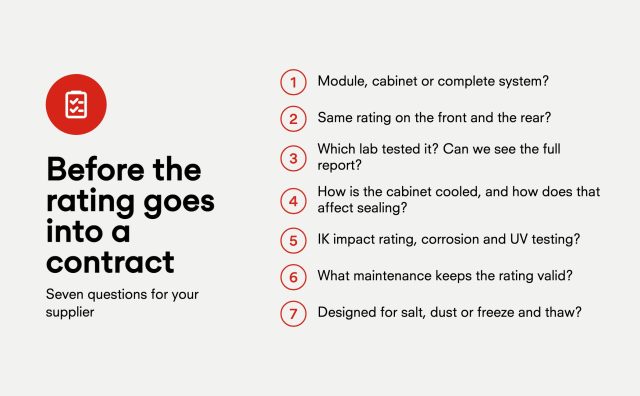
Questions to Ask a Supplier Before You Buy

  1. Does the rating describe the module, the cabinet or the complete system including power and data?
  2. Is the rating the same for the front and the rear?
  3. Which laboratory tested it, and can the full test report be shared rather than a summary?
  4. How is the cabinet cooled, and how does that interact with the sealing?
  5. What is the IK impact rating, and what corrosion and UV testing exists for coatings and gaskets?
  6. What maintenance keeps the rating valid, including resealing after a module swap?
  7. Which conditions was the product designed for: coastal salt, desert dust, freeze and thaw?


Infographic checklist of seven questions to ask an LED supplier about an IP rating

A broader contract checklist is in what to ask an LED manufacturer before signing a contract. Read as a narrow laboratory result, an IP rating is useful and honest. Read as a guarantee, it hides the questions that decide whether a screen survives five winters. INFiLED’s view is that the best-specified outdoor installations pair the rating with a written answer to each of the questions above.

User registration
Join us to download our content. It only takes a moment!

    I have read and accept the privacy policy

    This site is protected by reCAPTCHA and Google.

    It looks like you are visiting the website from
    Select your region: