Confirm

Wind Load and Outdoor LED Screens: What “20 m/s” Actually Means at a Festival

05.09.2026

A spec sheet that lists a 20 m/s wind rating for an outdoor LED screen reads like a simple pass or fail number. Below it, you build. Above it, you do not. In practice it is closer to a warning label than a green light, because 20 m/s wind load is measured under specific test conditions that a real festival site rarely matches exactly.

That gap between the number and the field is where most wind-related problems start, not from ignoring the rating but from misreading what it covers. Sustained wind, gusts, screen orientation and even where the wind is measured all change what “safe” actually means on a given day.

By the end of this article you will know what 20 m/s translates to in real terms, how wind actually loads an outdoor LED screen, and where the decision points sit between monitoring, bracing and bringing a screen down.
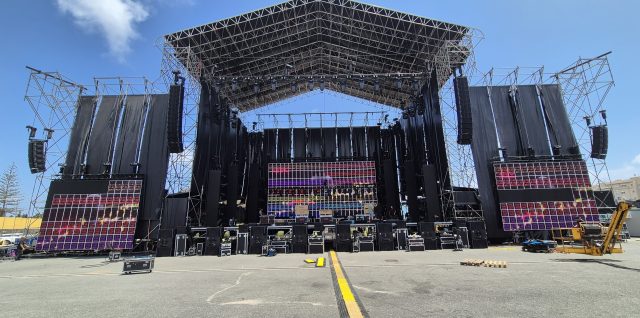
INFiLED ARmk2 Series LED screens on an open-air concert stage in the Canary Islands in daylight

ARmk2 Series on an open-air stage.

What a Wind Load Rating Actually Describes

Twenty meters per second converts to roughly 72 kilometers per hour, or about 45 miles per hour. On the Beaufort scale, published by weather agencies including the US National Weather Service, that sits at force 8, officially described as a gale. It is strong enough to impede walking and snap small branches, not a breeze anyone would call gentle.

Wind load itself is the force that moving air exerts on a surface, and it scales with the square of wind speed, so a jump from 10 to 20 m/s is not double the force, it is roughly four times as much. A manufacturer’s 20 m/s rating for an outdoor LED screen, the figure INFiLED and other display makers publish for their outdoor-rated panels, is typically a structural limit for the screen and its support system under sustained wind from a specific direction, tested in a controlled setup. It is not automatically the same number a crew should treat as their operating limit on an exposed festival field, where gusts, funneling between structures and uneven ground all add load the rating does not account for.

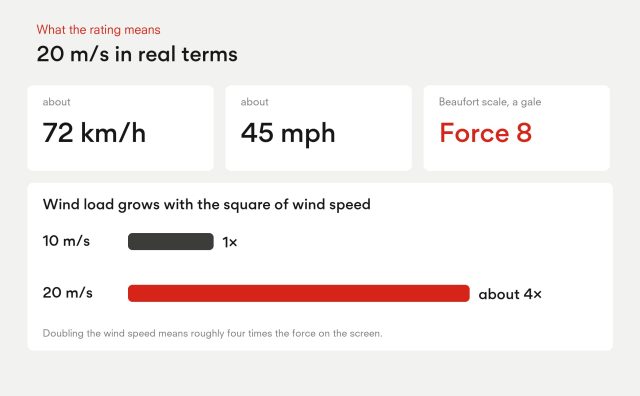
20 m/s is about 72 km/h or 45 mph, force 8 on the Beaufort scale, a gale. Wind load grows with the square of wind speed: going from 10 to 20 m/s means about four times the force.

How Wind Actually Loads an Outdoor LED Screen

An outdoor LED screen behaves like a sail long before it behaves like a wall. Wind does not need to push the whole structure over to cause damage; it only needs to exceed what the panels, locks and support structure were designed to resist, and that resistance is a shared property of the display and the ground support or truss it is mounted to, not the panels alone.

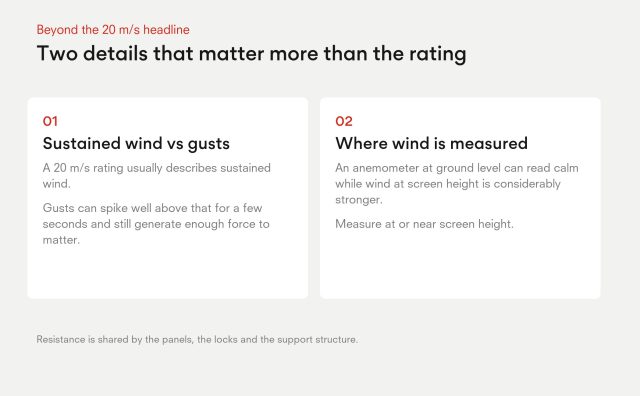
Two details matter more than the headline number. The first is sustained versus gust speed. A 20 m/s rating usually describes sustained wind, while gusts can spike well above that for only a few seconds and still generate enough force to matter. The second is where wind speed is actually measured. An anemometer at ground level can read calm while wind at screen height, several meters up, is considerably stronger, which is why serious wind plans measure at or near screen height rather than trusting a ground-level reading.

Screen format changes the math directly. A solid screen catches close to its full surface area in wind pressure. A mesh format lets a portion of the wind pass through, which is why wind load guidance for solid signage treats solid and perforated surfaces as different calculations entirely, not variations on the same number. On a 6 by 4 meter solid outdoor screen, roughly 24 square meters of surface area, wind pressure at 20 m/s translates into a load measured in kilonewtons across that structure, which is a meaningful engineering figure, not an abstract one.

Building a Wind Plan Instead of a Wind Rating

The practical question for a festival or outdoor build is never just “what is the rating.” It is “what do we do as conditions change,” which means a wind plan needs defined thresholds rather than a single cutoff.

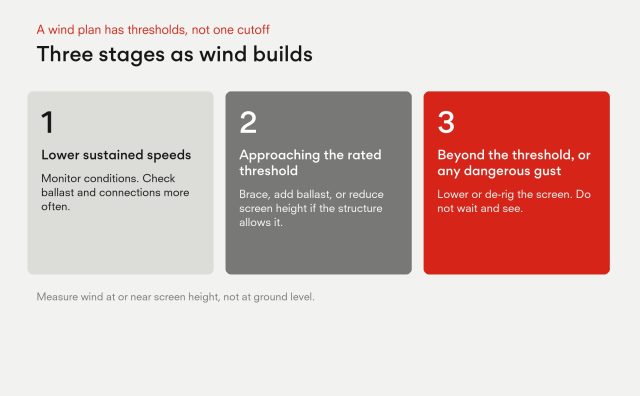
A workable structure typically has three stages. At lower sustained speeds, the crew monitors conditions and checks ballast and connections more frequently. As wind approaches the screen’s rated threshold, the response shifts to active bracing, additional ballast, or reducing screen height if the structure allows it. Beyond that point, or on any dangerous gust, the only correct response is to lower or de-rig the screen, not to wait and see. High-profile incidents make the stakes concrete: festivals including Stagecoach have had to evacuate entirely during sudden high winds, a reminder that wind decisions on an outdoor stage affect more than the equipment.

Three stages of a wind plan: at lower sustained speeds monitor and check ballast; approaching the rated threshold brace, add ballast or reduce height; beyond it or on any dangerous gust lower or de-rig the screen. Measure wind at screen height.

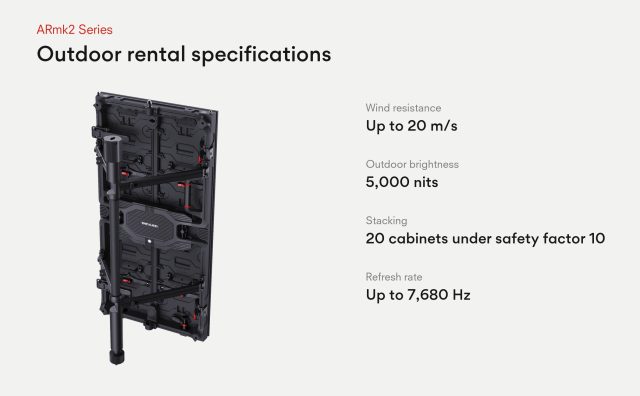
This is also where the choice of screen matters at the planning stage, not just during the show. Choosing genuinely wind-rated outdoor LED panels, with an IP65 rating and enough outdoor brightness, such as 5,000 nits, to remain legible in daylight, gives a production more margin to work with when weather turns. That margin does not remove the need for a wind plan, but it changes how much room the plan has to work in.

A Worked Example: 6 by 4 Meters at 20 m/s

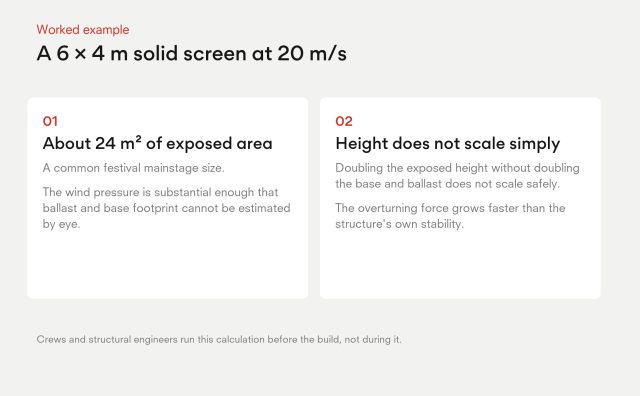
Consider a 6 by 4 meter solid outdoor LED screen, a common festival mainstage size. At roughly 24 square meters of exposed area, the wind pressure generated at 20 m/s sustained is substantial enough that ballast and base footprint calculations cannot be estimated by eye. Doubling the exposed height without doubling the base and ballast accordingly does not scale safely, because the overturning force grows faster than a taller structure’s own stability.

This is the calculation crews and structural engineers run before a build, not during one. Treating it as a site-specific engineering question, rather than a single number copied from a spec sheet, is what separates a wind-rated screen from a wind-safe build.

The Rating Is a Starting Point, Not a Verdict

Twenty meters per second is a useful, concrete figure, but it describes a test condition, not a promise about every site and every gust. Sustained wind, gust speed, measurement height and screen format all shift what that number means on the day of a show.

INFiLED rates ARmk2 for 20 m/s wind resistance as an engineering baseline, and the crews who get the most out of that rating are the ones who still build a wind plan around it rather than treating it as the whole answer. The goal on any outdoor build is not to hit the highest number on the sheet. It is to know, before conditions change, exactly what happens next.

User registration
Join us to download our content. It only takes a moment!

    I have read and accept the privacy policy

    This site is protected by reCAPTCHA and Google.

    It looks like you are visiting the website from
    Select your region: