Confirm

The Most Valuable Screen in an Airport Faces Two Directions at Once

27.07.2026

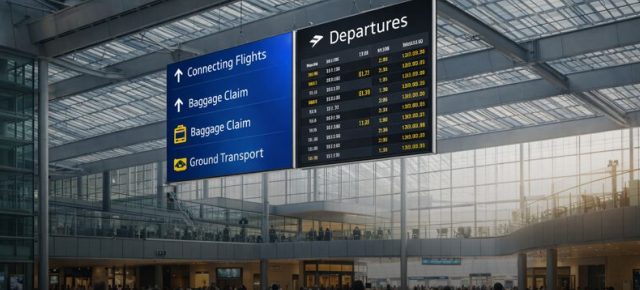
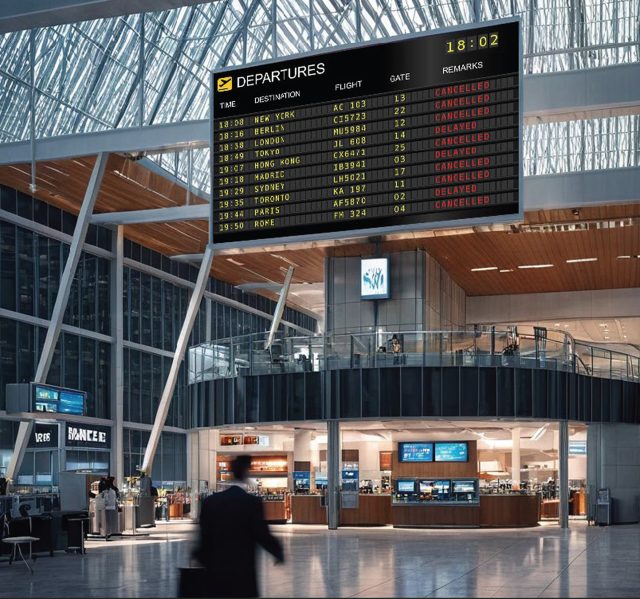
Stand in the middle of any terminal concourse and watch the traffic for a minute. Departures moving one way. Arrivals moving the other. Transfers cutting across both. Now look up at the suspended displays and count how many of them are working for more than one of those flows. In most buildings, the answer is none of them.

The suspended zone above a concourse is the highest-value media real estate in the building, and it is not close. It is the only surface in the space that every passenger flow can see simultaneously, unobstructed by heads, columns, retail units or queue barriers. Floor-level signage disappears behind a crowd. Wall-mounted displays serve whoever happens to be facing that wall. The ceiling zone serves everyone.

Which makes it strange that most of it is being half-used.
Infiled

A single-sided suspended display consumes the entire structural allowance for that mounting point, the entire sightline through that part of the volume, and the entire installation and cabling budget — and serves the passengers walking towards it. The ones walking away see the back of a cabinet.

That is the problem GeminiLED addresses. Five areas worth understanding:

  1. The arithmetic of bidirectional flow
  2. Two independent faces in one installation
  3. Slim enough that the architect says yes
  4. 24/7 is a different engineering problem
  5. Suspended, or freestanding when the ceiling is not available
Infiled
INFiLED doubled-sided LED screen-GeminiLED Series

1. The arithmetic of bidirectional flow

In a corridor with two-way movement, a single-sided display reaches roughly half the passing audience at any moment. Every other cost associated with that display — the structural survey, the ceiling anchors, the power run, the signal path, the commissioning, the maintenance access — is incurred in full regardless.

That asymmetry is what makes single-sided suspended signage an expensive way to reach an audience. The screen is not too small or too dim. It is pointed at half the building.

It also has a content consequence. Because the display can only face one way, wayfinding and commercial content end up competing for the same surface. Terminal operators either dilute the wayfinding with advertising or forfeit the advertising revenue to keep the wayfinding clean. Neither is a good outcome, and both are artefacts of the display having one face.

2. Two independent faces in one installation

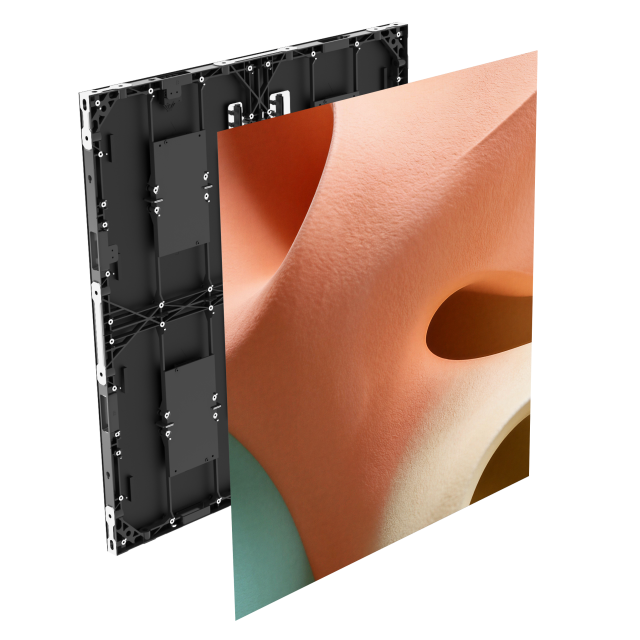
GeminiLED is a dual-sided suspended display with two fully independent display faces. Each face has its own brightness calibration and its own content control.

One mounting point. One power feed. One signal input. Two audiences.

The independence is what makes this more than a novelty. Departures-side can run gate information at full brightness while the arrivals-side runs retail or brand content at a level appropriate to the light on that side of the atrium. A mall can run wayfinding towards the car park and promotional content towards the anchor store. The two faces are not a mirror; they are two separate media surfaces sharing one piece of infrastructure.

For an operator, that changes the business case for the ceiling zone entirely. The same structural allowance now carries an operational surface and a commercial surface at once, rather than forcing a choice between them.

Infiled

3. Slim enough that the architect says yes

In terminals, atriums and retail concourses, the objection to a suspended display is almost never resolution. It is whether the architect will accept the object hanging in the volume.

GeminiLED’s total profile — both faces, complete cabinet — is 25.5 to 27 mm. Roughly the width of a finger. From any oblique angle it reads as a plane rather than a box, which is what keeps it from interrupting the long sightlines that atrium design is usually built around.

The cabinet weighs 7.5 to 8.7 kg in a magnesium alloy structure, and the optimised structure supports secure suspension of up to 15 cabinets for larger volumes. Low cabinet weight is what turns a ceiling installation from a structural problem into a straightforward one — particularly in an existing building, where the anchor capacity is whatever the original engineer specified decades ago and is not negotiable.

Two faces in a profile thinner than most single-sided cabinets is the specification that gets this past both the architect and the structural engineer.

Infiled

4. 24/7 is a different engineering problem

A display in a public transport building never turns off. That is a materially different requirement from a display in an office lobby, and it shows up in the parts of the specification that rarely make the headline.

Thermal management is engineered to reduce overheating and downtime risk under continuous operation — the failure mode for always-on displays is almost never dramatic; it is a gradual thermal degradation that shows as colour drift across a wall long before anything actually stops working.

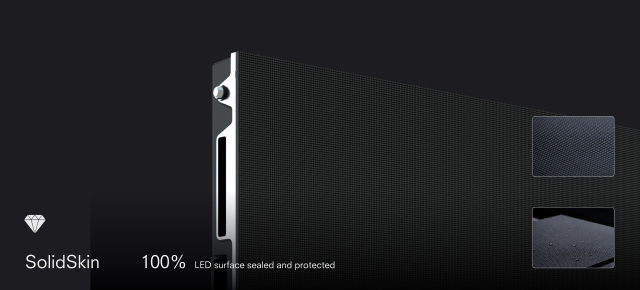
SolidSkin addresses the environment. Its protective layer, with an IP65 front rating, shields every LED against moisture, dust and impact, and delivers a softer, smoother surface across the display. In a concourse — cleaning trolleys, luggage, construction hoardings, decades of dust — surface protection is the difference between a display that still looks new in year six and one that has been visibly repaired.

Underneath that, a 5G-efficient control system keeps signal transmission stable with clean internal cabling, EMC Class B certification allows the display to operate alongside public and safety-critical systems without interference, and independent component replacement means servicing does not require dropping the array.

On image performance: up to 1,500 nits with fine greyscale, and MIP technology that holds colour and brightness uniform across wide viewing angles. In a concourse, most people see the screen obliquely and in motion, never square-on — off-axis consistency does more for real-world legibility than peak brightness does.

5. Suspended, or freestanding when the ceiling is not available

Retrofit is the normal case, not the exception. Most terminals, stations and malls receiving new display infrastructure were built long before anyone specified for it, and a great many of them cannot take a new ceiling fixing at all — either the structure will not permit it or the listed or architectural status of the space will not.

GeminiLED supports a freestanding totem configuration for exactly that situation: floor-standing base, 16:9 or 9:16 orientation, self-contained, no ceiling fixing and no wall anchoring. The same dual-sided logic applies at floor level, where a totem in the middle of a concourse has traffic on both sides by definition.

That flexibility is what keeps the product specifiable across a whole estate rather than only in the buildings that happen to co-operate.

Infiled
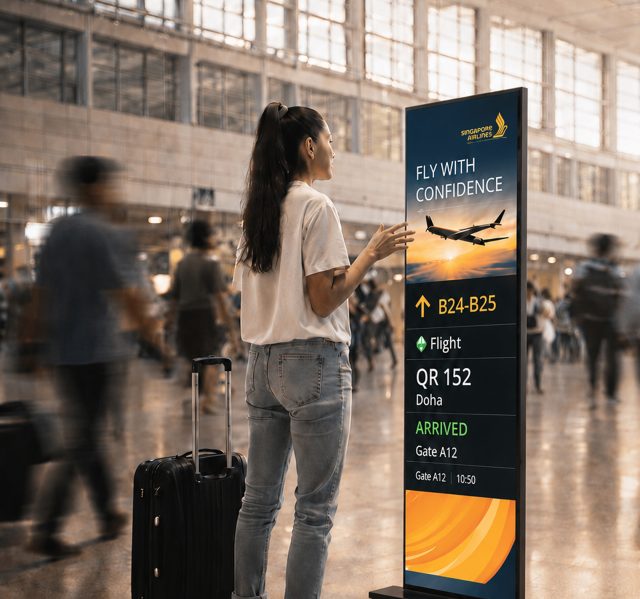
GeminiLED supports a freestanding totem configuration for floor-standing base, 16:9 or 9:16 orientation.

The question to ask about your ceiling zone

Not “what resolution do we need up there,” but: how much of the audience walking underneath our suspended displays can actually see them?

If the answer is half, then the ceiling zone — the best media real estate in the building — is running at half capacity, at full cost.

Related reading:

User registration
Join us to download our content. It only takes a moment!

    I have read and accept the privacy policy

    This site is protected by reCAPTCHA and Google.

    It looks like you are visiting the website from
    Select your region: