Confirm

Fan Zone LED Screens: Planning a Semi-Permanent Display for Weeks, Not Nights

15.11.2026

A fan zone LED screen is judged for weeks, not for one evening. Thousands of people watch it, the weather changes daily, and nobody is standing beside it at 3 am when a panel drops out. Specify it like a one-night hire and the gaps appear halfway through the run.

The same applies to a Christmas market screen that switches on this month and to a pop-up LED screen. A semi-permanent LED screen is a small infrastructure project with a long tail of weather, wind, permits, power and repairs. Below: what to specify, what to ask your hire company, and which series suit which run.
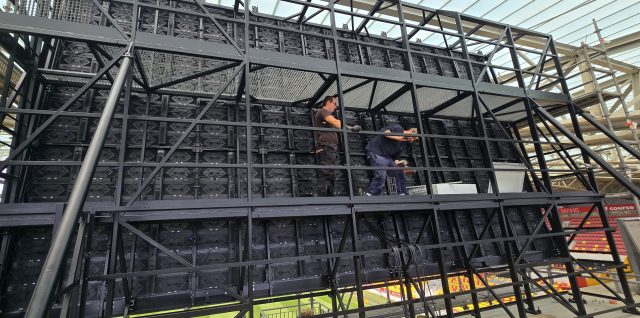
Two technicians working on the steel frame behind an LED screen at a stadium

What makes a fan zone LED screen different from a one-night hire

A fan zone is a public area where crowds watch live sport together, usually with food, music and sponsor activations, and the big screen for public viewing is its centrepiece. Some last an evening. The ones covered here last days or weeks, so weather, overnight hours, crowd contact and repairs stop being edge cases and become the plan.

INFiLED’s case study of the FIFA Fan Festival in Atlanta, a 38-day Atlanta build, shows what a fan zone LED screen looks like at scale. Its programme mixed live match broadcasts, concerts, cultural activities and sponsor content. The build was one 20 by 13.5 metre main stage screen and three 5 by 3 metre delay screens around Centennial Olympic Park, all from the AR3.9mk2 Turbo edition of ARmk2. The page lists heat, humidity, thunderstorms and crowd security among the challenges and reports no failures in 38 days.

Other public viewing builds follow the pattern. A two-week watch party at Boston City Hall Plaza in June 2026 used 144 one-metre Black Widow AMT panels in a gently curved 16 by 9 metre screen. Fan zone ideas for the hours between fixtures come from Atlanta’s programme: concerts, cultural acts and sponsor content that changes by day.

DimensionOne-night hireWeeks-long run
WeatherOne forecast to checkEvery forecast, overnight included
StructureBallast and bracing for that eveningDesigned and independently checked, with a wind plan
Power, control and securityCrew on site watch the feedScheduled content, automatic restart, remote alerts, locked access
Permits and insuranceOne event permissionDay limits, licensing and sponsor content cleared; cover confirmed for the full run
CostA day rateInstall, structure, power, monitoring, spares and strike, not just the screen

How big, how fine, how bright: fan zone screen size and pitch

There is no standard fan zone screen size. The right area depends on how far the back of the crowd stands from the glass and how many angles the site has, and the faults people notice are predictable: too small for the crowd, poor sightlines, a washed-out picture in daylight. Atlanta paired its main screen with three delay screens around the park, one way to serve a large site.

Pixel pitch follows the nearest viewer. A common rule of thumb puts minimum comfortable viewing distance in metres at roughly the pitch in millimetres; it is not exact. By that rule a 3.9 mm screen like Atlanta’s suits viewers from about four metres out, while a Christmas market stall holder or pop-up shopper two or three metres away calls for something finer. OREZ 2.6 mm outdoor series panels are IP65 and 7.6 kg at 500 by 500 mm, listed at 4,000 to 5,000 nits by variant, and the page lists a semi-permanent DOOH configuration. NX adds a 3.91 mm outdoor cabinet at IP65 and 5,000 nits.

Brightness cuts both ways: Boston’s page says bright daylight raised its requirements, while a winter market trades mostly in the dark. Specify the peak for the brightest hour, schedule dimming from a light sensor with a hard night ceiling, and budget energy for long dark evenings. For a site that keeps its screen after the event, MV is the fixed option, its cabinets locking into a continuous aluminium frame; the MV Series for fan zones page covers the hardware. The 2022 screens at a leisure complex in Doha were fixed installations with an outdoor cinema planned afterwards.

Weather, wind and winter: what weeks outdoors test

IP65 is the working baseline for any fan zone LED screen left out overnight: dust-tight, and protected against low-pressure water jets from any direction. Check whether the datasheet says front and rear, because the rear often carries the power and signal connections. The MV page and the Boston Black Widow AMT page state IP65 front and rear; the ARmk2, NX and OREZ pages give one IP65 rating per outdoor model, so ask the supplier to confirm the rear before a six-week run. The figures in this article come from INFiLED’s spec tables, not headline claims.

A 20 m/s wind rating, quoted on the ARmk2 rental and DOOH panels page and in the Atlanta case study, is a test limit rather than a promise for your site; what a 20 m/s rating means at a festival depends on gusts, screen height, screen format and site layout. SCOSS, the UK’s Standing Committee on Structural Safety, has warned that large outdoor screens are sometimes used as products rather than designed as temporary structures. Its SCOSS warning on outdoor video screens, as reported by LABC, recommends independent design and erection checks. On a long run add a written wind plan with thresholds, a named person who acts on it daily and ballast that stays in place. NX lists optional wind-resistant braces.

Winter changes the checks. The spec tables list -20 °C to +50 °C for ARmk2 outdoor models, OREZ and MV, and -10 °C to +45 °C for NX, so match the range to the coldest forecast night. An IP code says nothing about temperature. Ask the supplier how a cabinet copes when a freezing night is followed by a warm, lit day; condensation deserves a specific answer.

Permits, power and repairs when nobody is on site

Permits are where plans slip, and rules are local. The examples are from England and Wales: prompts, not a global checklist. Boston’s project page cites nearly a year of planning behind a two-week run. In England, the permitted-development right for temporary land use (Class B of the planning order) allows 28 days in total in a calendar year, no more than 14 of them for a market. A Christmas market open for five weeks, or a fan zone running for six, falls outside it, so ask the local planning authority what applies. Ask too whether sponsor content on the screen needs advertisement consent. Licensing is separate: a temporary event notice in England and Wales covers fewer than 500 people at any time and no more than seven days.

The spec tables give consumption per panel as a maximum and an average (180 W maximum and 60 W average on most OREZ variants), so size the supply on the maximum and judge running costs on the average. Test that the control system restarts unattended and returns to the right content, and set the night plan in software, not by whoever locks up. Fence the base, lock rear access and cover cables; Atlanta’s page lists crowd security as a challenge.

At 3 am the questions are who knows and who can act. The MV series with DMS monitoring reports temperature, pixel health, defect alerts and operational status to a cloud platform. The ARmk2, NX and OREZ pages do not describe monitoring, so ask your hire company what is on the rig and who gets the alert. Serviceability is a specification: ARmk2 offers front and rear maintenance with power distribution units that remove without tools, OREZ lists dual service access, and MV has a separate tool-free power unit. Carry spares by type, agree a written response time and decide who may open a cabinet overnight.

A fan zone LED screen checklist, from site survey to strike

INFiLED does not rent screens to end users. Organisers hire through rental companies (the rental staging range shows what those companies buy) or buy, so most of these questions go to your supplier.

  1. Survey viewing distances, sightlines, sun angle, ground, power and truck access.
  2. Size the area from the furthest viewer, add delay screens for a large site, and set pitch from the nearest viewer.
  3. Compare spec-table figures: IP rating front and rear, operating range against the coldest night, brightness by model.
  4. Commission a structural design with independent checks, and write a wind plan with thresholds and a named owner.
  5. Start permits first: planning, licensing and sponsor content, with timelines in writing.
  6. Size power on maximum draw, test unattended restart and protect the control supply.
  7. Set night rules: brightness schedule, hard ceiling, overnight content and manual overrides.
  8. Agree monitoring, alerts, spares, response times and cabinet access in writing.
  9. Plan the strike: removal order, ground reinstatement and where the kit goes next.

For a one-off, the hire contract decides who carries weather and repair risk, so read it. If the same site runs every year and you can store and service the kit, work through the rent or buy break-even guide and consider a fixed MV or semi-permanent OREZ build.

Frequently asked questions

What is a fan zone?

A fan zone is a public area where crowds gather to watch live sport on big screens, usually with food, music and sponsor activations. Some run for an evening; large tournament fan festivals run for weeks, and those need the screen planned as semi-permanent infrastructure.

What happens in the fan zone?

Live match screenings share the day with concerts, cultural activities and sponsor content, as in Atlanta’s 38-day festival. What the screens show changes daily, so they need reliable playback, a brightness schedule and a plan for the hours between fixtures.

What size should a fan zone LED screen be?

There is no fixed size. Match the area to the furthest viewers and the number of angles on site, then choose pixel pitch from the nearest viewer. Atlanta used a 20 by 13.5 metre main screen plus three 5 by 3 metre delay screens; Boston used 16 by 9 metres.

How much does a fan zone LED screen cost for a multi-week run?

No single honest figure exists, because fan zone cost covers far more than panels: area, pixel pitch, structure and engineering checks, power, install and strike, monitoring, spares and run length all move the quote. Ask for it itemised for the whole run, not a day rate multiplied by the days.

What IP rating does an outdoor LED screen need for weeks outdoors?

IP65 is the working baseline: dust-tight and protected against low-pressure water jets from any direction. Check whether the datasheet covers front and rear, and read the operating temperature range separately, because an IP code says nothing about cold.

Can an LED screen run for weeks at a Christmas market?

Yes, if it is specified for the run. Atlanta’s screens ran 38 days outdoors through heat, humidity and thunderstorms. For a Christmas market, match the operating range to the coldest forecast, schedule night dimming, and agree monitoring and spares in advance, since nobody will be on site overnight.

User registration
Join us to download our content. It only takes a moment!

    I have read and accept the privacy policy

    I agree that INFiLED EUROPE, SL processes my personal data to review and, where appropriate, investigate and reply to the message I have sent, according to the privacy policy, which I have read and accept without reservation, and which gives additional information on this processing and on how to exercise my rights of access, rectification, restriction, erasure, objection and portability of my data.

    This site is protected by reCAPTCHA and Google.

    It looks like you are visiting the website from
    Select your region: