Confirm

How to Choose the Right LED Wall for Corporate Lobbies and Boardrooms

07.02.2026

Corporate environments punish the wrong LED decisions in quieter ways than events or studios. A lobby LED wall that looks impressive on day one can become a constant maintenance and content problem. A boardroom LED wall can end up fatiguing for long meetings, soft on text, or reflective in daylight, even if the spec sheet looks strong.

The most common misunderstanding is treating corporate spaces like a simplified version of broadcast or rental, then buying based on brightness, resolution labels, or “4K-ready” claims without mapping the display to viewing distance, content type, room lighting, and operational ownership. We’ve spent time to write down this guide built around those realities.
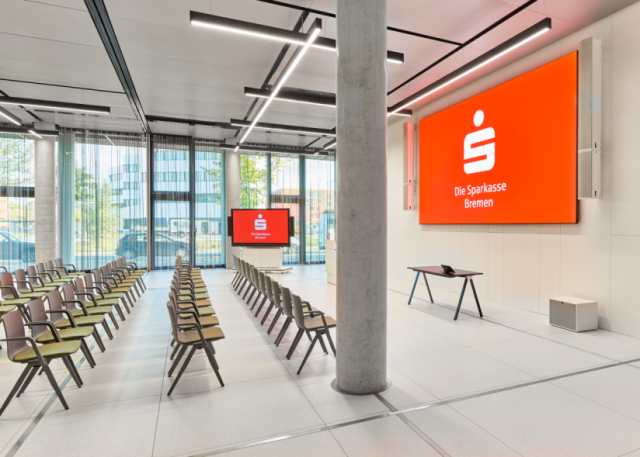
Infiled

Photo Credit © Die Sparkasse

Corporate LED Walls: The Decisions That Matter After the Demo

An LED wall is a direct-view LED display built from cabinets and modules, scaled to fit the architecture. In corporate spaces, the success criteria are less about peak impact and more about consistent legibility, minimal distraction, and low friction for facilities and AV teams.

Key concepts that drive good decisions:

  • Pixel pitch (mm): the spacing between pixels. It directly affects how clean text looks and how close people can sit before seeing pixel structure. Viewing distance guidance is a useful baseline, but it must be validated with real content and seating positions. AVIXA’s discussion of pixel pitch and viewing distance provides a practical framework.
  • Brightness (nits): required brightness is driven by ambient light, reflections, and content, not by maximum capability. Corporate users usually want stable, comfortable brightness for long dwell times.
  • Color accuracy and white point: boardrooms often show people, products, and brand colors. Consistency matters more than wide gamut claims.
  • Refresh rate and processing: impacts camera capture in hybrid rooms and affects perceived stability during motion and scrolling.
  • Serviceability: how fast modules and power supplies can be replaced, and whether service can happen without closing the space.

A corporate LED wall is an operations asset. The display, processing, mounting, control, and content pipeline all matter.

What Shows Up After Go-Live: Text, Glare, Drift, and Ownership

Corporate lobbies and boardrooms look straightforward until the first month of real use. That is when the “system behavior” shows up.

Viewing distance and content density determine whether the wall feels premium or cheap

Lobby viewers are often far away and moving. Boardroom viewers are close, seated, and staring at fine details. That difference changes everything.

  • In lobbies, the LED wall is usually for brand storytelling, welcome messaging, or ambient content. People do not need to read dense spreadsheets from three meters away. Pixel pitch can often be looser if the closest practical distance is still several meters.
  • In boardrooms, the LED wall must render text, UI elements, and shared desktops cleanly. A pitch that is acceptable for a lobby can look soft and “grainy” in a boardroom where the front row sits close.

We’ve given an overview in this article where it explains how pixel pitch sets the recommended distance and why it is the first decision to anchor.

Brightness is limited by comfort, reflections, and camera behavior

Lobbies often have glass, polished stone, and daylight. Boardrooms often have windows and downlights. In both cases, “more nits” is not automatically better. Higher brightness can increase glare, reveal uniformity issues, and make skin tones look harsh. It also increases the risk of discomfort when the display is within a viewer’s peripheral vision for long periods.

For rooms where cameras are used (executive town halls, recorded meetings, press briefings), the display’s behavior under capture matters. Flicker, banding, or rolling artifacts often come from the combined interaction of refresh rate, scan method, and camera shutter settings, not from a single number in a brochure.

Color and grayscale stability matter more than wide-gamut claims

Corporate content is usually SDR and designed for standardized color spaces. If the LED wall cannot hold a stable white point and consistent grayscale across brightness levels, brand colors drift and faces look off. This is why calibration targets are still relevant even outside post-production. Netflix’s calibration guidance is a clear example of common targets like Rec.709 and D65 that many content pipelines assume.

Ownership determines whether the display stays healthy

In corporate spaces, the wall is shared by facilities, IT, and AV. If it is unclear who owns brightness settings, scheduling, content approvals, and service calls, the system drifts. The best deployments treat commissioning, controls, and maintenance planning as part of the spec.

Lobby vs Boardroom Specs: Two Use Cases, Two Priorities

A corporate LED wall decision should be guided by how the space is used day-to-day, not by showroom demos.

Lobby LED wall priorities: architecture, reflections, and content reality

For lobbies, buyers should start with questions that prevent expensive rework:

  • What is the closest real viewing distance? If people only approach within a few meters, pitch requirements are different than a boardroom.
  • How reflective is the environment? Glass walls and glossy stone can create mirror-like reflections. Anti-glare treatments and controlled brightness ranges often matter more than peak brightness.
  • What content will actually run? If content is mostly motion graphics and brand loops, prioritize uniformity, clean blacks at practical brightness, and predictable content scaling.
  • How will it be mounted and serviced? Architectural walls often restrict rear access. Front service design can be the difference between a quick fix and a construction event.

Boardroom LED wall priorities: text clarity, latency, and meeting ergonomics

Boardrooms are where mistakes show up as daily frustration:

  • Text and UI clarity: validate with real laptop mirroring, shared desktops, and typical slide decks. If the front row is close, pitch and processing must support fine edges and small fonts.
  • Latency and switching: awkward delays between sources erode confidence in the room. Processing should be selected with collaboration workflows in mind, not just video playback.
  • Comfort over long sessions: target a brightness level that works with the room’s lighting design, then keep it stable. Dolby’s guidance on bias lighting and ambient surround illustrates why controlled ambient light improves perceived comfort and consistency in real viewing environments. 

This is also where a manufacturer’s engineering discipline shows. INFiLED deployments in corporate meeting spaces tend to go smoother when the project team treats readability tests, calibration expectations, and service access as requirements, not “nice-to-haves.”

Avoiding the silent cost drivers

Corporate buyers often budget for the wall and forget the operational cost:

  • calibration checks after module replacement
  • spare module strategy and matching
  • cleaning access and environmental dust
  • control interface training for admins
  • content creation and safe scaling rules

An LED wall that is technically fine can still fail if the organization cannot maintain it predictably.

A simple decision framework that works for both spaces

Step 1: Define the dominant use case, not the aspirational one

Lobby walls are usually brand and ambiance. Boardroom walls are collaboration and readability. If the design tries to satisfy both without clear priorities, it often ends up mediocre in both. Decide what “good” means for each space in measurable terms: smallest readable text size, acceptable reflections, target brightness range, acceptable downtime for service.

Step 2: Validate pixel pitch using real content in real seating positions

Do not approve pitch based on generic charts alone. Use charts to shortlist, then test:

  • common slide templates
  • spreadsheets and dashboards
  • video conferencing layouts
  • brand color panels and skin tones

This step prevents the most common boardroom failure: a wall that looks crisp in marketing videos but struggles with desktop content.

Step 3: Specify controls, scheduling, and admin behavior

A corporate LED wall needs predictable behavior: daily schedules, brightness profiles (day vs evening), and lockouts that prevent accidental misconfiguration. Buyers should ask who will manage this and how changes are logged.

Step 4: Design for service without drama

Serviceability is not only a technical feature. It is a business continuity choice. Define:

  • response time expectations
  • spare parts on-site vs on-call
  • how quickly a module swap can be done without closing the room
  • how uniformity is verified after replacement

If INFiLED is involved, this is typically the phase where engineering-led planning reduces future downtime, because maintenance workflows get designed into the system rather than patched later.

A Wall That Stays Readable, Comfortable, and Supportable

Choosing the right LED wall for corporate lobbies and boardrooms comes down to matching the display to human behavior and room constraints. Lobbies reward strong architectural integration, reflection control, and consistent performance at practical brightness. Boardrooms demand close-range clarity for text, predictable collaboration workflows, and comfort over long sessions. Pixel pitch should be validated with real content and real seating positions, not guessed from a spec sheet. Color stability, processing choices, controls, and service planning often determine long-term satisfaction more than headline specs. When corporate buyers treat the wall as a system with operational ownership, the result is a display that feels dependable rather than temperamental, which is the standard experienced LED partners like INFiLED tend to design toward.

User registration
Join us to download our content. It only takes a moment!

    I have read and accept the privacy policy

    This site is protected by reCAPTCHA and Google.

    It looks like you are visiting the website from
    Select your region: