Confirm

Why DOOH Screens Need to Survive Being Seen From an Angle (Most Don’t)

10.08.2026

A spec sheet is measured head-on, standing dead center, at the distance a technician chose to get the best number. A street is nothing like that. A DOOH screen on a retail strip or an exhibition floor is seen by people walking past at 30, 45, even 70 degrees off center, for two or three seconds, while doing something else.

That mismatch between how a display is tested and how it is actually watched is where most DOOH underperforms. Viewing angle is treated as a checkbox spec, usually quoted as a wide number without qualification, when in practice most panels lose meaningful brightness and color accuracy well before they reach that number. This article explains what that spec actually measures, why so many screens fail to hold up to it in the field, and what buyers should look for instead.
Infiled

Fundamentals: What “Viewing Angle” Actually Means

Viewing angle is usually published as a single wide number, something like 160 degrees horizontal, that suggests uniform performance across the entire arc.

In practice, most LED and LCD panels define viewing angle using a brightness threshold, often the angle at which luminance drops to half its on-axis value. That definition tells a buyer almost nothing about what happens well before that cutoff.

Color can shift, contrast can flatten, and brightness can taper gradually starting at 20 or 30 degrees off center, long before the panel reaches its rated limit. For an advertiser, that tapering is the difference between a message that reads clearly to someone approaching from the side and one that looks washed out or color-shifted by the time they are close enough to actually register it. The published number, in other words, is not a pass or fail spec. It is a curve, and the shape of that curve is what determines real-world legibility.

How Viewing Angle Actually Behaves in Real Deployments

Independent testing backs this up. Peer-reviewed research on LED display modules has shown that the further a viewing angle deviates from the normal direction, the worse display uniformity becomes, with brightness and color both degrading well before the panel’s stated angular limit.

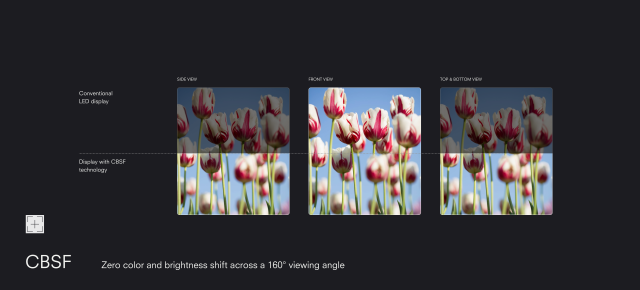
That is the gap CBSF technology was built to close. Rather than accepting gradual falloff, CBSF is engineered to hold color and brightness essentially flat across its full rated arc, up to 160 degrees horizontal and 110 to 160 degrees vertical depending on configuration, so the image a viewer sees walking past at 45 degrees is close to identical to the one seen dead center.


Infiled

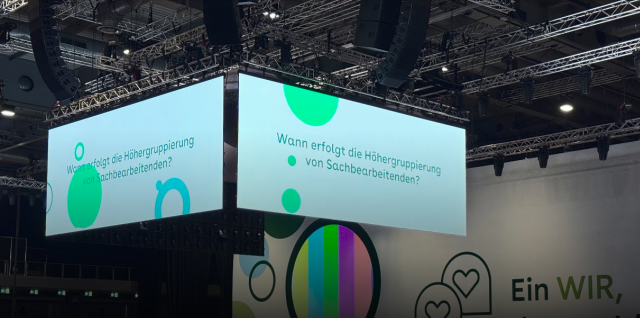
Combined with up to 5,000 nits of outdoor peak brightness and an IP65 rating, the panel is built to hold that performance in direct sunlight and weather, not just in a controlled showroom demo built around a single fixed camera position.

That distinction matters most for buyers comparing panels on paper, since most angular specs are measured indoors, under conditions that do not reflect how a DOOH screen is actually seen once it is installed on a street corner or a show floor.


Infiled

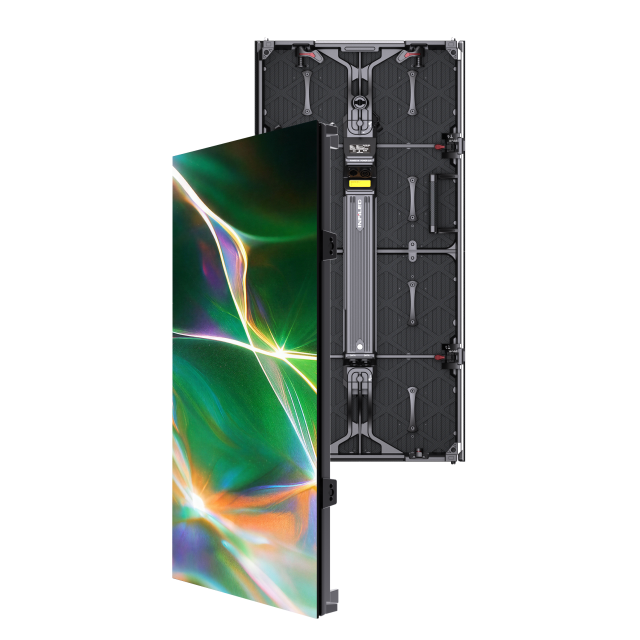
High brightness up to 5000 nits, together with durable reinforced cabinet design, RS is a perfect DOOH screen.

Practical Implications for DOOH and Exhibition Buyers

For a media owner selling advertising inventory, viewing angle performance directly affects what a screen can charge.

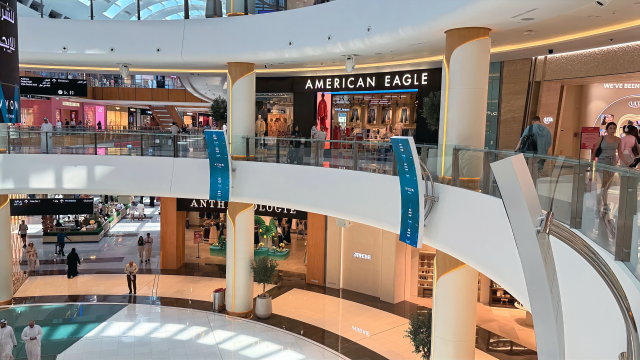
A billboard on a busy corner is viewed from a range of angles by traffic and foot traffic moving in multiple directions, and a screen that only looks correct within a narrow center cone is effectively delivering a smaller usable audience than its size suggests.

The same logic applies on a trade show floor, where a booth’s screen competes for attention in a crowded aisle and most viewers are approaching from an angle rather than standing directly in front of it.

INFiLED has seen this gap show up repeatedly in DOOH deployments, where a panel that tested well in a spec comparison still drew complaints once installed at street level, because the test never accounted for the angles real audiences actually use. Buyers evaluating DOOH LED displays should ask for angular brightness and color data, not just a single rated number, and ideally see the panel demonstrated off-axis before committing to an install.


Infiled

RS installed at a trade show

A Different Way to Evaluate DOOH Screens

Advertisers and media owners comparing panels should treat viewing angle the way they treat pixel pitch: as a spec that needs context, not just a number to compare across spec sheets. A useful question to ask a vendor is how brightness and color are measured at 30, 45 and 60 degrees off center, not just at the panel’s rated maximum.

It is also worth asking whether that figure applies uniformly across the full screen or degrades toward the edges of larger installations, since panel-to-panel consistency compounds the effect. What actually determines ROI for DOOH advertisers is less about a single headline spec and more about whether the screen performs consistently for the full range of people who will actually see it, from every angle they approach from.

Judging a Screen by How It’s Actually Seen

Viewing angle is one of the few specs on a DOOH data sheet that predicts real audience experience rather than lab performance, yet it is usually the least scrutinized.

A screen with strong nits and fine pixel pitch can still underperform on a street corner if its color and brightness fall apart 30 degrees off center, well within the range most passersby actually occupy. Advertisers moving from static to LED should factor angular performance into that decision from the start, not as an afterthought once a screen is already installed and the complaints start coming in from the media buying team.

INFiLED built the RS Series around CBSF for exactly this reason, treating consistent off-angle performance as core to what a display needs to deliver in real advertising and exhibition environments, not just in a controlled demo.

User registration
Join us to download our content. It only takes a moment!

    I have read and accept the privacy policy

    This site is protected by reCAPTCHA and Google.

    It looks like you are visiting the website from
    Select your region: