Confirm

LED vs LCD Video Walls: Which One Is Actually Right for Your Space?

29.09.2026

The LED vs LCD video wall debate is usually framed as a contest with a winner. In real projects it is a sizing and distance problem. A team that needs a small wall in a meeting room and a team that needs a twelve metre wall in an atrium are not choosing between the same products, even if both call them video walls.

The common myth is that LED is simply the newer, better technology and LCD is what you buy when the budget runs short. That oversimplification produces LED walls too small to justify their cost and LCD walls stretched past the point where the seams dominate the picture. This article sets out the decision rules: where each technology wins, where the crossover sits, and what to check before committing.
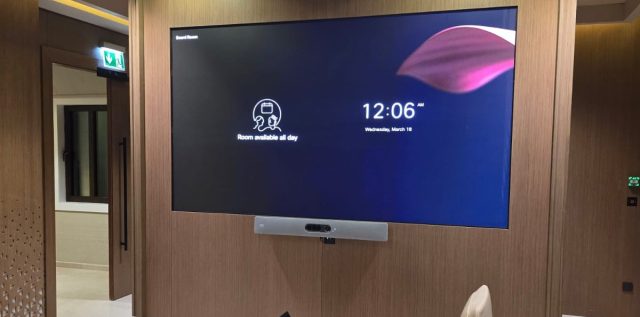
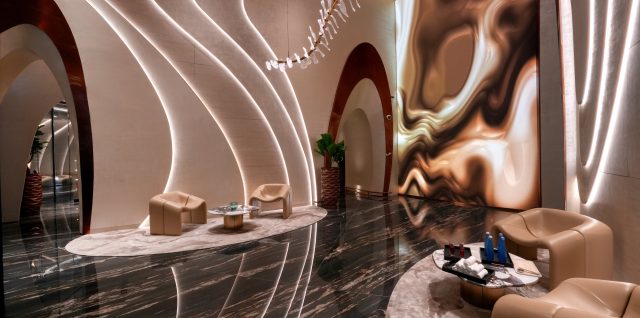
INFiLED WP Series LED video wall in the boardroom of Saudi Arabia's Ministry of Culture, set into a wood-panelled wall above a video conferencing bar.

The Difference That Shows First: Bezels and Seams

An LCD video wall is a grid of individual flat panels, and every panel has a frame. Even the best current options leave a line. LG lists an even bezel of 0.44 mm, or 0.88 mm bezel-to-bezel, on its 55-inch video wall panel, a figure it says comes from in-house testing. Other ultra-narrow ranges commonly list 1.8 mm or 3.5 mm bezel-to-bezel widths, and the narrower the bezel, the higher the price.

Whether that line matters depends on what the wall shows. If each panel carries its own source, such as a camera feed, a dashboard or a map layer, the grid works as a natural divider. If the wall carries one continuous image, such as a brand film, a floor plan or a headline, the grid cuts through faces and text. Distance softens the seam problem but does not remove it.

LED cabinets tile edge to edge with no frame, so the image stays continuous at any size. That continuity is a large part of why corporate lobbies are replacing LCD video walls with LED. In operations rooms the picture is different, and the seam can still be useful, as covered in LED and LCD in control rooms.

Brightness, Contrast and Ambient Light

Standard LCD video wall panels are typically specified at 500 to 700 nits. Indoor LED cabinets commonly start around 1,000 nits and go well above it, which is why LED holds its contrast in atriums, glazed lobbies and rooms with daylight. In a dim boardroom the situation reverses. An LED wall has to be turned down and properly calibrated or it becomes uncomfortable to watch, while an LCD panel at 500 nits is already comfortable.

Peak nits are a starting point, not a quality measure. LED contrast comes from each pixel emitting its own light, while LCD contrast depends on how well the panel blocks a backlight. What buyers notice over the years is uniformity. How LED panel calibration affects long-term image consistency explains why two walls with identical specs can look different after eighteen months, and why color accuracy matters more than brightness applies to most indoor rooms.

Resolution and Viewing Distance

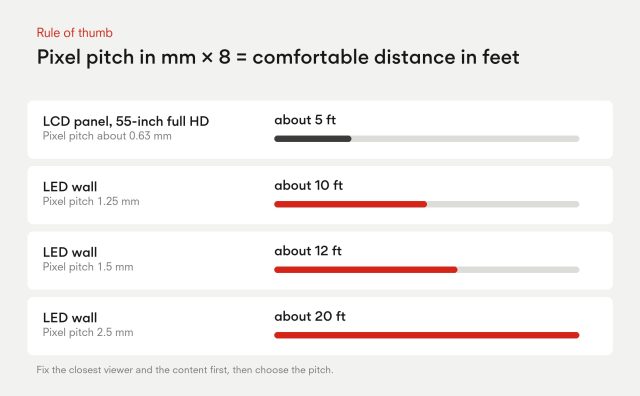
Resolution is where LCD looks strongest on paper. A 55-inch full HD panel packs 1,920 pixels across roughly 1,210 mm, a pixel pitch of about 0.63 mm, and 4K panels halve that. Tiled LCD therefore supports close viewing with no visible pixel structure. LED resolution is set by pixel pitch and wall size, not by a panel specification. A common rule of thumb multiplies the pitch in millimetres by 8 to give a comfortable viewing distance in feet, so a 1.25 mm wall sits comfortably at about 10 feet. AVIXA’s pixel pitch guidance adds that there is no right or wrong pitch, only the one that suits the viewing experience.

A finer pitch than the audience can resolve adds cost without visible gain, a trade-off covered in how pixel pitch impacts viewing distance, cost and image quality. INFiLED’s practical advice is to fix the closest viewer and the content first, then choose the pitch, rather than starting from a resolution label such as 4K.

Shape matters too. LED walls scale to any size and aspect ratio by adding cabinets, while LCD walls are fixed to a grid of standard panel sizes. Unusual proportions, curves and very large walls tend to favour LED.

Rule of thumb: pixel pitch in mm times 8 equals comfortable viewing distance in feet. 55-inch full HD LCD panel at about 0.63 mm, about 5 ft; LED wall 1.25 mm, about 10 ft; 1.5 mm, about 12 ft; 2.5 mm, about 20 ft.

Lifespan, Maintenance and Uptime

Rated lifespan needs careful reading on both sides. LED products are often rated around 100,000 hours, while LCD backlight ratings, such as the 70,000 hours listed on one typical 55-inch wall panel, are lower. Both figures describe how long the product takes to fall to a set brightness level, not the moment it fails, as how LED display lifespan is really calculated explains.

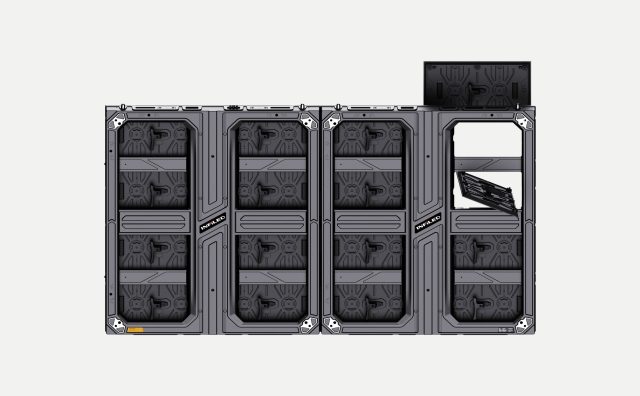
In daily use the difference is less about the number and more about what happens when something goes wrong. That same 55-inch panel weighs around 23 kg, and replacing one usually means access from behind or a service frame. An LED wall is repaired at module or cabinet level, and front-service designs let a technician work without rear access. Failure modes differ as well: what causes dead pixels in LED displays and how heat management impacts LED display performance and lifespan cover the LED side in detail. For a 24/7 wall, the useful question is how quickly a failed element can be swapped, not which technology has the bigger number on paper.

Cost and Where the Crossover Sits

LCD wins on initial price at small sizes. LCD panels can cost a fraction of an equivalent LED system, and LCD prices climb as brightness rises and bezels narrow. As a wall grows, LCD adds panels, mounts, processing and seams, while LED adds cabinets at a cost per m² that depends mostly on pitch. There is no single crossover figure, because it moves with pitch, brightness and service needs.

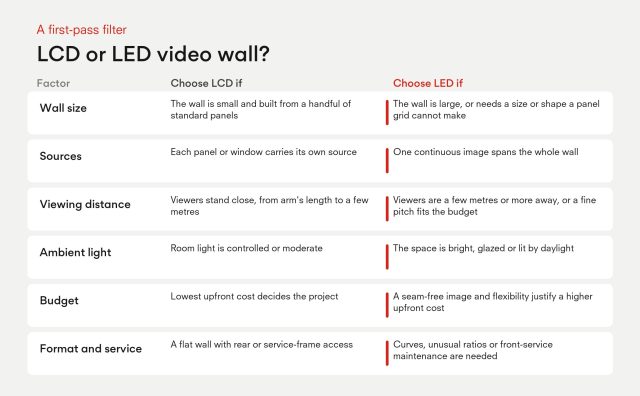
Operating cost depends on brightness, content and hours of use rather than technology alone. Total cost of ownership of LED displays is the better place to model it, and common mistakes companies make when buying LED video walls lists the costs that tend to be left out. Sector-specific trade-offs are covered for education and lecture halls. The table below turns the rules into a first-pass filter.

LCD or LED video wall filter: choose LCD for small walls of standard panels, separate sources per panel, close viewers, controlled light, lowest upfront cost and flat walls with rear access; choose LED for large or unusual walls, one continuous image, viewers a few metres away, bright or daylit spaces, a seam-free image and curves or front service.

INFiLED manufactures LED, which makes it worth saying plainly that LCD is still the better answer in some rooms. The projects that go well are the ones where viewing distance, content type and service access were settled before the technology was chosen.

User registration
Join us to download our content. It only takes a moment!

    I have read and accept the privacy policy

    This site is protected by reCAPTCHA and Google.

    It looks like you are visiting the website from
    Select your region: